

No, Zoloft does not work right away. For depression, meaningful benefit is usually assessed over 6 to 8 weeks of regular dosing, even though the medicine starts changing serotonin signaling much earlier.
That gap is the part many people feel in real life. The body can begin adapting within hours, but felt relief usually arrives in stages, and the first changes are often quieter than people expect.
Does Zoloft Actually Work Right Away
Zoloft is not a painkiller, so it doesn't produce instant relief on the first day. The usual clinical pattern is slower, because the medication has to build steady effects in the brain before mood symptoms shift in a way a person can clearly notice.
The FDA label established sertraline's efficacy for major depressive disorder in adult outpatient placebo-controlled studies lasting 6 to 8 weeks, including one 8-week flexible-dose study and one 6-week fixed-dose study, where Zoloft outperformed placebo on standard depression scales (FDA label). That timeline is the reason clinicians don't judge it by day one or day three.
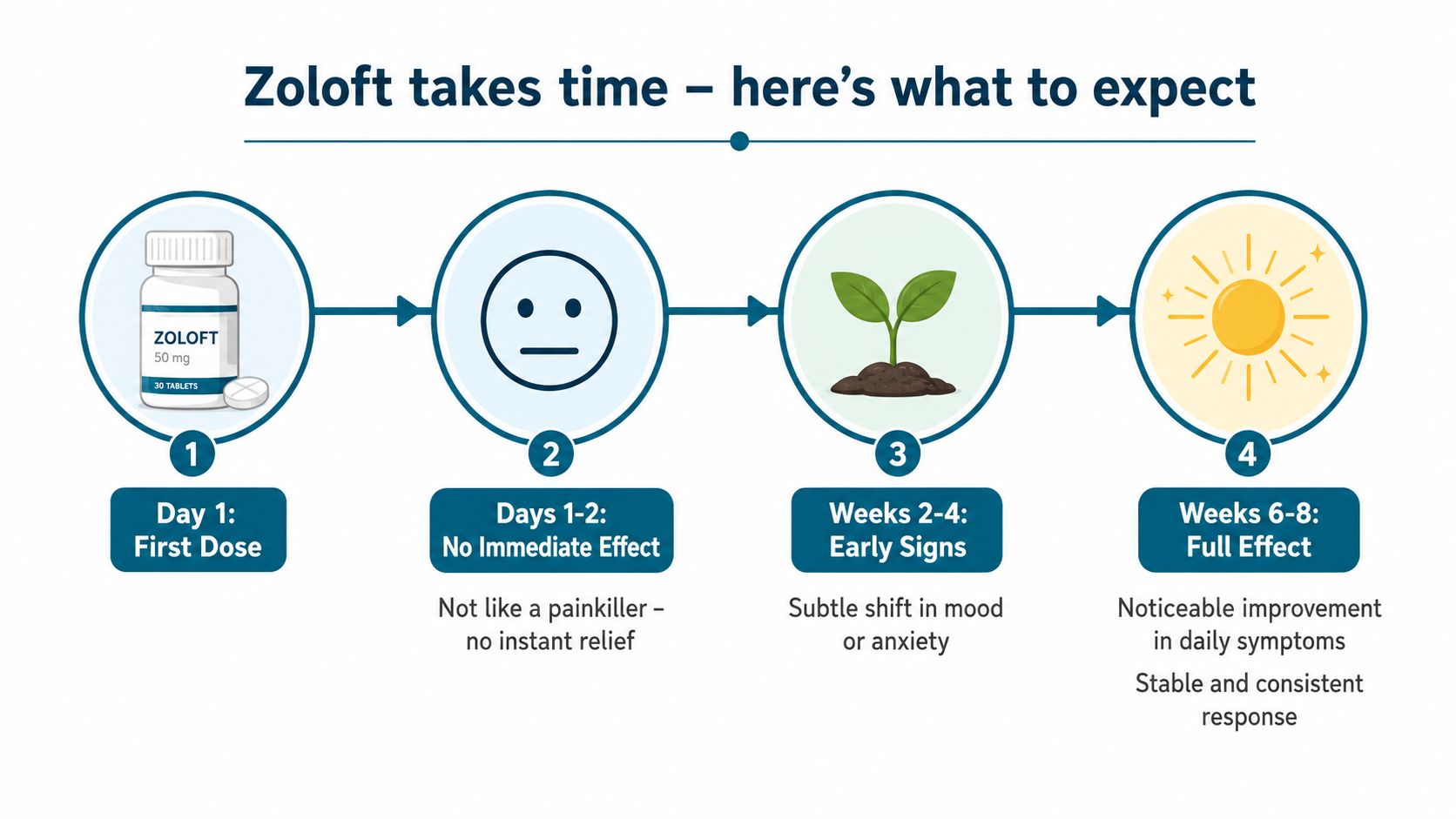
What early progress can look like
The first week can feel like a waiting room. Some people notice nothing except side effects, some notice a slight shift in sleep or tension, and some feel uncertain because they expected a dramatic mood lift.
A useful way to think about it is this, biology starts first, feelings lag behind. The medication can be active in the body before the person experiences the payoff.
Practical rule: if the question is, “Does Zoloft work right away?”, the clinically honest answer is no for mood relief, but yes for early biological activity.
For readers who are trying to understand the emotional side of that wait, understanding depression as an expat can be a useful companion piece because it frames depression as more than just sadness.
Why waiting doesn't mean it's failing
A lot of people confuse “not feeling better yet” with “not responding at all.” Those are different things. The FDA evidence and later clinical experience both support the same expectation, benefit is measured over weeks, not hours.
That distinction matters for anyone filling a first prescription, especially when motivation is already low. Daily adherence gives the medication a fair trial, while rushed judgments often cut treatment off before the brain has time to adapt.
How Zoloft Works in the Brain
Zoloft is an SSRI, which means it changes how serotonin is recycled between brain cells. A sponge sitting in a narrow channel keeps more serotonin available where neurons can use it instead of pulling it back too quickly.
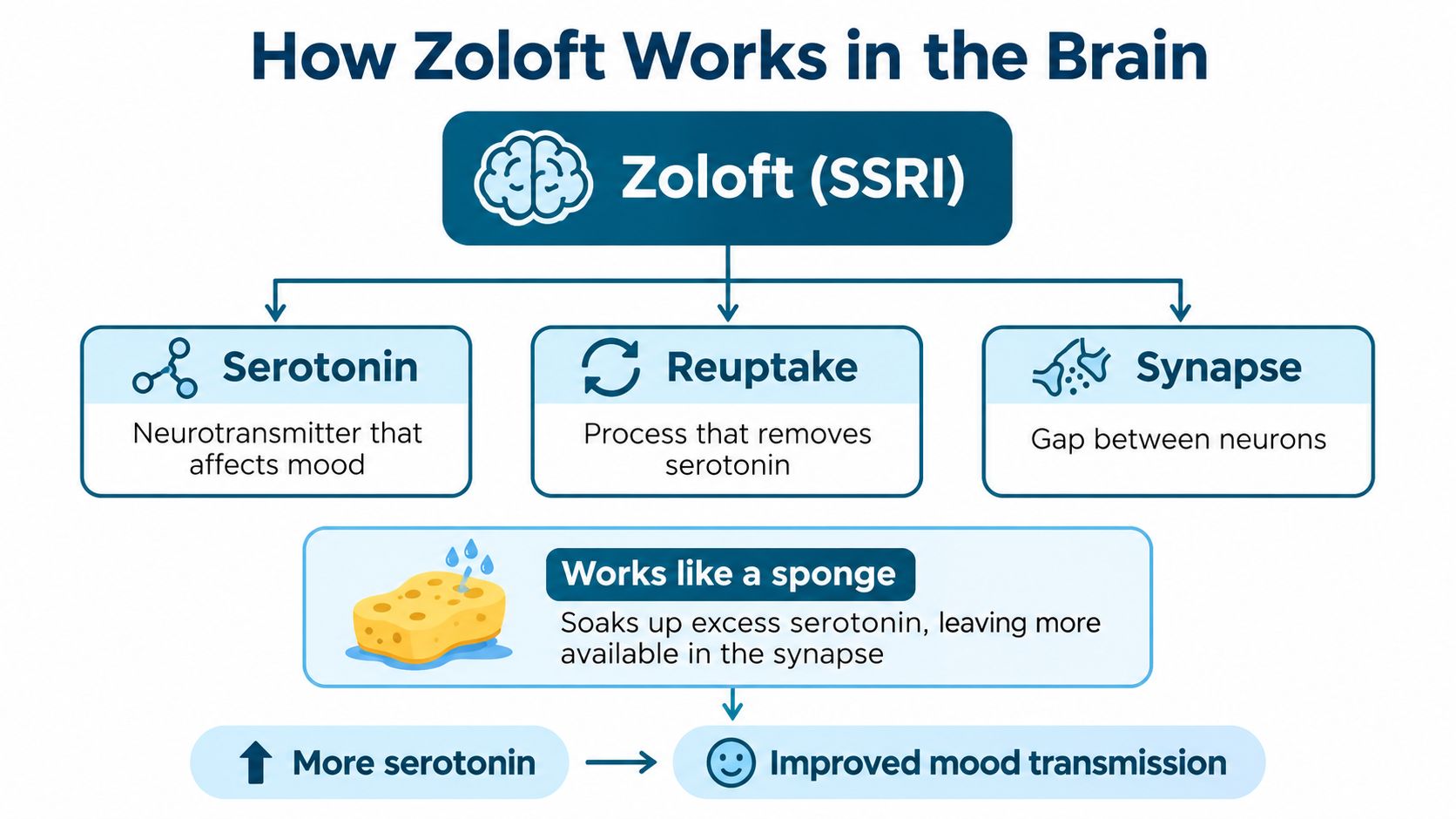
The part that confuses people is that the brain does not translate that chemical change into immediate emotional relief. Sertraline can increase serotonin signaling within hours, but downstream adaptation, including receptor-level changes, can take up to about 8 weeks. That delayed shift is part of why the medicine can be active before it feels helpful.
The brain changes faster than mood does
That is the difference between onset and felt benefit. The medication starts altering neurotransmission quickly, but mood circuits, stress responses, sleep regulation, and fear signaling need time to recalibrate.
A flooded garden helps explain it. Turning on the water happens immediately, but the soil still has to absorb it before the plants look revived. Serotonin is the water, receptor adaptation is the soil, and the visible recovery comes later.
Serotonin signaling can move fast, but the nervous system's adjustment is slower than the chemistry.
That is why a person may be taking the right medication and still feel unchanged in the first few days. The brain is responding, even if the person cannot feel the whole response yet.
Why early side effects can confuse the picture
Early on, some people feel nausea, restlessness, fatigue, or sleep changes. Those sensations can make the medicine seem stronger than it is, or weaker than it is, depending on the day.
For readers in recovery, that distinction matters even more. When someone is also trying to stabilize substance use, every new body sensation gets scrutinized, and it is easy to mistake adjustment effects for benefit or failure. For a plain-language serotonin primer, see this overview of brain chemicals.
A Realistic Week by Week Timeline
Zoloft usually starts changing chemistry before it changes how a person feels. That gap can be frustrating, especially for someone who is watching every small shift and wondering whether the medicine is doing anything at all.
The first week is often about observation, not transformation. Some people feel a little sleepy, some feel a little activated, some notice no emotional change yet, and some find that sleep begins to settle before mood does.
For depression, early benefit may show up in daily functions like sleep, energy, and appetite before the heavier symptoms of low mood or loss of interest start to ease. More noticeable mood improvement often takes longer, so a person can be getting better without yet feeling obviously better.
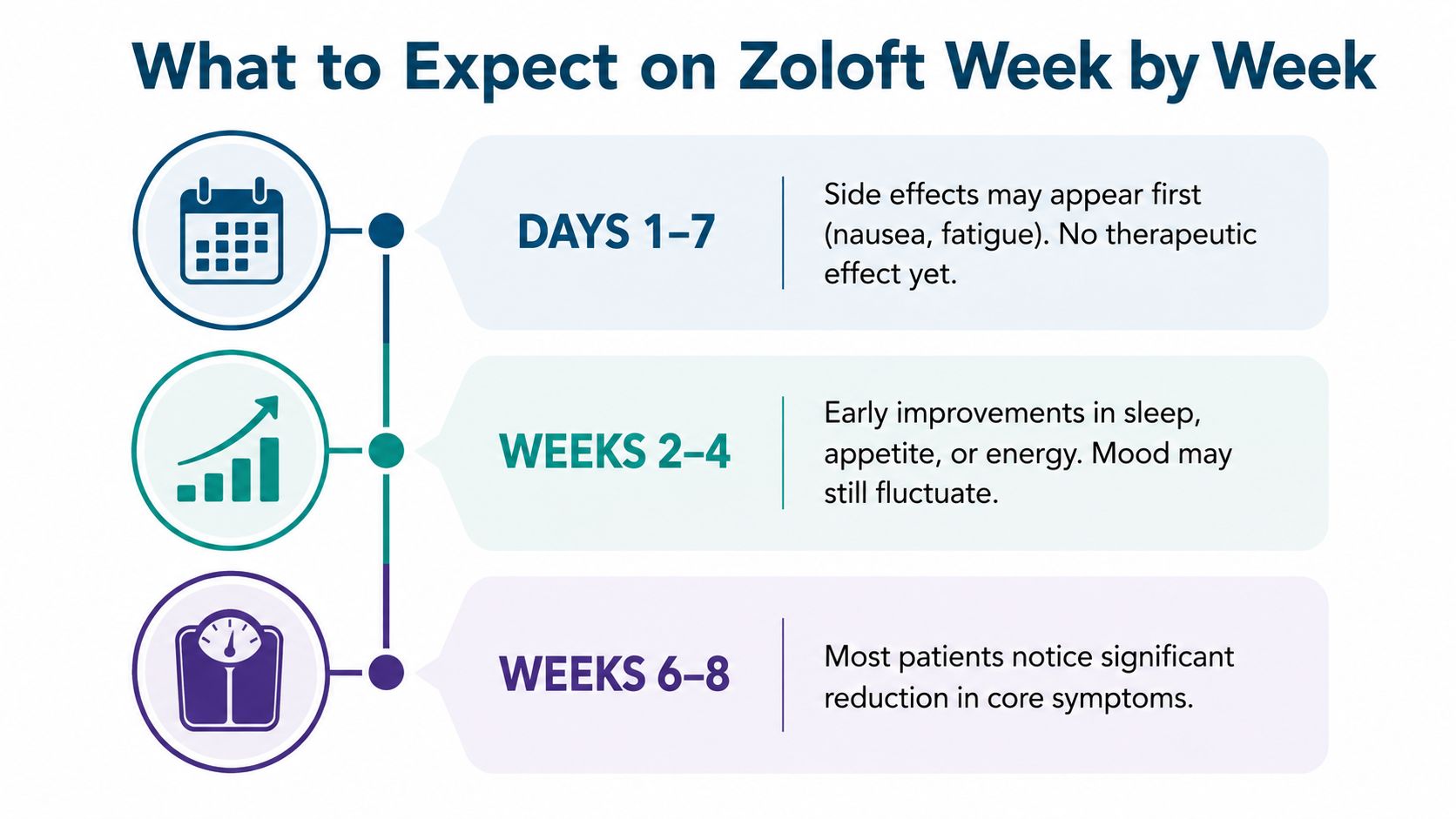
Days 1 to 7
This is the adjustment window. The medication is in the system, and the brain is beginning to adapt, but the outward payoff is usually small or absent.
A short daily note helps more than a long reflection. Sleep length, morning anxiety, appetite, and energy are easier to track than a vague sense of “better” or “worse.”
Useful habit: write one line each night, not a long journal entry. That makes patterns easier to spot when your memory is fuzzy or your mood is low.
Weeks 2 to 4
Some people begin to notice softer changes here. Sleep may become less broken, appetite may normalize, or energy may return before mood fully lifts.
That sequence can be confusing in two directions. If the body feels better first, a person may assume the medicine is already fully working. If mood is still low, they may assume it is not working at all.
For someone also trying to stabilize recovery, the waiting period can feel even more loaded. Early body changes may get interpreted as progress or failure, especially when there is already a lot of monitoring around mood, cravings, and stress. That is one reason coping with perimenopausal anxiety can look different from person to person, even when the same medication is involved.
Weeks 6 to 8
This is the window where core depressive symptoms are more likely to show a clearer shift. The change is usually more stable by then, and a prescriber has a better basis for deciding whether to hold steady, adjust the dose, or rethink the plan.
The best way to watch progress is to compare the same symptoms over time, not to judge the medication by one good afternoon or one rough morning. A simple symptom log makes early progress easier to see.
For a broader checklist of anxiety signs, symptoms, and treatment options, this guide can help readers sort out what to track while they wait.
Zoloft for Depression Versus Anxiety and Panic
The answer to “how long does Zoloft take?” depends partly on what it's being used to treat. Depression, generalized anxiety, and panic disorder don't always follow the same curve, so borrowing someone else's timeline can lead to the wrong conclusion.
In generalized anxiety disorder, sertraline separated from placebo by week 4, with responder rates of 63% versus 37% and effect sizes of 0.51 on CGI-improvement and 0.44 on Hamilton anxiety severity. In panic-disorder trials, statistically significant differences from placebo showed up at week 10 or 12, not immediately after initiation (FDA label).
Different conditions, different clocks
A person with anxiety may notice earlier relief in physical tension, sleep, or constant worry than someone whose main complaint is depressed mood. A person with panic symptoms may need a longer runway before the pattern becomes obvious.
That's why someone can say Zoloft helped their anxiety “pretty quickly” while another person says it took much longer. Both can be true, because the symptom targets aren't identical.
For a broader look at symptom patterns and escalation planning, anxiety signs, symptoms, and treatment options offers a useful framework.
| Zoloft Response Timeline by Condition | First Measurable Benefit | Full Therapeutic Window | Key Trial Timepoint |
|---|---|---|---|
| Depression | Often over weeks, with practical changes first | About 6 to 8 weeks or longer | 6 to 8 week placebo-controlled studies |
| Generalized anxiety disorder | By week 4 | Over several weeks | Week 4 separation from placebo |
| Panic disorder | Later than generalized anxiety, often not early | Around week 10 to 12 | Week 10 or 12 trial separation |
Why that matters in real life
A friend's story can be misleading if the condition is different. Someone treating panic symptoms should not expect the same week-by-week experience as someone treating depression, and someone with anxiety may see the earliest signs in reduced body tension rather than a dramatic mood shift.
Readers who are also going through hormonal transition may notice that emotional symptoms feel blended together, which is one reason coping with perimenopausal anxiety can be useful context when the picture includes both mood and physical stress symptoms.
What Can Speed Up or Slow Down Your Response
A slow response does not always mean the medicine is wrong. Often, something practical is interrupting the trial, such as the dose, consistency, interacting substances, or even the diagnosis itself.
Clinical guidance on sertraline says a poor response can reflect too-low dosing, not enough time, missed doses, drug or alcohol interactions, or a different diagnosis. That is more useful than a generic “wait and see” answer, because each of those issues can be checked and adjusted.
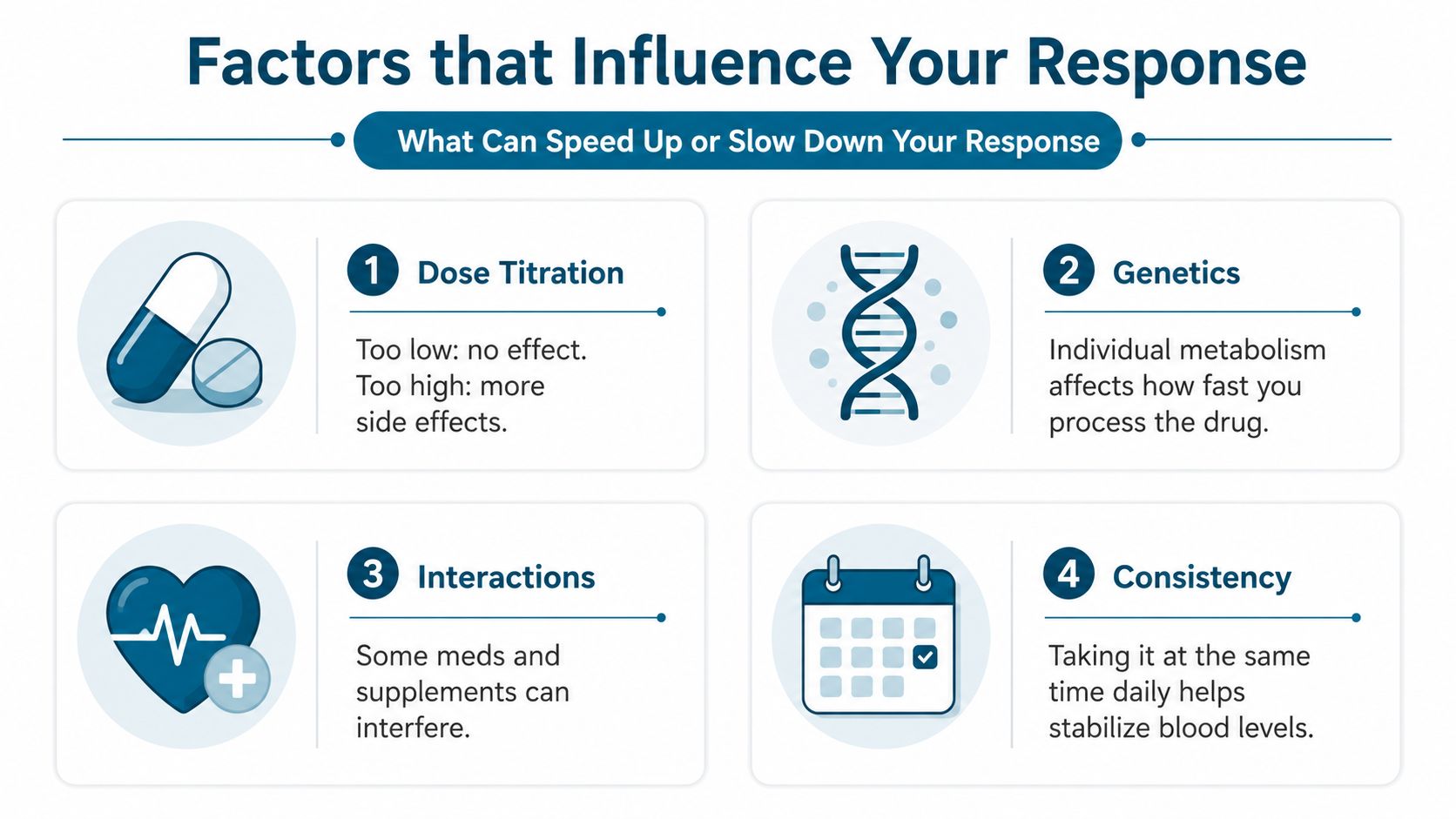
The dose can hide the signal
A dose that is too low may feel like nothing is happening. A dose that is too high can make side effects louder than the benefit, which can make the medication seem harder to tolerate than it really is.
Titration is meant to find the middle ground. Many prescribers raise the dose gradually rather than trying to force the final dose on day one, because the brain and body need time to adapt.
Consistency is often underestimated
Missed doses can make the whole timeline hard to read. If the pill is taken unevenly, the brain gets an inconsistent signal, and the person may feel like the medication is “in and out” instead of steadily building.
Alcohol and other drug interactions can muddy the picture too. In dual-diagnosis care, that issue is not minor, because recovery, sleep, and anxiety can shift at once.
Clinical rule of thumb: when the response looks unpredictable, check adherence, dose, and interactions before assuming the medication has failed.
Sometimes the diagnosis needs a second look
Not every low mood or anxious state is the same problem. Trauma, panic, depression, substance effects, withdrawal, and mixed anxiety-depression can overlap in ways that make a first plan look weaker than it really is.
Structured follow-up helps with that. A clear symptom log gives the prescriber something specific to adjust instead of guessing at what changed.
When to Call Your Prescriber Sooner
The first two weeks can be the most confusing part of treatment. Early side effects can overlap with anxiety, and early improvement can be subtle enough to miss, so the safest approach is to know which changes are normal adjustment and which need a same-day call.
A UK review of sertraline evidence found no clinically meaningful reduction in depressive symptoms at 6 weeks in primary care, which reinforces the need for structured follow-up rather than silent waiting (Lancet Psychiatry review30366-9/fulltext)). That doesn't mean the medication can't work, it means the response has to be checked, not assumed.
Call today if something feels unsafe
New or worsening suicidal thoughts, strong agitation, behavior changes that feel out of character, or allergic symptoms need prompt attention. If Zoloft is combined with other serotonergic agents and the person develops confusion, shaking, sweating, or a racing heart, that's not a wait-and-see situation.
Reassess soon if the pattern is flat
If there's no improvement at all by the follow-up window, or side effects are making daily life harder, the prescriber may need to revisit dose, timing, adherence, or the diagnosis itself. That check-in is especially important if a person is trying to stay sober at the same time, because symptoms can blur together.
Don't wait in silence
The goal isn't to panic over every symptom. It's to keep the trial visible, so a real response can be separated from a rough adjustment period.
Why Outpatient Support Makes the Wait Work Better
The waiting period is where many treatment plans wobble. People quit early, forget doses, or lose confidence because they're trying to manage medication changes while also handling depression, anxiety, and recovery stress at the same time.
That's where outpatient structure matters. Therapy, medication management, and case support give the person a place to sort out side effects, cravings, sleep disruption, and mood shifts before the next prescriber visit. For readers comparing support options, cognitive behavioral therapy is one of the most practical forms of care to pair with medication because it helps people respond differently while the brain is still adjusting.
Why dual-diagnosis care fits this topic
When substance use and psychiatric symptoms overlap, the timeline gets harder to interpret. A person may think Zoloft isn't helping when the issue is inconsistent dosing, alcohol use, withdrawal, or untreated anxiety feeding into relapse risk.
Zoe Behavioral Health is one outpatient option that provides psychiatric evaluations and medication management alongside PHP, IOP, outpatient counseling, sober living coordination, and dual-diagnosis support in Lake Forest. For someone in Orange County trying to hold both recovery and psychiatric treatment together, that kind of coordinated care can keep the medication trial from turning into guesswork.
What structured support adds
It gives the prescriber more data, the patient more accountability, and the family a clearer plan. It also keeps the focus on function, not just symptom labels.
That matters because Zoloft's early weeks aren't just a chemistry problem. They're a human logistics problem too.
What to Do Starting Today
Zoloft usually starts changing biology before it changes mood, so the first job is to make the trial easy to read. Take the dose at the same time every day, and write down sleep, anxiety, appetite, and side effects in one short note each day. That gives you a clearer picture of whether the medicine is starting to settle in or whether something else is getting in the way.
Book a follow-up before week 4 so the response is checked while there is still time to adjust the plan if needed. Timing guidance from Drugs.com timing guidance reflects the same basic clinical point, early changes can be biological before they feel like relief, so the first few weeks need close attention.
If the plan also needs therapy, medication review, or recovery coordination, a structured consult can help. A careful psychiatric review can improve your psychiatric medication plan when the issue is dose, diagnosis, interactions, or the need for more support, and it is often easier to make those decisions before the trial drifts too long.
For readers who want help coordinating medication, therapy, and dual-diagnosis care, the next step is simple and concrete.
Zoe Behavioral Health offers outpatient psychiatric and recovery support for people who need medication management, therapy, and structured follow-up while they wait for Zoloft to show its real effect. If you are trying to separate early side effects from true response, visit Zoe Behavioral Health to ask about care that fits depression, anxiety, and co-occurring substance use concerns.
