
A family member is in crisis, the phone keeps lighting up, and the same pattern repeats. Someone promises to stop using, another person covers rent, excuses the missed appointment, or cleans up the fallout, then everyone calls it love, loyalty, or just getting through the week.
A co dependent worksheet gives that pattern a name and a structure. In practice, it helps a person separate real care from over-involvement, then turn a blurry relationship dynamic into something specific enough to examine, track, and change.
What a Co Dependent Worksheet Actually Does
When a loved one's substance use keeps creating emergencies, the helper often stops noticing where support ends and self-erasure begins. That's where codependency shows up, as excessive emotional or psychological reliance on another person, usually with poor boundaries and over-involvement in that person's life. A structured worksheet is useful because it slows the reflex to rescue and turns the relationship into observable data rather than a vague feeling.
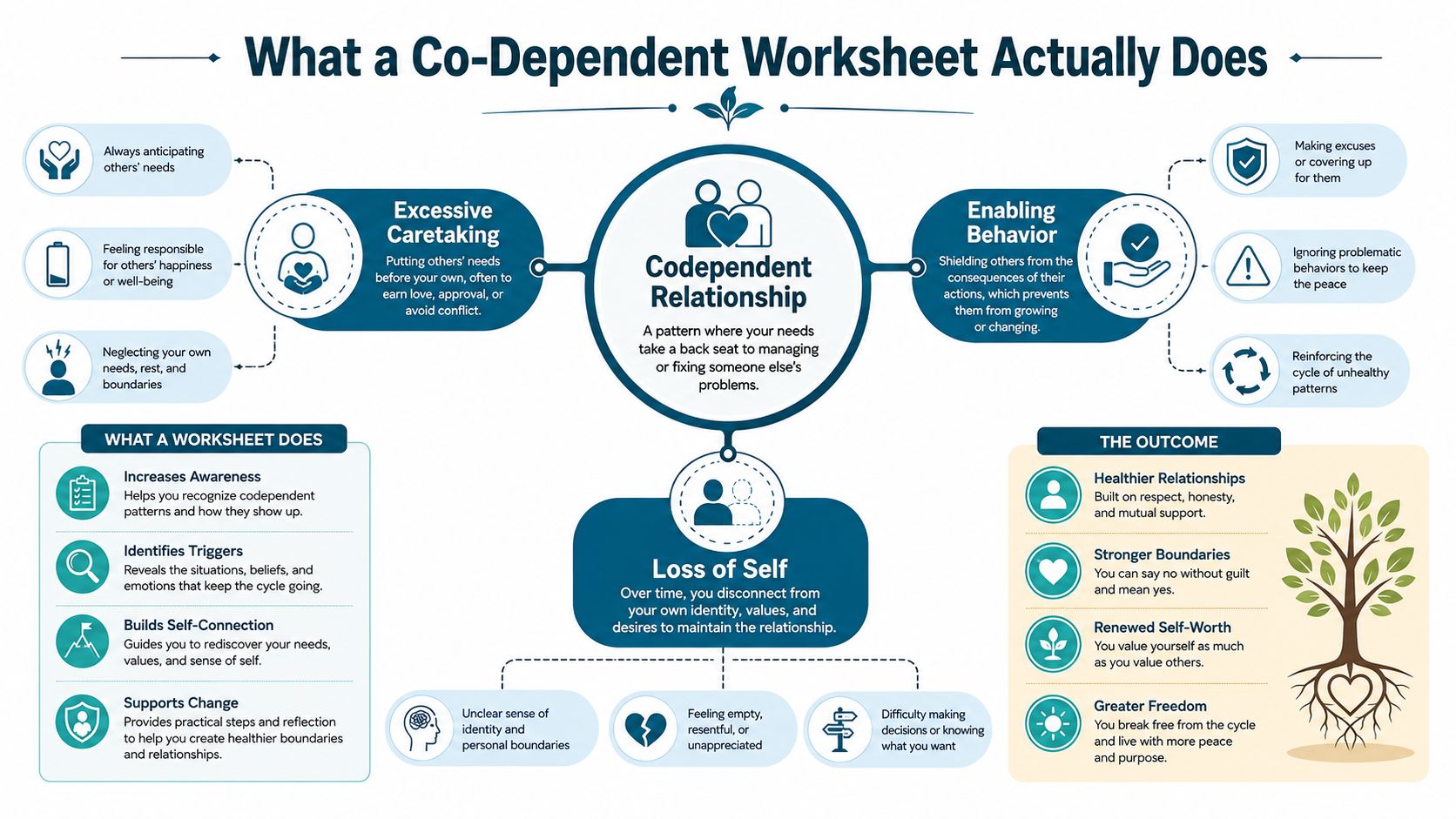
Why the worksheet has clinical weight
The idea didn't begin as casual journaling. It grew out of addiction-recovery practice, then later gained academic testing when a validation study of a revised codependency scale found that members of Co-Dependents Anonymous scored significantly higher than the general population on the total scale and all three subscales, while also showing lower self-esteem and emotional expressivity and higher familial dysfunction, depression, anxiety, and stress. That matters because a worksheet for codependency is built to surface patterns linked to measurable psychological differences, not just to provide encouraging prompts. The same study also supports why these tools keep circling back to emotional regulation, boundaries, and family-role patterns.
A strong worksheet does one more thing well, it bridges self-reflection and treatment planning. It gives a person language for what's happening, which is often the missing piece when guilt, fear, or habit keep steering the relationship. In an outpatient setting, that kind of structure helps a clinician see whether the problem is mainly boundary strain, unresolved trauma, active addiction, or all three at once.
Practical rule: if the worksheet makes the relationship more measurable, it's doing its job. If it only produces shame, it's being used like a verdict instead of a mirror.
The Core Sections of a Recovery Worksheet
A useful recovery worksheet doesn't ask for a life story. It asks for a clear snapshot. One common CoDA-aligned format uses five columns, and that format works because it keeps the focus on the relationship, the behavior, the feeling, and the consequence instead of drifting into blame.
| Relationship | Pattern | Behaviors | Feelings | Consequences |
|---|---|---|---|---|
| Example, brother with alcohol misuse | Over-responsibility, rescue urges | Calling work, paying bills, cleaning up after relapse | Anxiety, anger, guilt | Burnout, resentment, missed boundaries |
What each column surfaces
A sibling might write brother in the first column, then note overfunctioning or rescue behavior in the second. In the behaviors column, the details matter, such as covering for missed work, hiding bottles, or answering calls at midnight. The feelings column usually exposes the part people skip over, because caretaking often runs on fear, shame, or the belief that stepping back would make things worse. The consequences column then shows the cost, which may be exhaustion, tension at home, or a reduced sense of self.
The scoring piece keeps the worksheet from staying abstract. One common format uses a 0-to-3 scale, then adds the total score, and it frames any score above 20 as a reason for deeper reflection rather than as a diagnosis. That distinction matters. The number is a prompt for honesty, not a label that ends the conversation. The same worksheet logic often asks for 7 days of tracking, and another structured approach spends about 10 to 15 minutes per person mapping the five columns, which is usually enough time to stay focused without spiraling into rumination.
If the completed page shows the same pattern across several relationships, the worksheet is pointing to a role the person keeps taking on, not just one bad interaction.
Filling Out the Prompts Step by Step
The most useful prompts are direct. They ask whether the person is in a codependent relationship, with whom, why, and whether the relationship should be improved, paused, or ended. That kind of question can feel blunt, but blunt is often kinder than vague when a client has spent years explaining away harm.

How to answer without slipping into accusation
A good rule is to keep the language self-referential. Instead of writing about what someone else “always” does, the person writes what happens, what gets triggered, and what choice follows. That keeps the page honest and reduces the urge to turn the worksheet into a prosecutor's brief.
For a partner in early recovery, the forecast question can be especially revealing. The page may ask what the person thinks they'll feel in the coming days, weeks, months, or years if they keep rescuing, if they pause contact, or if they end the relationship. Those time horizons help separate a short-term spike of discomfort from a longer pattern of relief, grief, or regret. The answer is often messy, which is fine. Messy is data.
Doing the exercise at the same time of day helps too, because the emotional tone is more comparable from one entry to the next. A client who writes after work every evening will usually capture different material than someone who writes after a calm breakfast. That consistency makes patterns easier to see.
For readers who want a parallel practice for digging into difficult thoughts, the guided format in shadow work prompts for anxiety can complement the worksheet by helping the person name the fear underneath the rescue impulse.
How to Tell Codependency From Normal Caregiving
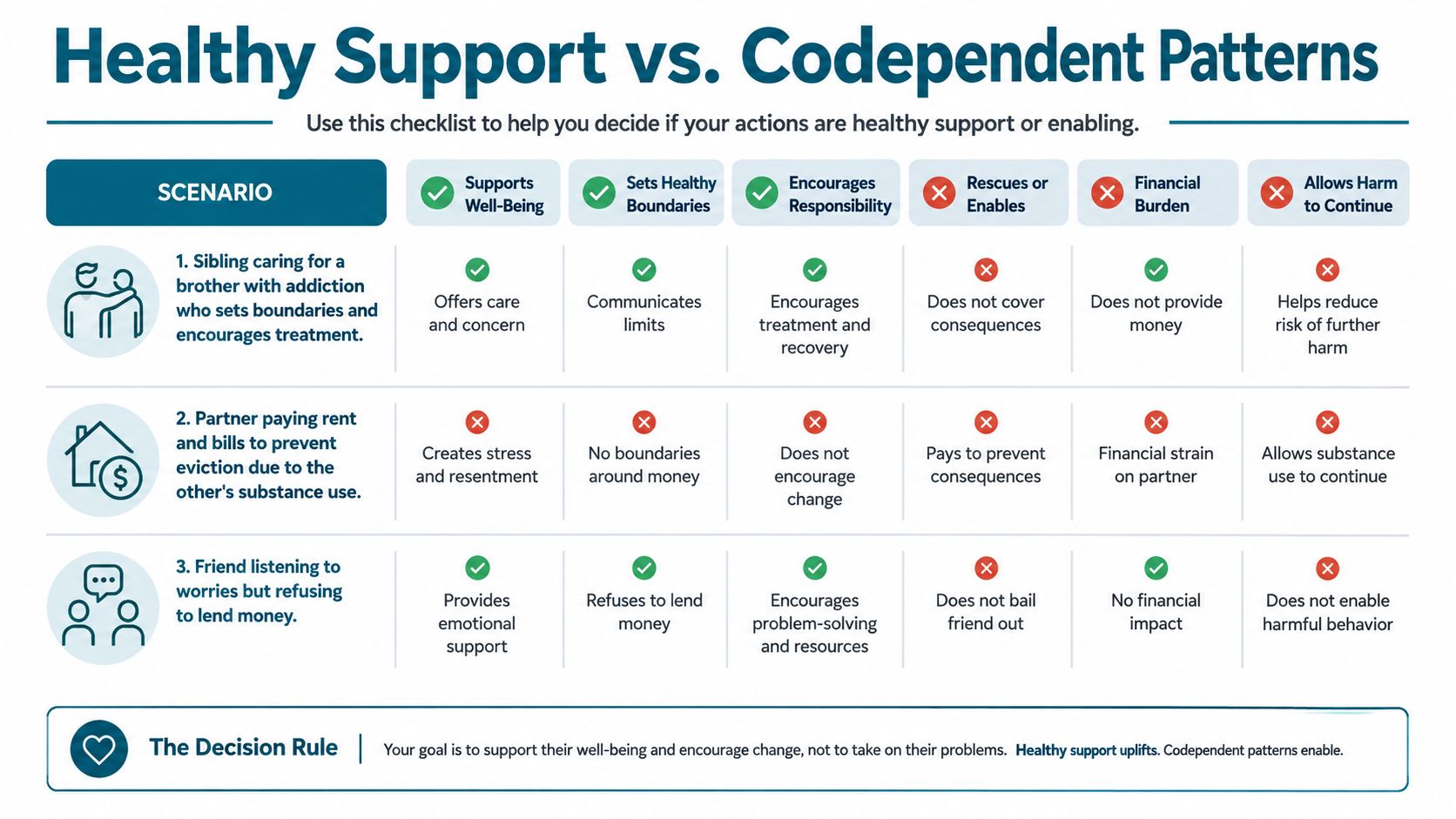
Much worksheet content stays too broad. Not every exhausted caregiver is codependent, and not every boundary problem means the relationship is broken. The deciding question is whether the helper still has a separate self, or whether they've disappeared inside someone else's crisis.
A simple decision rule
A clean way to sort it is to ask three things. Are the helper's own needs still being met? Is the help requested, or is it imposed? Would the helper feel devastated if the relationship ended? If the answer keeps tilting toward self-loss, imposed rescue, and emotional collapse at the thought of separation, the pattern is moving toward codependency.
A sibling caring for a parent with cancer may be doing hard, healthy caregiving if the support is coordinated, temporary, and does not erase the sibling's own work, sleep, or boundaries. A spouse supporting early sobriety may be helping well if the support includes treatment participation, agreed limits, and room for both partners to stay responsible for their own behavior. An adult child of a parent in active addiction is on different ground when every phone call becomes an emergency response, every need gets overridden, and the adult child feels guilty for having any life of their own.
That distinction lines up with the practical gap many worksheets miss. They teach self-focus and boundary setting, but they rarely give a rule for sorting ordinary caregiving from codependent over-functioning. A good copy-ready prompt is, “Am I helping, or am I disappearing?” That single question is often more revealing than a long checklist.
For readers who want a deeper look at the helping-versus-enabling line, this internal guide on enabling vs helping pairs well with the worksheet because it names the behavioral split more directly.
Adapting the Worksheet for Co Occurring Substance Use
When substance use and relationship strain live in the same house, the worksheet works best as a dual-focus tool. It can track the codependent pattern and the substance pattern on the same page, which is often what outpatient clients need when one problem keeps fueling the other. The worksheet becomes less about theory and more about what happened today, what triggered it, and what got reinforced.
A hybrid version that fits real life
A practical adaptation is to fold two extra lines into the standard five-column format. One can capture triggers for reaching for a substance, and the other can capture treatment milestones such as therapy attendance or medication-assisted treatment dosing. That makes it easier to see the moment when a craving and a rescue urge happened close together. A person in intensive outpatient care might note a stressful call from a sibling, a craving spike, then the decision to bail the sibling out anyway.
That pairing matters because the same day can contain both relapse risk and boundary failure. The worksheet should record both, not just one. It helps clinicians and clients see whether the pattern is moving toward avoidance, emotional numbing, or enmeshment.
Clinically structured 12-step work usually handles this in phases. Therapists often pace it as orientation and consent first, then 1 to 2 steps per session, because Steps 4 and 8 can be emotionally difficult and overwhelm people if they're pushed too fast. That pacing is one reason the worksheet fits outpatient care well. It supports reflection without pretending reflection is the whole treatment plan.
A useful companion for people who need the addiction side of the picture named more directly is codependency and addiction, which helps connect the relational pattern to substance-use recovery without collapsing one into the other.
Clinical note: when the worksheet starts showing a craving, a rescue, and a regret in the same 24 hours, the issue is no longer just insight. It's a treatment target.
When the Worksheet Signals You Need Professional Help
A worksheet is useful until it starts showing the same distress on repeat. That's the point where self-work usually stops being enough. Persistent scores above 20 across multiple weeks, worsening anxiety or depression entries, suicidal thoughts, or any pattern where substance use and codependent behavior keep feeding each other are all signs that the issue belongs in structured care, not only in a notebook.
That's where outpatient treatment makes sense for many adults. Zoe Behavioral Health in Lake Forest, Orange County, provides outpatient drug, alcohol, and mental health treatment with dual-diagnosis care, MAT, and a PHP/IOP continuum that lets clients sleep at home while rebuilding routines. For someone whose worksheet shows both relational enmeshment and substance-driven coping, that kind of setup is often a better fit than trying to solve everything alone. The center also offers 24/7 admissions guidance and insurance verification, which means the next step can be one practical call rather than another week of overthinking.
Three questions to ask before choosing a program
- Does the program treat both substance use and mental health together?
- Can the schedule support real-life responsibilities while still providing structure?
- Will the team help turn worksheet insights into a treatment plan, not just a conversation?
A worksheet can name the pattern, but it can't replace care when the pattern is entrenched. When the page keeps lighting up with the same warning signs, the safest move is to get clinical eyes on it.
Building a Sustainable Weekly Routine Around the Worksheet
A worksheet only helps if it gets used often enough to show a pattern. A workable rhythm is simple, 2 minutes daily, 15 minutes once a week, and one monthly conversation with a therapist or sponsor. That pace is realistic, and realism matters more than intensity when the goal is lasting change.
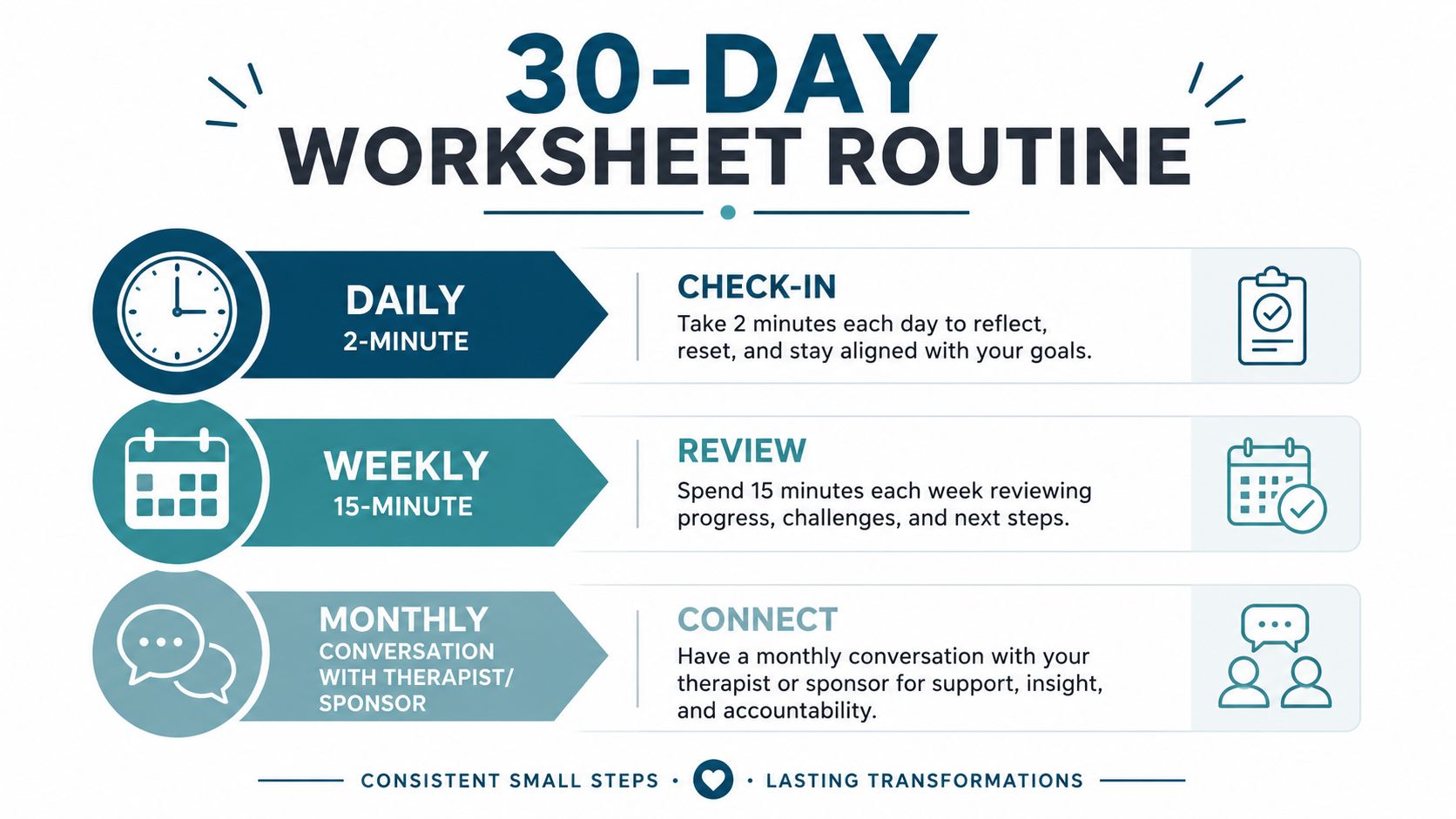
Make the routine hard to skip
Pair the check-in with something already in place, like morning coffee, a commute, or the first sit-down after work. That keeps the worksheet from becoming another lofty habit that fails under pressure. For clients who do better with structure, the routine in sober structure can reinforce the same idea from the recovery side, consistent actions beat big promises.
The most common stalls are predictable. Avoidance usually means the page is touching something painful. Perfectionism often shows up as waiting for the “right” answer. Shame tends to appear after a high-score week, especially when the person thinks the number means failure. Conflict with a family member about being written about can also shut the process down, so it helps to write only what is clinically useful and not every emotional detail.
The worksheet is a mirror, not a verdict.
Zoe Behavioral Health can help adults who are seeing codependency, substance use, and mental health strain in the same pattern. If the worksheet is showing you that your helping has started to cost you your peace, visit Zoe Behavioral Health to learn how outpatient treatment can turn those patterns into a workable recovery plan.
