
Leaving detox or stepping down from PHP or IOP can feel strange in a very specific way. The calendar gets lighter, the nurses and therapists aren't checking in as often, and the person suddenly has more hours in the day but fewer built-in guardrails. That's usually when the question lands hard, what does a sponsor do, and what kind of support is still realistic once formal care starts to taper.
A recovery sponsor is part of the answer, but not the whole answer. In 12-step recovery, that person gives lived-experience guidance, accountability, and step-by-step support, while outpatient treatment continues to handle therapy, medication decisions, case management, and relapse-prevention planning. For people leaving structured care, that distinction matters because the handoff from clinical support to daily life is where many good intentions get tested.
The goal here is simple, to make the sponsor role plain enough that families and patients can use it well. That means separating peer support from clinical care, showing how sponsorship fits alongside MAT and outpatient treatment, and giving a practical way to choose and work with a sponsor without expecting them to do a clinician's job.
What Life Looks Like When Clinical Care Steps Back
The first week after detox or a step-down from PHP can feel deceptively quiet. There's no morning ride to treatment, fewer scheduled groups, and a lot more unstructured time, which can be exactly when cravings, doubt, and old habits start talking louder.
A person in that moment usually doesn't need a lecture. They need a bridge. That's where recovery sponsorship becomes relevant, because it offers something outpatient care can't fully provide on its own, a steady peer relationship that works in real time, outside the clinic, in ordinary life.
A sponsor is not a replacement for discharge planning, medication follow-up, or therapy. In recovery settings, especially 12-step programs, the sponsor is the experienced peer who helps a newer member work the steps and stay engaged between meetings. That lived-experience support becomes especially useful when the structure of treatment is no longer filling every gap.
For families, this transition can be confusing too. One person may ask whether a sponsor can manage relapse risk, another may wonder whether sponsorship conflicts with medication, and someone else may assume any supportive person can fill the role. Those are fair questions, and the answers depend on understanding what a sponsor does, and just as important, what the sponsor does not do.
Practical rule: when clinical care steps back, sponsorship should step in as peer accountability, not as a substitute for treatment.
A strong outpatient program can still matter here. A place like Zoe Behavioral Health can provide PHP, IOP, therapy, case management, and coordinated next steps, while sponsorship can help a person practice recovery in the messy hours between appointments. That combination is often what makes the transition feel manageable instead of abrupt.
What a Sponsor Actually Is in Recovery
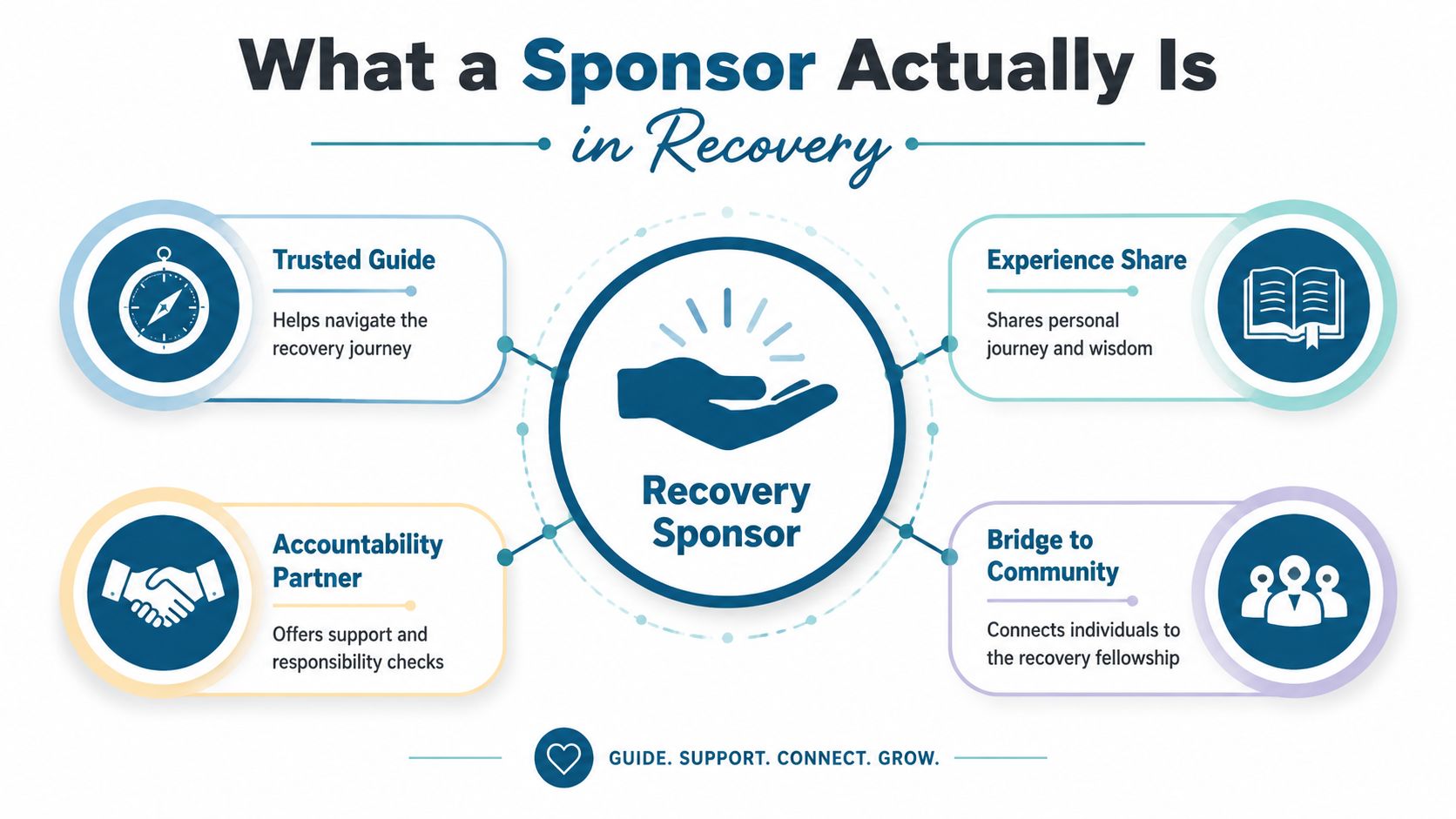
A recovery sponsor is like a seasoned hiking guide on a long trail. The guide doesn't carry every pack, make every choice, or walk for the other person, but they know the terrain, they've been through rough weather, and they help the newer hiker keep moving when the path gets complicated.
In 12-step programs such as AA and NA, the sponsor is usually a more experienced peer member who helps a newer member work through the 12 steps, shares personal experience, and shows what recovery looks like in daily life. That role is relational, not professional. It depends on trust, consistency, and honesty more than credentials.
The simple version
A sponsor usually does three things well.
- Shares lived experience. They talk about what helped them stay sober, what tripped them up, and how they handled cravings, shame, or fear.
- Provides structure. They help the newer member move through step work instead of drifting.
- Keeps recovery visible. They remind the person that recovery is something practiced, not just discussed.
The role is not limited to one recovery culture. Some people encounter a sponsor-like relationship in faith-based groups or in other mutual-help communities, where the language may be different but the idea is similar, an experienced peer offering guidance and accountability. The details vary, but the core theme stays the same, someone who has walked the road helps someone who is just starting.
A sponsor is a peer guide, not a professional fixer.
That distinction matters because the sponsor relationship works best when it stays grounded in recovery work. It's a bridge to fellowship, accountability, and step work. It isn't friendship by default, and it isn't therapy in disguise.
Core Responsibilities and Clear Limits of a Sponsor
The sponsor role makes sense once it's broken into actual tasks. A good sponsor helps a person stay connected to recovery between meetings, and that practical presence can influence outcomes. One review summarized by Recovery Research found that people who had a sponsor at the end of treatment had 33% greater chances of avoiding illicit drug use or related problems, and 50% greater chances of avoiding stimulant use, at 1 month post-treatment, compared with those without a sponsor. Another analysis reported that having an AA sponsor during months 0–3 was associated with nearly a three-fold increase in the probability of complete abstinence during months 4–6, after adjustment for AA participation, treatment, readiness for change, and intake drinking, as summarized in the same research overview at PMC's recovery sponsorship review.
What sponsors usually do
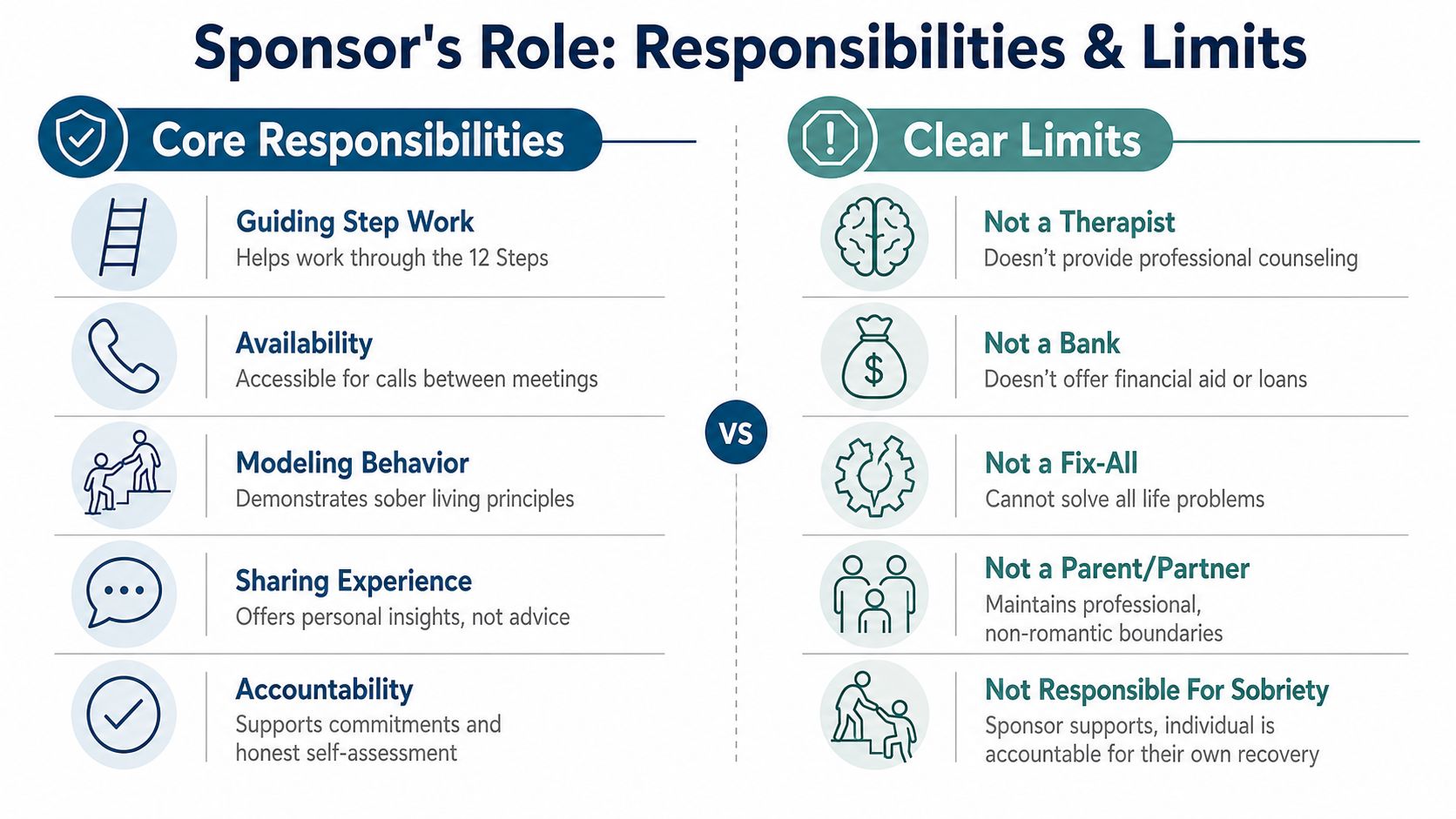
A sponsor is often available for calls, helps with step work, models sober behavior, and offers accountability. That can mean reading through step assignments, talking through a rough evening, or reminding someone to show up when they'd rather disappear.
A useful way to think about the role is this:
| Sponsor Responsibilities vs Limits | Responsibility | Limit |
|---|---|---|
| Step work | Helps a newer member work the steps | Doesn't replace therapy or clinical care |
| Between-meeting support | Offers contact and check-ins | Isn't a crisis line |
| Modeling | Shows how recovery is lived | Doesn't control another person's choices |
| Accountability | Encourages honesty and follow-through | Isn't responsible for someone else's sobriety |
The limits matter as much as the help. A sponsor is not a therapist, doctor, crisis counselor, or licensed clinician. That means the sponsor does not manage withdrawal, prescribe medication, diagnose mental health conditions, or handle suicidal ideation. If someone is medically unstable, in psychiatric danger, or unsure about medication, the right move is clinical care, not sponsorship.
For readers who want a parallel example of why accountability helps behavior change, accountability works better for porn recovery is a useful discussion of how regular check-ins can support follow-through. The lesson is familiar, accountability helps, but it only works when the boundaries are clear.
How Sponsorship Works Alongside Treatment and MAT
A sponsor works best as one layer in a larger recovery plan. That's especially true for someone leaving outpatient care, because PHP, IOP, therapy, and medication support each answer a different question.
Clinical care handles diagnosis, safety, symptom tracking, and medication decisions. Sponsorship handles lived experience, step work, and day-to-day encouragement. Those roles can coexist without tension, and people who try to pit them against each other usually end up with less support, not more.
For someone in outpatient recovery, the split often looks like this:
- Clinical team: manages withdrawal follow-up, psychiatric concerns, medication questions, relapse risk, and treatment planning.
- Sponsor: listens to cravings, talks through step work, and helps with recovery routines between meetings.
- Family or trusted supports: help with structure, transportation, and a calmer home environment when possible.
That's why MAT and sponsorship are not opposites. Many people using medication-assisted treatment still work with a sponsor and participate in 12-step recovery, while their clinicians make decisions about medication and symptom management. The sponsor is there for peer support and recovery habits, not for medication direction. For a plain-language overview of MAT itself, the article on what MAT is and how it works can help frame the clinical side of the conversation.
This balance matters in outpatient programs too. A setting like Zoe Behavioral Health can provide PHP, IOP, individual therapy, case management, and MAT support, while sponsorship adds a peer relationship that continues after the session ends. That pairing is often what helps a person move from “I know what to do” to “I can do it on a Tuesday night when no one's watching.”
Choosing the Right Sponsor for Your Situation
The right sponsor isn't just a nice person in the room. The right sponsor is someone whose recovery style, availability, and boundaries fit the stage the person is in right now. A person stepping down from PHP or IOP often needs more structure and faster access than someone who's been sober for years.
A practical filter
- Gender matching: Many people feel more comfortable choosing a same-gender sponsor, especially when the relationship needs to stay focused and free of mixed signals.
- Continuous sobriety: Look for meaningful, uninterrupted recovery time, because consistency matters more than charisma.
- Step experience: A sponsor should know the steps well enough to guide someone through them, not just talk generally about staying sober.
- Availability: A busy but well-intentioned sponsor is still a poor fit if they rarely answer the phone.
- Communication style: Some people need directness. Others need calm reassurance. The fit matters.
- Shared values: The sponsor should work within the principles of the program, not reinterpret them into personal rules.
- Life-stage fit: Someone coming out of detox may need different pacing than someone managing sobriety after years of abstinence.
| Sponsor Vetting Checklist | What to Look For |
|---|---|
| Gender match | Comfort, safety, and fewer distractions |
| Sobriety stability | Consistent recovery habits over time |
| Step work | Real experience guiding the 12 steps |
| Availability | Reasonable access for calls and check-ins |
| Communication style | Clear, respectful, and encouraging |
| Shared experience | Familiarity with similar recovery challenges |
| Program alignment | Stays within the fellowship's principles |
A good place to meet candidates is often the home group, a treatment alumni network, or a referral from outpatient staff who understand the person's level of care. Families can help by asking whether the match feels steady, respectful, and appropriately bounded rather than trying to choose based on charm alone.
Selection test: if the person feels intense, inconsistent, or overly controlling in the first conversation, that's usually not a good sponsor fit.
Questions and Conversation Starters for a New Sponsor
The first conversation doesn't need to sound polished. It just needs to reveal whether the relationship feels safe, structured, and useful. A prospective sponsor should be able to answer practical questions without sounding evasive or offended.
Good starter questions include these:
- Step process: How do you usually work the steps with someone new?
- Availability: What does your schedule look like for calls or check-ins?
- Craving support: If cravings spike at night, how do you usually handle that conversation?
- Medication history: Have you worked with people who are on MAT?
- Mental health: Are you comfortable supporting someone who also manages depression, anxiety, or other diagnosed conditions, while staying in your lane?
- Boundaries: What are your expectations around contact, meetings, and step assignments?
- Recovery style: What do you expect from the people you sponsor?
The sponsor should also ask questions. That's part of the commitment. A healthy sponsor might want to know how long the person has been sober, whether they're attending meetings, what support they already have, and whether they're working with a clinician or outpatient team. Those questions are not nosy when they're asked with respect. They show the sponsor is taking the role seriously.
The tone should feel calm, not transactional. If the conversation turns into pressure, guilt, or a personality test, that usually means the relationship is already getting off track.
A strong first call often sounds ordinary. There's clarity, some humility, and a basic agreement on what each person is there to do. That simplicity is a good sign.
Red Flags and Common Misconceptions
A sponsor should feel steady, not confusing. If the relationship starts to feel secretive, romantic, controlling, or dismissive of treatment, the person should treat that as a warning sign instead of a challenge to push through.
Warning signs that matter
- Sexual boundary issues: Any flirtation, romantic pressure, or inappropriate intimacy is a hard stop.
- Pressure to skip clinical care: A sponsor should not tell someone to stop therapy, ignore medical advice, or reject MAT.
- Claims treatment is unnecessary: Recovery support is not a substitute for licensed care when it's needed.
- Personal instability: Frequent crises, erratic behavior, or chaotic relationships can make the sponsor unreliable.
- Focusing on themselves: If most conversations become about their life, the sponsorship dynamic is off balance.
- Breaking anonymity: A sponsor should not share someone's personal story without permission.
- Over-control or demand: Excessive control usually helps the sponsor's ego more than the sponsee's recovery.
One common misconception is that a sponsor is basically a therapist. That's wrong. A sponsor can listen, encourage, and model recovery behavior, but they don't diagnose or treat mental health conditions. Another mistake is assuming sponsorship alone is enough to maintain recovery. It can help a great deal, but it works best inside a broader plan that may include outpatient care, family support, meetings, and medication when appropriate.
A third misconception is that any willing person can sponsor anyone else. Willingness matters, but so do sobriety stability, step knowledge, communication style, and boundaries. A person who means well but can't hold those limits may cause more confusion than help.
If a sponsor relapses, the response should be practical, not dramatic. The person can look at the relationship, the boundaries, and the need for backup support, then decide whether to continue or step away using a clear plan like the one described in what to do if a sponsor relapses.
Building Your Recovery Plan Beyond a Sponsor
A sponsor can be a powerful part of recovery, but the strongest plans don't depend on one relationship alone. They combine peer support, outpatient care, family involvement when it's healthy, and medication support when it's appropriate.
That broader view helps families avoid false choices. Recovery isn't sponsor or clinician, peer support or MAT, meetings or therapy. For many people, the workable answer is all of the above, organized in a way that keeps each person in the role they can fulfill.
The same is true for mental health recovery more broadly, where people often move through different tools as stability improves. The article on mental health recovery stages and tools is a useful reminder that progress usually comes from layering supports, not expecting one support to do everything.
That's where a structured outpatient continuum can help. Through build your sober support dream team, the idea is simple, surround the person with the right mix of clinical care and peer support so the next step doesn't feel like a cliff. Zoe Behavioral Health's outpatient services, including PHP, IOP, outpatient counseling, sober-living coordination, and alumni engagement, can give a sponsor something to plug into rather than replace.
For adults in Orange County and nearby communities, that can make the transition out of formal care feel less fragile. A sponsor helps with the lived experience of staying sober today, while outpatient treatment helps with the clinical and practical parts of building a stable life.
Zoe Behavioral Health provides outpatient treatment, including PHP, IOP, counseling, case management, and MAT support, for people who need structure while they build a recovery routine. If the question is how sponsorship fits alongside treatment, a conversation with the admissions team can help connect the pieces in a way that makes sense for the next step. Visit Zoe Behavioral Health to ask about outpatient care and how support can be coordinated around recovery sponsorship.
