
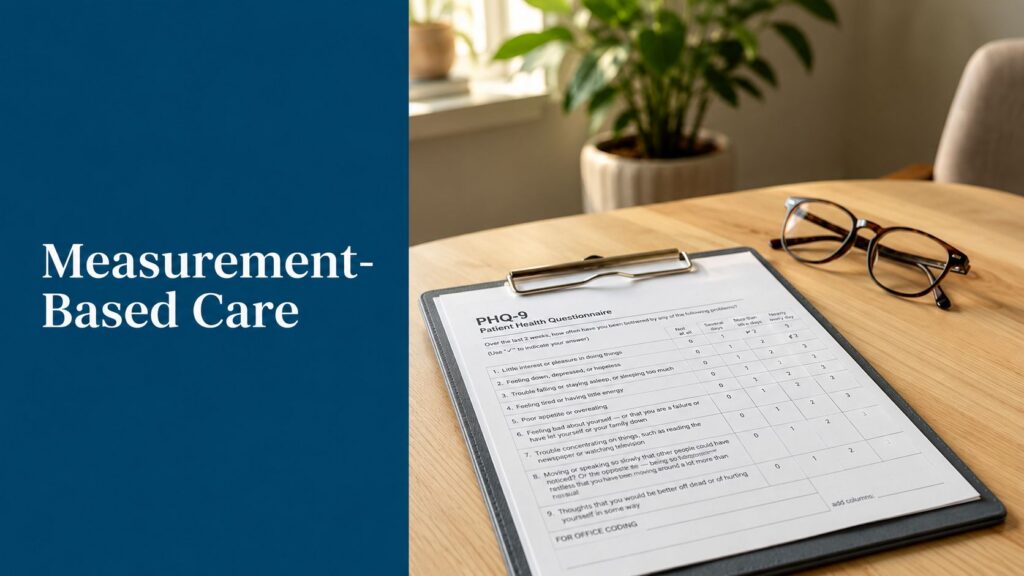
A person can walk into a Partial Hospitalization Program on day one and still not know whether the plan will help. The patient may be honest, the clinician may be experienced, and the conversation may still run on instinct more than evidence. Measurement based care exists to change that, especially in outpatient addiction and dual-diagnosis treatment where symptoms, cravings, sleep, mood, and attendance can shift fast.
In a real program, the difference is visible almost immediately. Instead of asking a patient to describe progress from memory, the team uses repeated patient-reported data to decide whether the current plan is working. That turns treatment into a structured conversation, one that can catch non-response early, support medication decisions, and keep care from drifting for weeks before anyone realizes it.
What It Feels Like to Start Treatment Without Data
The first week in treatment can feel deceptively hopeful. A patient sits in a group room, says the right things, and promises to be open, while the clinician is trying to decide whether the plan needs more structure, more support, or more time. Without objective data, both people are guessing a little, even when they mean well.
That guesswork matters because behavioral-health progress is rarely clean. Someone may sound stable in session and still be worsening between visits. Another person may feel discouraged but be moving in the right direction, just not fast enough to notice without a baseline and follow-up measures.
Practical rule: if progress only lives in memory, it's easy to miss the patient who is quietly drifting off track.
Measurement-Based Care earns its place in outpatient treatment. It replaces the vague question of “How are you doing?” with repeated, structured check-ins that show whether the current level of care is helping. In PHP and IOP, that matters because the team has a narrow window to adjust intensity before relapse risk or mood decline becomes a bigger problem.
For addiction and dual-diagnosis care, the issue goes beyond symptom scores. Cravings, attendance, medication adherence, functioning, and sleep can all change before the patient can fully articulate what's happening. Repeated measurement gives the care team a cleaner view of the pattern, not just the story told in one session.
At Zoe Behavioral Health, that kind of visibility matters in real time. A patient in an outpatient program may look engaged on the surface and still need a different schedule, a medication review, or a stronger relapse-prevention plan. Measurement-Based Care helps the team see those shifts early enough to respond with something concrete instead of waiting for a crisis to make the answer obvious.
Defining Measurement-Based Care in Plain Language
Measurement based care is not a one-time questionnaire and it's not a paperwork add-on. The American Psychological Association describes it as routine symptom and functioning assessment used throughout care. The U.S. Interdepartmental Serious Mental Illness Coordinating Committee defines it as standardized, valid, repeated measurements used for shared patient-provider treatment planning. That wording matters because it shows that MBC is a workflow, not a form.
The Four Operational Pieces
A useful way to picture MBC is to break it into four actions.
- A validated measure gets administered routinely. In outpatient care, that usually happens before an encounter when possible, so the team has fresh data rather than stale recall.
- The clinician reviews the result. The score is only useful if someone looks at it in time to act.
- The patient reviews the result too. Shared understanding matters, because the patient should know what the score means and whether it fits lived experience.
- The plan gets re-evaluated collaboratively. If the data say the current approach isn't helping, the treatment plan changes.
That workflow is similar to checking blood pressure in medical care. A single reading can inform a visit, but repeated readings over time tell a much more useful story about risk, response, and whether the current intervention is enough.
For readers who want a broader evidence-based frame, a practical overview of measurement-driven treatment planning helps show how data becomes part of clinical decision-making rather than just documentation. The same logic shows up in behavioral health when repeated measures are used to guide session focus, level of care, and support between visits.
What MBC is not, though, is just as important. It isn't a one-time intake form, and it isn't a single self-report checklist used for billing or compliance. It also doesn't replace judgment. It sharpens judgment by showing whether the patient is moving.
The Evidence Behind Measurement-Based Care
The original case for MBC came from a blunt mismatch between what clinicians believed and what outcomes showed. Michael Lambert's research found therapists thought 85% of patients improved, while actual improvement was estimated at only 40% to 60%, and providers thought deterioration happened in about 3% of cases even though studies showed 5% to 10% of adults and 15% to 25% of adolescents worsen during therapy. Those gaps are exactly why MBC became a quality-control system in behavioral health.
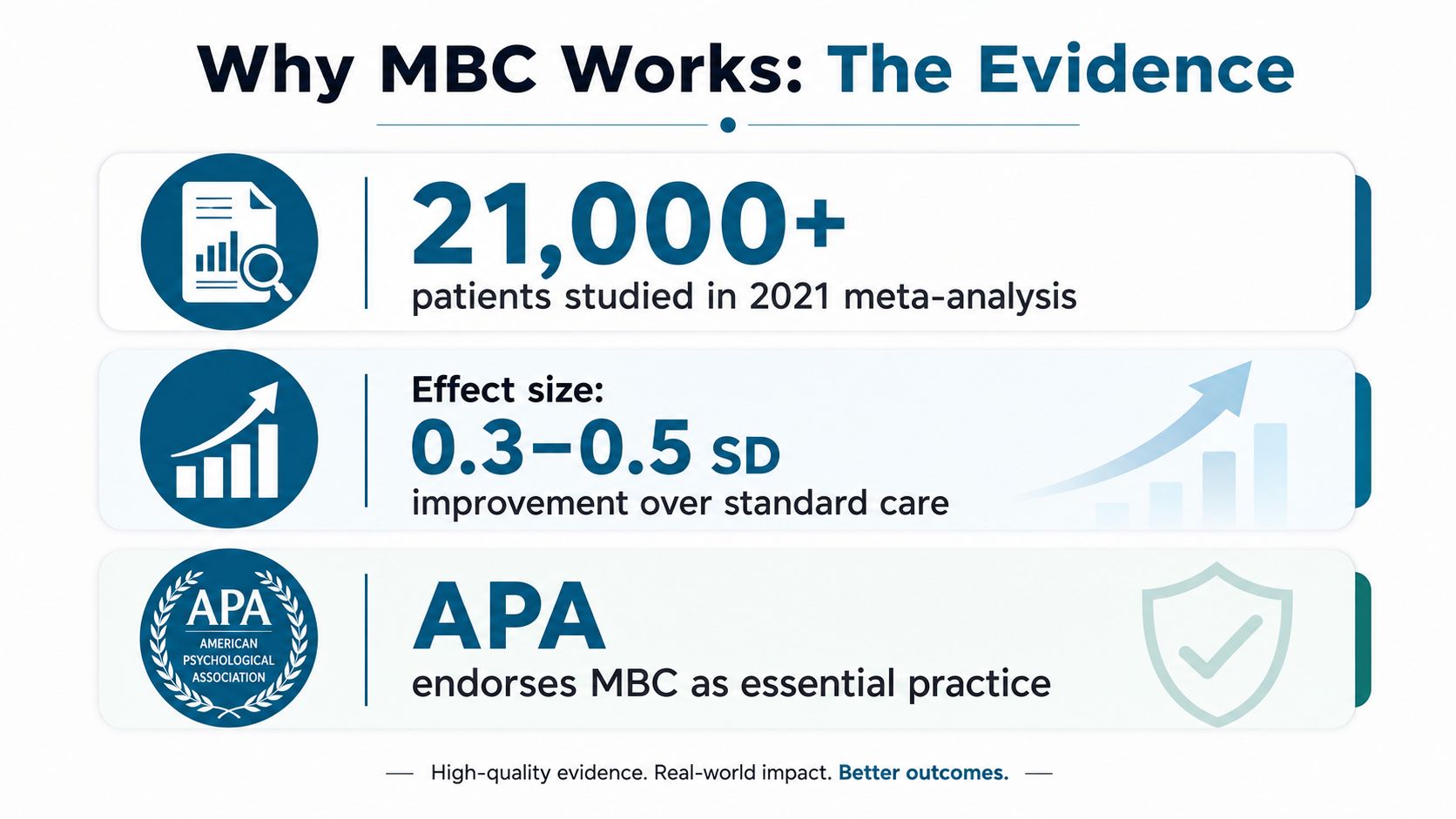
A later layer of evidence made the case even stronger. The APA cited a 2021 meta-analysis that examined more than 21,000 patients and found feedback-informed care reduced symptoms across all case types, with an even stronger effect for patients who were not improving. That matters operationally, because the people most likely to benefit from earlier intervention are the ones who are easiest to miss in a busy outpatient program.
The implementation story is just as important as the research story. One review noted MBC is typically used in less than 20% of behavioral-health settings, which tells you the barrier isn't whether it works. The barrier is whether programs can build the workflow well enough for clinicians to use it consistently. A 2025 Frontiers study then showed large-scale implementation was followed by an approximate 5 percentage-point improvement in patient outcomes, which was about a 23.5% relative improvement on a combined PHQ-9 and GAD-7 measure.
For a practitioner, the takeaway is simple. MBC isn't only a research concept or a documentation trend. It's one of the few behavioral-health practices that can improve outcomes in real-world programs, provided the measures are brief, relevant, and used to change care. That's also why the implementation details matter more than the slogan.
See the practical framing in the context of why care models work best when they are measurable. The point isn't to score people. The point is to notice sooner when treatment is flat.
Common Instruments and How Often They Are Used
The strongest outpatient programs don't rely on one instrument for every person. They use a small set of validated measures and match them to the treatment goal. That usually starts with symptom scales, then expands to substance use, withdrawal, safety, and functioning when needed.
A Working Toolkit for Outpatient Care
- PHQ-9. This tracks depression severity and is often used at intake, weekly, and at discharge. It's short, easy to repeat, and useful when a patient's mood is part of the presenting problem.
- GAD-7. This measures anxiety symptoms on a similar cadence, especially when worry, panic, or physical tension is affecting participation in treatment.
- AUDIT. This helps assess alcohol-related risk and is often used at intake and follow-up when alcohol use is a core treatment target.
- DAST. This captures drug-use related concerns and can be repeated when the team is tracking stimulant, opioid, or polysubstance patterns.
- COWS. The Clinical Opiate Withdrawal Scale is useful when opioid withdrawal symptoms need closer monitoring, especially during medication changes or early stabilization.
- Functioning and quality-of-life measures. These matter because symptom reduction alone doesn't tell the whole story. Patients also need to sleep, work, attend group, and manage daily routines.
A broader view of measurement is helpful in care settings where progress isn't only about symptoms. For families looking to track therapy progress in a structured way, the same principle applies, repeated data is most useful when it informs the next decision rather than sitting in a chart.
Common MBC Instruments Used in Outpatient Treatment
| Instrument | What It Measures | Typical Cadence | Triggers Plan Adjustment |
|---|---|---|---|
| PHQ-9 | Depressive symptoms | Intake, weekly, discharge | Rising scores, flat scores, worsening function |
| GAD-7 | Anxiety symptoms | Intake, weekly, discharge | Panic, persistent worry, poor response |
| AUDIT | Alcohol-related risk | Intake and follow-up | Escalation, relapse signals, poor self-control |
| DAST | Drug-use related concerns | Intake and periodic review | Continued use, cravings, instability |
| COWS | Opioid withdrawal symptoms | As needed during stabilization | Medication or level-of-care changes |
| Functioning measure | Daily-life performance | Regular check-ins and discharge | Attendance problems, poor role functioning |
The key point is cadence. Measures should be completed before each clinical encounter when possible, because waiting until the end of treatment wastes the chance to adjust earlier. In practice, the best programs don't overload patients with long forms. They choose measures that are brief enough to sustain, but specific enough to change the plan.
How MBC Works Inside PHP and IOP Programs
PHP and IOP are the places where Measurement-Based Care becomes operational, because the patient is seen often enough for patterns to matter. In a well-run outpatient program, the workflow begins at intake, continues several times per week in PHP, shifts to weekly check-ins in IOP, then repeats at discharge and follow-up. That cadence gives the team enough information to see whether the patient is settling, stalling, or sliding backward.
At Zoe Behavioral Health in Lake Forest, that rhythm fits a setting where patients sleep at home but still receive structured daytime care close to the coast. For readers comparing levels of care, a practical overview of IOP structure explains why this level often serves as the bridge between higher-intensity treatment and more independent recovery.
A patient completes a brief self-report measure before group or individual therapy. The clinician reviews the result before or during the visit, then brings it into the clinical huddle so the team can compare notes across therapy, case management, and psychiatry. During the next individual session, the patient sees the same information and can talk through what the number means in daily life.
That shared review is where MBC stops being abstract. If the patient's depression score is flat but attendance has dropped, the team can raise support before the problem becomes a dropout. If cravings or withdrawal symptoms are worsening, the plan can shift faster, especially when medication-assisted treatment is part of the picture.
The strongest outpatient workflows make the score visible, discuss it promptly, and tie it to a decision the patient can feel that same week.
PHP gives the team several touchpoints per week, which makes it easier to spot change quickly. IOP still provides enough signal to support medication adjustments, stronger group placement, or more targeted individual work. The same data can also guide whether a patient needs broader support, such as yoga, outdoor therapy, or a quieter clinical pace.
For billing and documentation teams, a clear note structure also matters, especially when therapy intensity changes. Guidance on billing 90837 with Clarity can help staff align clinical documentation with what was done in session, which matters when measurement data changes the treatment focus.
Patient Benefits, Privacy, and Honest Trade-Offs
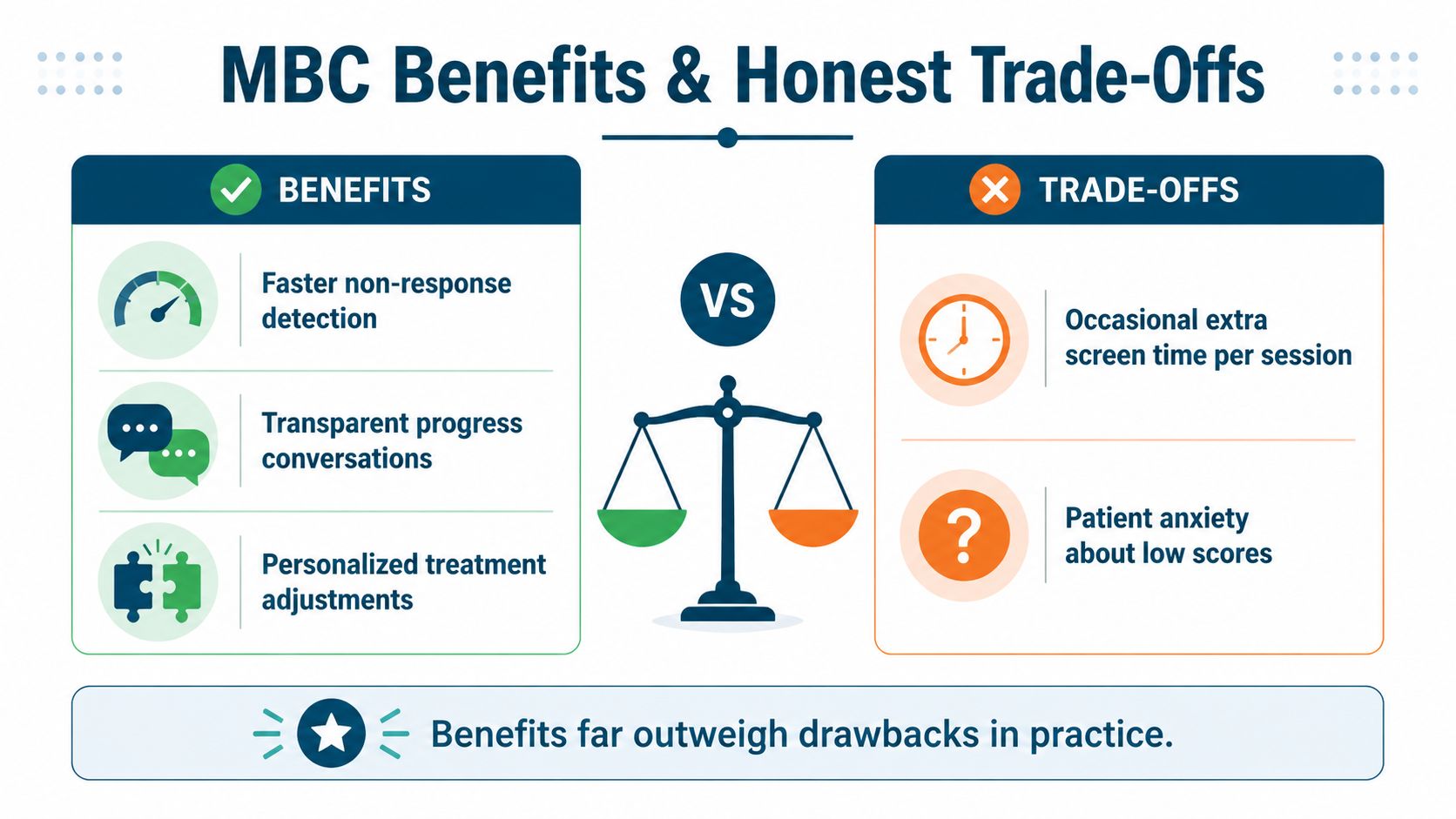
Patients usually want three things from treatment. They want to know if it's working, they want to feel heard, and they want to know the data isn't being misused. MBC helps with the first two by making progress more visible and conversations more specific. It also gives the team a better chance to catch non-response early instead of waiting until the patient is already discouraged.
Privacy is a real concern, and programs should treat it that way. Patient-reported outcomes and validated instruments are typically handled under standard HIPAA protections, and access should stay limited to the clinical team that needs the information for care. In a well-run outpatient program, the score is part of treatment planning, not something floating around casually.
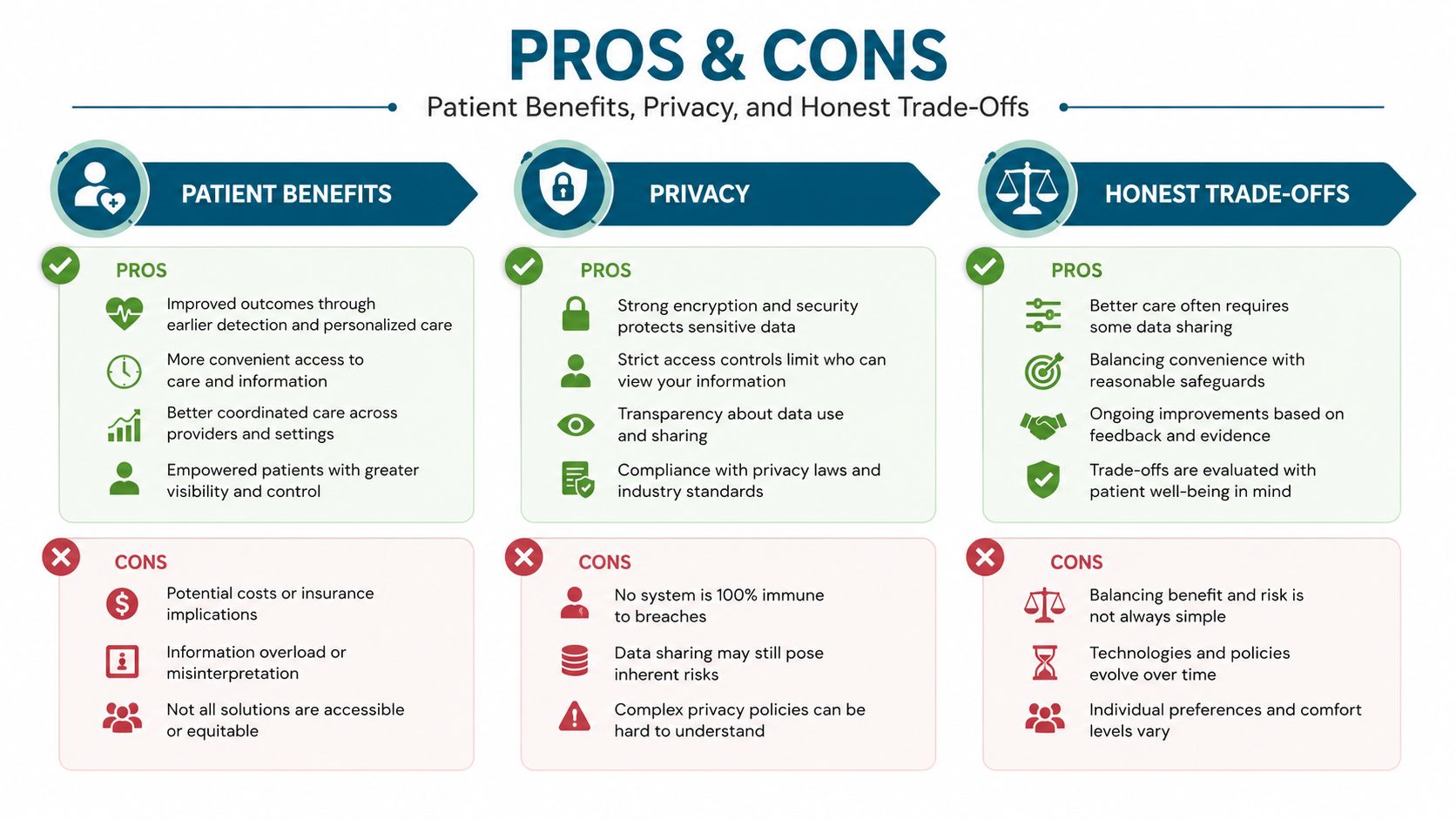
The trade-offs are worth naming plainly. Repeated surveys can feel burdensome if they're too long or too frequent. Scores can also feel reductive when they miss context, like a bad week after an argument, a job loss, or unstable housing. Some clinicians are skeptical that scales add anything beyond a careful conversation, and programs need staff time, training, and workflow design to make MBC useful rather than annoying.
Useful standard: more measurement is not automatically better. The best programs choose brief, clinically relevant tools and act on the results.
That's especially true in addiction and dual-diagnosis care, where the most helpful measures often include more than mood alone. If the patient is honest about cravings, sleep, attendance, and medication adherence, the team can use MBC to understand the whole picture. If those domains get ignored, the program may still produce a score, but not a better decision.
Why Zoe Behavioral Health Leads on MBC in Orange County
For adults in Orange County, choosing an outpatient program that consistently uses measurement based care is a meaningful quality signal. It tells families the team is checking progress on purpose, not just hoping the patient gets better between visits. In a setting that treats drug use, alcohol use, and mental health together, that matters because the plan often needs to change before symptoms become an emergency.
Zoe Behavioral Health is a California-licensed outpatient center in Lake Forest that offers PHP, IOP, outpatient counseling, sober-living coordination, and MAT for opioid and other dependencies. Those services are a strong fit for repeated measurement because each level of care benefits from seeing whether the patient is improving, plateauing, or needing more support. The program's multidisciplinary model, small groups, and complementary options like outdoor therapy and yoga also give the clinical team more levers to adjust when the data calls for it.
The practical advantage is fit. Patients can sleep at home, keep rebuilding routines, and still get structured daytime treatment with regular check-ins. That arrangement makes it easier to use measurement to guide real decisions, including whether the patient needs more group support, a different therapy focus, or tighter psychiatric follow-up. For families comparing programs, the question should be whether the clinic uses the data to change care, not whether it collects forms.
When a program pairs measurement with individualized treatment, the admission process gets clearer too. Families can ask about insurance verification, clinical fit, and whether PHP, IOP, or outpatient counseling is the right next step. They can also ask for 24/7 admissions guidance so placement doesn't get delayed while someone is trying to decide alone.
Frequently Asked Questions About Measurement-Based Care
Is MBC just a standard intake questionnaire? No. Intake is only the starting point. MBC uses repeated, validated measures over time so the team can see whether treatment is helping and change the plan when it isn't.
Do patients see their scores? They should. Shared review is part of the model, and it usually makes progress conversations more concrete and less guessy.
Is repeating surveys optional? In a real MBC program, it's part of care, not a side task. The exact frequency depends on the level of care and the measure being used.
What happens if scores don't improve? The team should reassess. That can mean changing intensity, revising therapy goals, adjusting medication support, or adding services that address what the score is missing.
Will families be informed? Families may be included when the patient consents and when sharing information supports treatment. Privacy still matters, so good programs keep the clinical team aligned without over-sharing.
Zoe Behavioral Health offers outpatient PHP, IOP, counseling, MAT support, and dual-diagnosis care with a measurement-based approach that helps treatment stay responsive instead of static. If a patient or family is trying to decide what level of care makes sense, Zoe Behavioral Health can help with admissions guidance, insurance verification, and a clear next step toward treatment.
