

At the kitchen table, a family may be having the same conversation for the tenth time. An adult son insists his drinking is under control, a spouse searches for treatment options, and parents wonder whether another serious talk will help or only create more conflict. The family sees consequences. The person using substances sees reasons to defend the behavior.
That gap can feel like denial, but it may also reflect a different level of readiness. The stages of change model, also called the Transtheoretical Model, gives clinicians a way to understand that readiness without reducing it to willpower, morality, or love for the family. Developed by James Prochaska and Carlo DiClemente, the framework describes how people often approach, begin, sustain, and sometimes revisit behavior change.
When Someone You Love Is Not Ready to Change
A daughter says, “Nothing is wrong,” after missing work and arguing with her partner. Her family hears denial and wants an immediate treatment plan. She may be noticing the same consequences privately, while feeling embarrassed, frightened, or unsure what change would require. Clinically, that gap calls for curiosity before persuasion.
The stages of change model helps explain why people with similar substance use patterns can respond differently to the same recommendation. One person may be willing to consider an evaluation. Another may attend only because a spouse arranged it. A third may be practicing new coping skills but still struggle when stress rises.
Clinical perspective: Readiness is an assessment finding, not a permanent identity.
Clinicians commonly describe five core stages, precontemplation, contemplation, preparation, action, and maintenance. Relapse, sometimes called “recycling,” can move someone toward an earlier stage. The model uses intention and behavior over time, rather than symptom severity, to describe readiness. Preparation involves intending to stop within 30 days, action means behavior change for 0 to 6 months, and maintenance means sustaining change for more than 6 months, as described in the clinical overview of the Transtheoretical Model.
These time markers help organize a clinical conversation, but they do not predict exactly what a person will do next. Readiness can shift after a health concern, relationship conflict, period of stability, or return to use. The model works best as a heuristic for choosing the next conversation, not as a fixed identity or guaranteed roadmap.
For families, the useful question is, “What kind of support can this person hear today?” Someone in precontemplation may respond to respectful information and feedback about risks. Someone preparing to change may need help scheduling an evaluation, removing practical barriers, and choosing one immediate step.
Families can protect the relationship while setting clear boundaries. A calm agreement about safety, finances, transportation, or contact during intoxication may accomplish more than repeated arguments about whether the person has a problem. Families facing a loved one who does not want treatment can find further guidance in this resource about unwillingness to seek addiction care.
The Five Stages of Change Explained
A person considering recovery can be compared with someone considering a major lifestyle change, such as quitting smoking. The comparison isn't exact, but it makes the emotional movement easier to recognize.
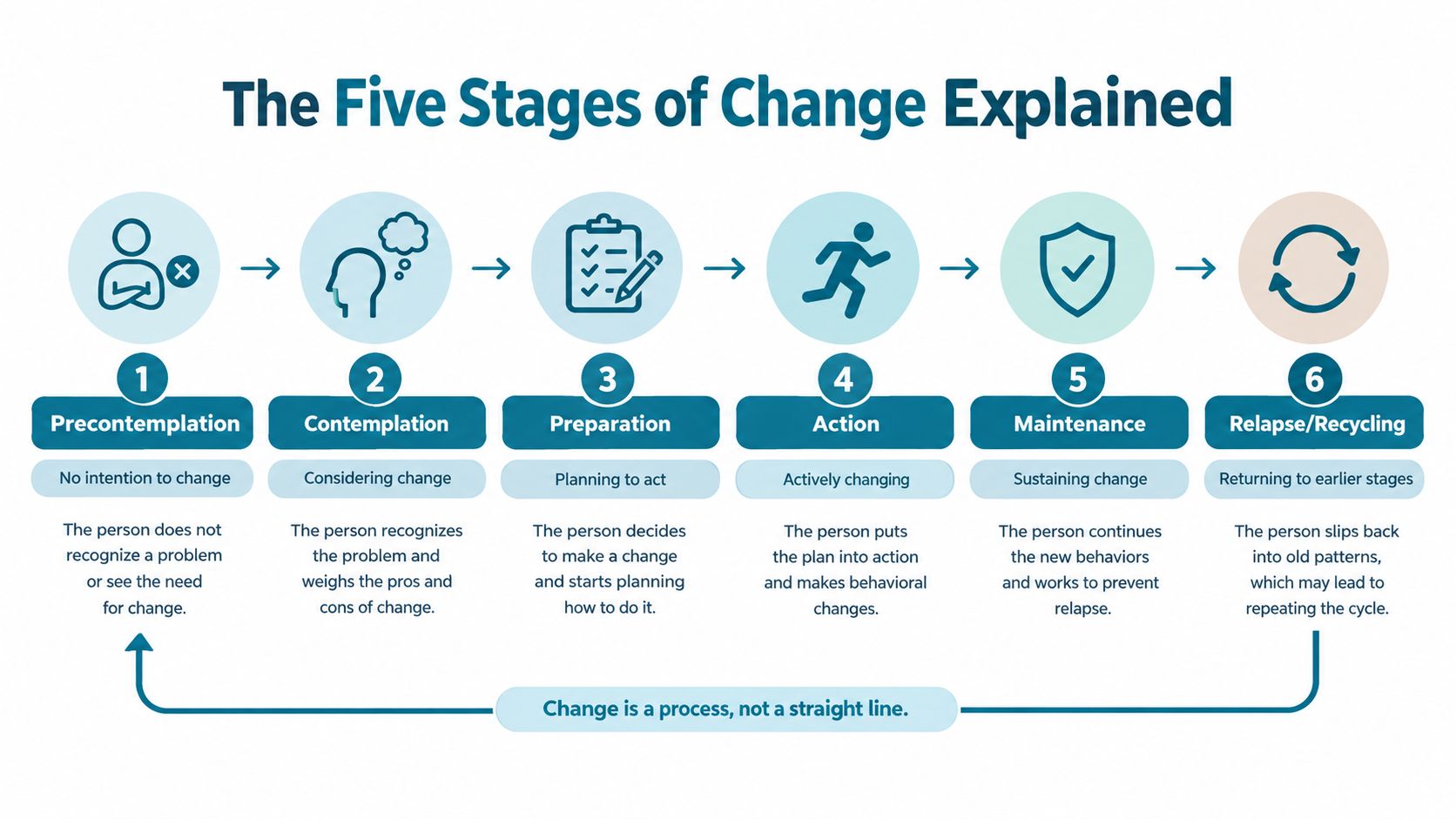
Precontemplation
In precontemplation, the person isn't intending to change. A person with an alcohol concern might say, “I drink because everyone is overreacting,” or “I can stop whenever I want.” The emotional tone may include defensiveness, indifference, or a focus on other people's behavior.
A clinician doesn't begin by demanding a quit date. The first task is to understand the person's view, provide relevant information with permission, and gently explore connections between substance use and problems the person already recognizes.
Contemplation
In contemplation, the person sees reasons to change but also sees reasons to continue. Someone might say, “I know drinking is hurting my marriage, but it's the only way I can relax.” This stage can last while the person weighs relief, fear, identity, relationships, and practical barriers.
The central feature is ambivalence, not laziness. Treatment conversations work better when the clinician helps the person examine both sides rather than arguing one side away.
Preparation
In preparation, intention becomes more concrete. The person may say, “I need an evaluation,” “I'm going to stop after this weekend,” or “I need help managing cravings.” The model's commonly used formulation places an intention to stop within 30 days in this stage, as described in the National Center for Biotechnology Information clinical reference.
Preparation calls for a realistic plan, anticipated barriers, support contacts, and a specific first appointment. The person may still feel nervous, but the conversation has moved from whether change matters to how change could begin.
Action
Action means the person is actively changing behavior. In the cited formulation, action covers 0 to 6 months of behavior change. A patient may attend treatment, avoid high-risk settings, take prescribed medication, repair routines, and practice coping strategies.
Action can look productive while still feeling unstable. New behaviors haven't yet become reliable under every stressor, so structure and feedback matter.
Maintenance and recycling
In maintenance, the person sustains the new behavior for more than 6 months under the commonly used formulation. Attention shifts toward protecting progress, handling triggers, and strengthening a life that supports recovery.
Relapse or recycling means the person may return to contemplation, preparation, or another earlier point. The model is therefore a map of readiness, not a set of boxes. Clinicians use it to guide conversation, then reassess rather than forcing someone to accept a label.
Matching Treatment to Where Someone Is Right Now
Stage-matched care starts with a simple clinical discipline: the intervention must fit the person's current readiness. Treatment guidance tied to the model recommends information and problem connections during precontemplation, commitment work during preparation, and relapse-prevention support during maintenance, as outlined in this clinical treatment table on stages and interventions.
For someone in precontemplation, a session may feel exploratory rather than directive. The clinician asks what the substance provides, reflects the person's concerns, shares neutral feedback, and discusses safety without insisting on an immediate commitment. Motivational interviewing and harm-reduction conversations can preserve contact while the person develops more awareness.
Contemplation requires a different rhythm. The clinician may help the patient list what substance use solves in the short term and what it costs over time. The purpose isn't to win a debate. It's to help the patient hear personal reasons for change in their own words.
Preparation is more practical. Sessions may focus on:
- Small goals: Choose an immediate step that can be completed rather than a vague promise to “do better.”
- Barrier planning: Address transportation, work schedules, medication questions, family conflict, and access to continuing support.
- Coping preparation: Identify likely triggers and decide what the patient will do before cravings become overwhelming.
In action, the therapist can be more skills-focused. Treatment may include relapse-prevention practice, medication management, emotional regulation, communication work, and active recovery support. The clinician reviews what worked, examines setbacks without punishment, and adjusts the plan.
| Stage | Primary Clinical Focus | Typical Session Activities |
|---|---|---|
| Precontemplation | Awareness and trust | Explore the person's perspective, provide feedback with permission, discuss safety |
| Contemplation | Ambivalence resolution | Weigh benefits and costs, identify values, strengthen personal reasons for change |
| Preparation | Concrete commitment | Set next steps, anticipate barriers, coordinate appointments and supports |
| Action | Skill development | Practice coping strategies, review progress, manage medication, plan for triggers |
| Maintenance | Protection of gains | Update relapse-prevention plans, reinforce routines, prepare for stress |
Pushing a precontemplative patient into action often creates resistance. Families and providers can learn more about readiness-focused conversations through this guide to motivational interviewing and long-term sobriety.
Why Relapse Is Part of the Process
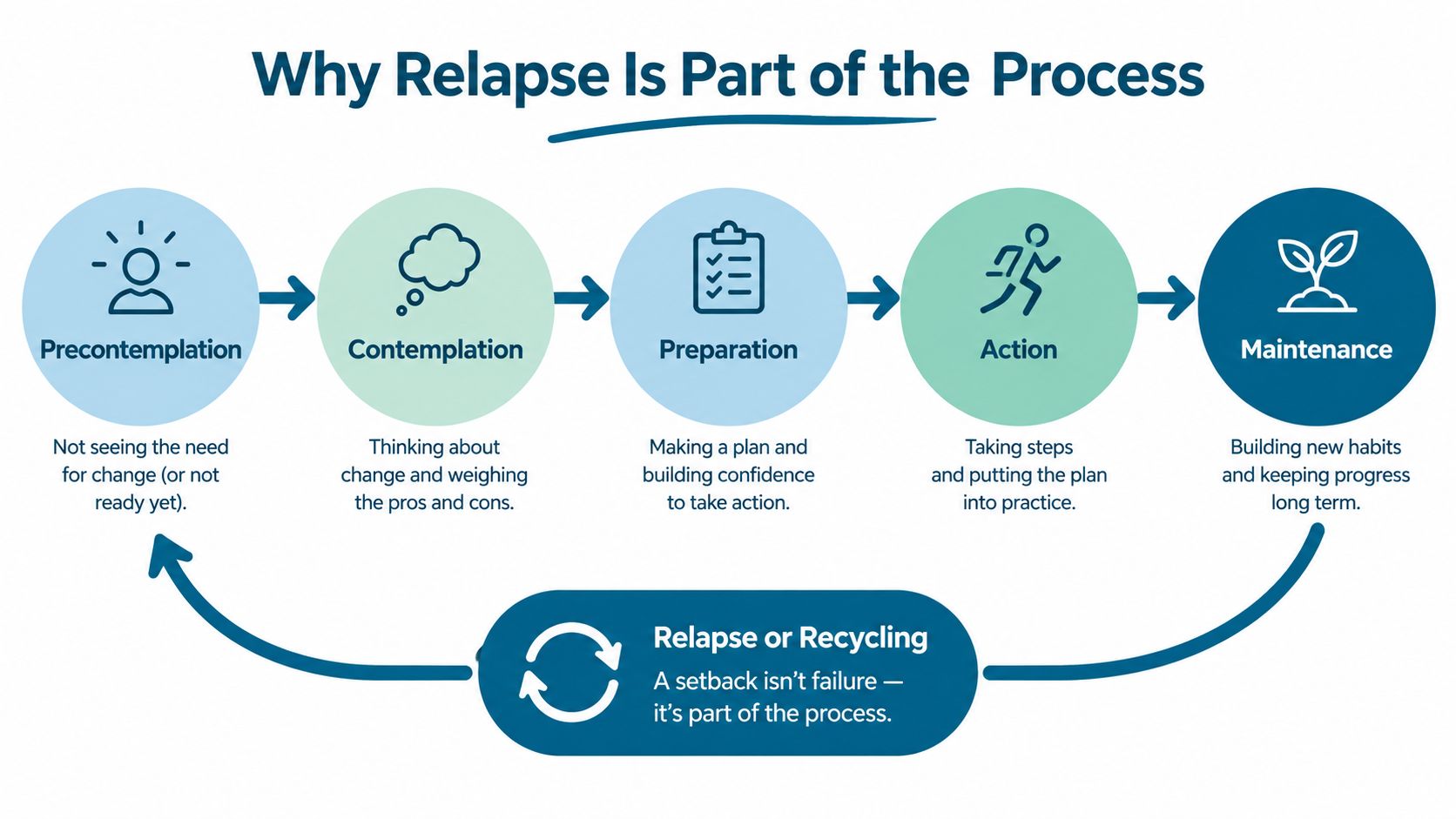
Recovery rarely follows a staircase. A person may attend treatment, make meaningful changes, encounter grief or conflict, and return to substance use. The stages of change model treats this movement as cyclical, not as proof that earlier work was meaningless.
For an outpatient patient, recycling may begin with a missed session followed by shame. The person may avoid calls, binge over a weekend, then contact the therapist. A lapse may involve a brief return to use, while a more sustained relapse may require a broader reassessment of safety, supports, medication, triggers, and level of care. Clinicians should distinguish the event from the person's character.
The response also depends on what happened next. A patient who re-engages quickly may need a revised coping plan and more frequent contact. Another patient may need medical evaluation, a higher level of structure, or renewed motivational work before skills training can resume.
Progress isn't measured only by whether someone ever slips. It's also measured by whether the person can return to honesty, safety, and support.
Families benefit from a written plan that identifies warning signs, trusted contacts, boundaries, and the first response after a lapse. Resources on tailored relapse prevention plans for families can help relatives organize that response without relying on panic or shame. Additional guidance on re-engaging after a setback appears in this discussion of life after relapse.
Re-staging isn't punishment. It's a clinical update. The patient may be in contemplation about stopping again, preparation for a new plan, or action after re-entering treatment.
What the Research Shows
A family may see a loved one agree to treatment in the morning, then question it after a difficult evening. That shift does not mean the model has failed. It shows why the stages of change work better as a readiness heuristic than as a fixed roadmap.
Reviews have found limited evidence that stage-based programs consistently improve behavior change or move patients through stages more effectively than non-stage-based care. A major critique also found no convincing evidence that moving someone closer to action necessarily produces sustained later change. This evidence is discussed in the review of Transtheoretical Model interventions.
Readiness can change with withdrawal, family pressure, sleep, medication, housing, work, and immediate consequences. A person may sound prepared during an intake and ambivalent during the next session. The working stage should therefore be updated when the person's words, behavior, or circumstances change.
A brief readiness conversation may be enough to select the next intervention. A fuller assessment is needed when safety, co-occurring mental health symptoms, withdrawal risk, or available support could affect treatment decisions. The stage label organizes the conversation. It does not replace clinical judgment.
| Clinical area | Stage-matched evidence | Practical implication |
|---|---|---|
| Substance use treatment | Evidence is mixed, with limited support for stage-based care as a standalone engine | Use readiness to personalize engagement, skills, and follow-up |
| Motivational interviewing | Often works along the same readiness continuum by supporting movement toward preparation or action | Use collaborative conversation rather than confrontation |
| Psychotherapy outcomes | Readiness can be associated with outcomes, but association doesn't prove that stage movement causes lasting change | Treat readiness as useful context, not a guarantee |
| Health behavior programs | Findings across stage-based interventions are inconsistent | Choose the simplest assessment that answers the clinical question |
The most defensible use is practical and modest. The model gives clinicians a shared vocabulary for personalization. They can listen for ambivalence, ask what the patient is ready to consider, and match the conversation or intervention to that answer. They should not treat discrete stages as deterministic predictors. This evidence-aware position, including the model's heuristic value and concerns about stage validity and classification reliability, appears in the review of the model's predictive utility.
How Outpatient Programs Use the Model in Practice
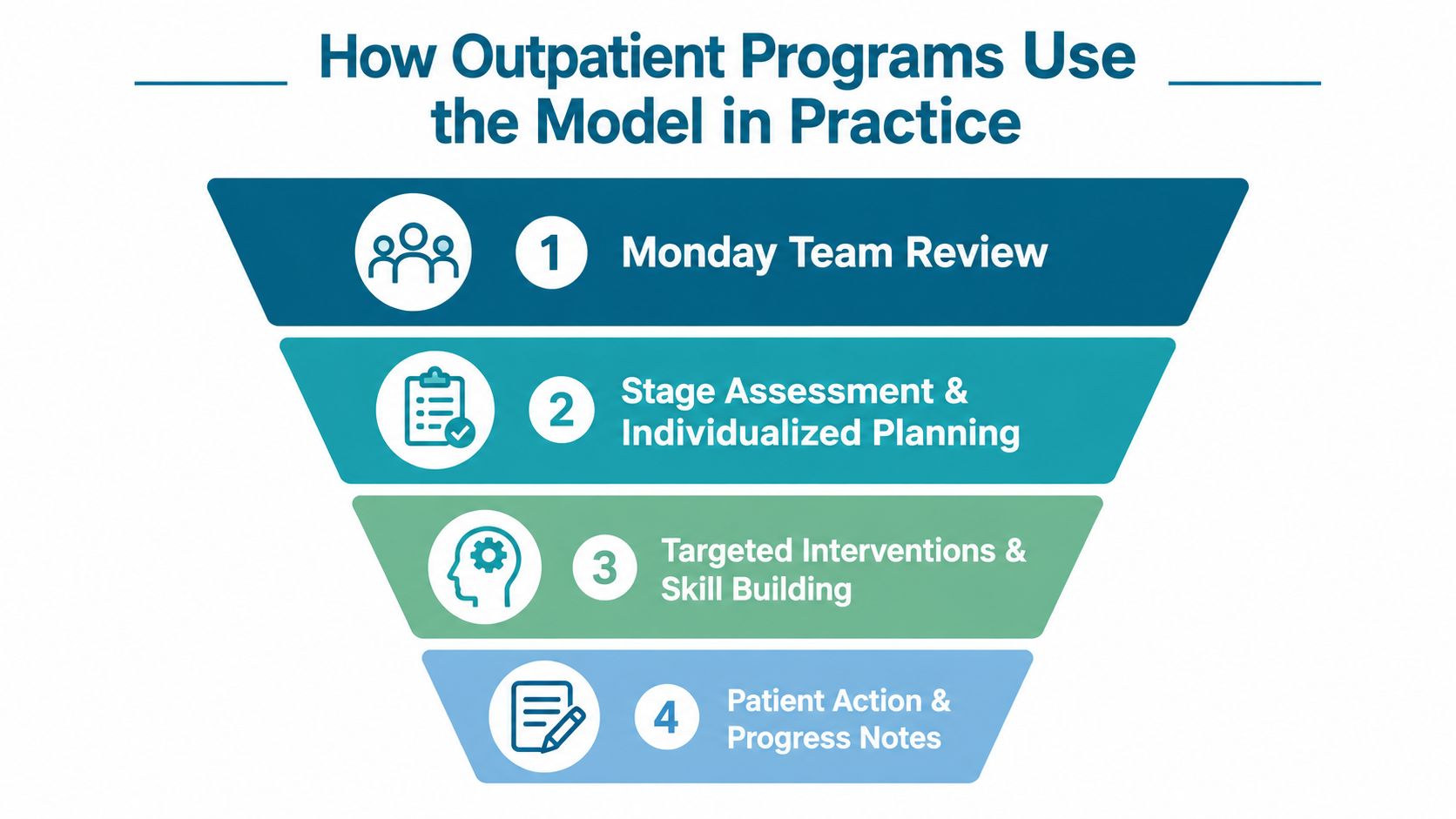
On a Monday morning in a partial hospitalization program, the clinical team may review each patient's current risks, goals, participation, and readiness. A patient who says treatment is pointless may receive a different group invitation than a patient asking for help with cravings. The chart can record the working stage, the evidence supporting that impression, and the intervention being used, while leaving room for revision.
An intensive outpatient program may then run a process group where patients examine ambivalence, practice coping skills, or plan for a high-risk event. The group leader doesn't assume every participant belongs at the same point in the change process. One person may need permission to discuss whether change is worthwhile. Another may need rehearsal for refusing substances at a social gathering.
A week of shifting clinical decisions
During an individual session, a therapist may begin with motivational work when a patient is in contemplation. If the patient decides to schedule an evaluation and remove alcohol from the home, the therapist can shift toward preparation. After treatment begins, the focus may move again toward behavioral skills, medication coordination, emotional regulation, and relapse prevention.
The level of care can change with readiness and safety. A person in precontemplation may start with assessment and motivational engagement before the team recommends a more intensive structure. Someone in preparation may enter PHP directly when symptoms or risk require close support, then step down to IOP as daily functioning improves. A patient in action or maintenance may use outpatient therapy and recovery supports while continuing to monitor triggers.
What the team records
Useful clinical artifacts include weekly stage notes, individualized goals, medication updates, attendance patterns, safety plans, and relapse-prevention plans that change as readiness changes. The record should show why an intervention fits the patient today, not merely assign a label.
The same readiness-informed workflow can support other outpatient needs, including eating disorder IOP support, where engagement, ambivalence, and skill practice may also change over time. The framework doesn't replace diagnosis or risk assessment. It helps the team choose language, pacing, and structure that the patient can use.
What Patients and Families Can Do at Each Stage
Families often want a sentence they can use tonight. The most helpful sentence depends on what the loved one can tolerate hearing.
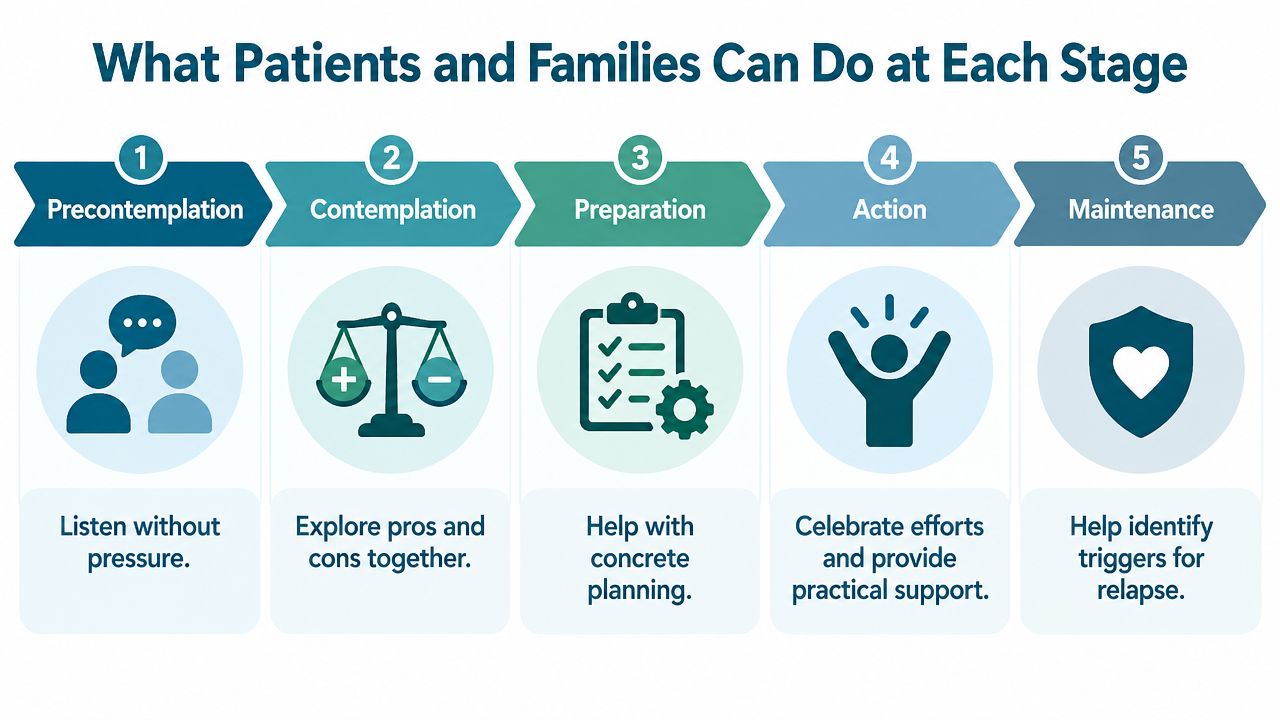
Precontemplation
Internally, the person may not accept that substance use needs to change.
- Do ask with curiosity: “What does drinking give you?” or “What do you notice after using?”
- Don't build every conversation around proof: Repeated arguments can make the person defend the behavior more strongly.
- Protect safety: Set clear boundaries around driving, violence, money, childcare, and contact during intoxication.
Contemplation
The person recognizes a problem but feels divided about changing.
- Do explore both sides: Ask what the person likes about using and what it has cost.
- Normalize ambivalence: Mixed feelings don't mean the person is incapable of recovery.
- Don't force a decision date: A pressured promise may create compliance without commitment.
Preparation
The person is beginning to turn intention into logistics.
- Do help with concrete planning: Support an evaluation, arrange transportation, gather insurance information, and identify the first appointment.
- Reduce avoidable friction: Discuss triggers at home, medication questions, work obligations, and who can provide support.
- Don't take over every decision: The plan works better when the patient owns the next step.
Action
The person is actively practicing change and may need steady reinforcement.
- Do celebrate effort specifically: Recognize attendance, honest disclosure, coping practice, and repaired routines.
- Offer practical support: Help protect sleep, meals, transportation, and time for treatment.
- Don't interpret difficulty as failure: New skills need repetition, especially during stress.
Maintenance and relapse
Maintenance involves protecting gains. If relapse occurs, the person may feel shame and expect rejection.
- Do plan for high-risk situations: Identify warning signs, contacts, and the first call after a lapse.
- Respond calmly and briefly: Reconnect with the treatment team and address immediate safety.
- Don't use humiliation as a treatment strategy: Shame often drives secrecy, while honest contact gives clinicians information.
A family doesn't need to diagnose the stage perfectly. The aim is to keep dialogue open, respond to actual behavior, and avoid turning a temporary position into a permanent identity.
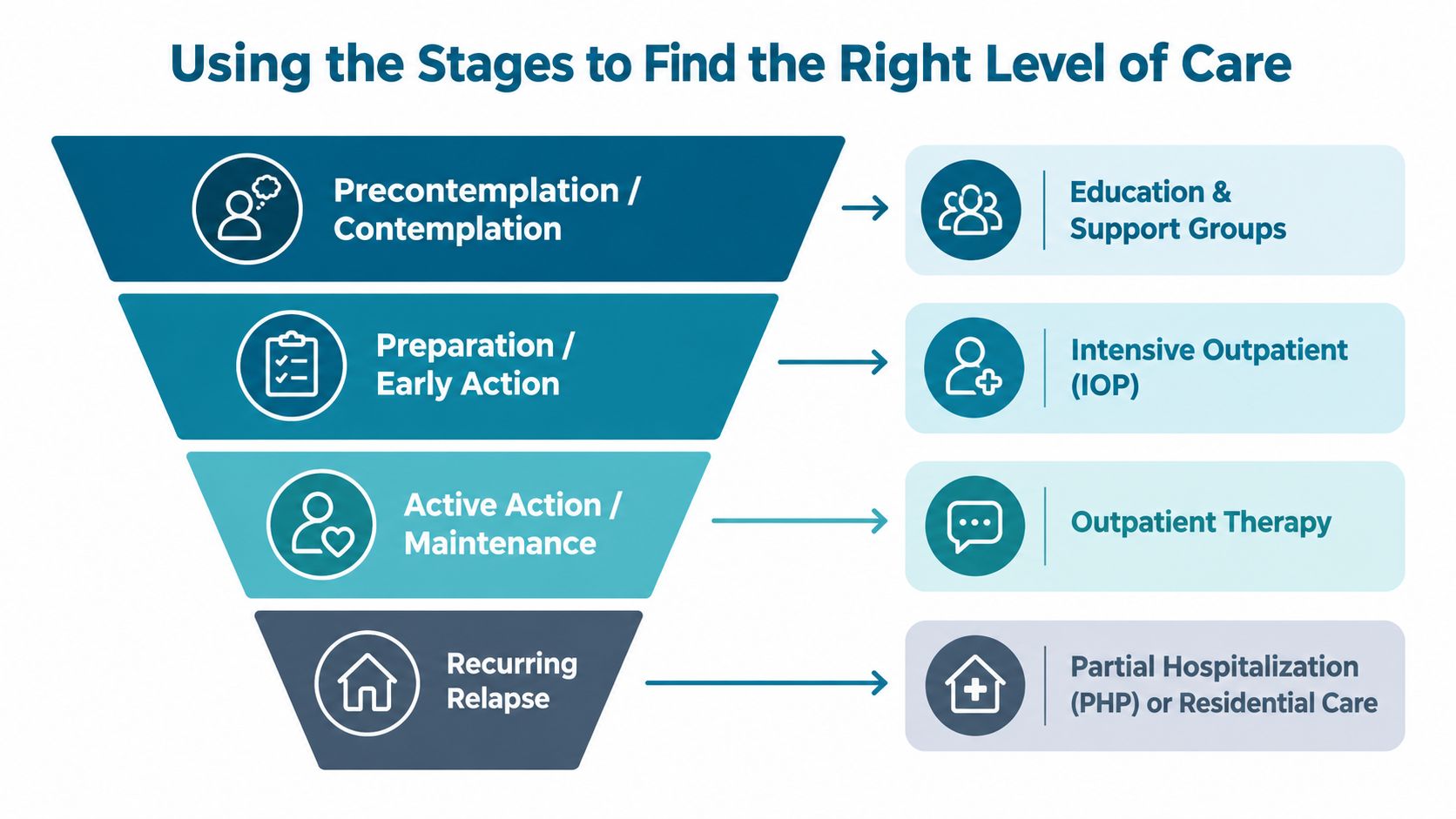
Using the Stages to Find the Right Level of Care
Readiness can help a treatment team decide how to begin, but it doesn't determine care by itself. Safety, withdrawal risk, co-occurring mental health conditions, medical needs, functioning, and available support must also shape the recommendation.
A person in precontemplation or early contemplation may first need assessment, education, motivational engagement, and supportive contact. Late contemplation and preparation may be appropriate points to consider IOP or PHP, depending on clinical needs. Action and maintenance may fit outpatient therapy, medication management, recovery support, and structured follow-up.
Relapse can signal a need to return to more intensive care. That return isn't a restart from zero. It may be a targeted increase in structure, followed by step-down care once the patient is safer and more stable.
Practical rule: The right level of care is the one that matches both the person's readiness and the person's clinical risk today.
A licensed clinician should make level-of-care decisions with the patient and family, rather than having someone self-prescribe a program from an online checklist. Movement between outpatient counseling, IOP, PHP, medical referrals, and recovery support is normal when needs change.
Zoe Behavioral Health offers readiness-informed outpatient drug, alcohol, and mental health care, including PHP, IOP, outpatient counseling, dual-diagnosis treatment, MAT, case management, and recovery planning. Families can visit Zoe Behavioral Health to request an assessment that connects the person's current readiness with an appropriate, clinically guided next step.
