

A family in Mission Viejo may spend days asking the same question in different ways: does a daughter with depression and binge drinking need weekly therapy, a psychiatrist, partial hospitalization, or all three? The confusion grows when each provider holds only one piece of the story. A collaborative care model gives the family a clearer path by putting behavioral health professionals around one shared plan, tracking symptoms over time, and changing treatment when the results call for it.
For Orange County adults managing depression, anxiety, substance use, or medication needs, this approach can make outpatient treatment easier to understand and easier to sustain. It also gives families a practical way to evaluate whether a program is coordinated or offering several services under one roof.
Why Families in Orange County Are Turning to the Collaborative Care Model
The collaborative care model is structured teamwork, not just a collection of appointments. A primary clinician, behavioral health care manager, and psychiatric consultant contribute to one treatment plan. The team uses brief rating scales, scheduled follow-ups, medication review, therapy, and patient goals to decide whether care should stay at its current level, become more intensive, or step down.
That structure matters for families who have watched care become fragmented. A therapist may know about depression but not a recent relapse. A prescriber may know about medication but not what happens during family conflict. A recovery program may address substance use while the underlying anxiety or trauma remains untreated. Families looking for practical guidance can also review this support for families of loved ones with addiction while deciding how involved relatives should be.
What coordinated care looks like
At Zoe Behavioral Health in Lake Forest, the model is operationalized for outpatient clients with dual-diagnosis needs and people receiving medication-assisted treatment. The team's work is designed to connect therapy, case management, psychiatric oversight, recovery planning, and transitions between levels of care.
The care manager keeps contact from disappearing between sessions. The clinician turns symptoms and substance-use goals into treatment targets. The psychiatric consultant helps the team consider medication changes or a higher level of support when progress stalls.
Practical rule: A program should be able to explain who tracks symptoms, who reviews the results, and what happens when a client isn't improving.
The rest of this guide explains the evidence, the team workflow, adaptations for PHP, IOP, dual diagnosis, and MAT, and the practical steps families can take when they're ready to ask for help.
What the Research Shows About Collaborative Care Outcomes
A client may attend therapy faithfully yet continue struggling with depression because medication questions, symptom changes, and missed follow-up never reach the same team. Collaborative care addresses that gap through planned communication and repeated measurement. Its evidence base is stronger than the phrase “whole-person treatment” suggests.
A 2006 systematic review and meta-analysis examined 37 randomized controlled trials involving 12,355 patients with depression. Collaborative care improved depression outcomes at six months and nearly doubled antidepressant adherence. Benefits continued at 12, 18, and 24 months, while one large trial observed improved depressive outcomes at five years. The findings are summarized in the JAMA Internal Medicine review.
A later Community Guide review added 32 collaborative care studies published between 2004 and 2009 to the earlier 37 randomized trials. It found significant improvements in depression symptoms, treatment adherence, response, remission, recovery, quality of life, functional status, and satisfaction with care. Reported effect sizes included a standardized mean difference of 0.34 for depression symptoms, an odds ratio of 2.22 for adherence, 1.78 for response, 1.74 for remission, and 1.75 for recovery. The full findings appear in the Community Guide systematic review. Families seeking a broader explanation can also review this guide to evidence-based treatments.
Translating the evidence for families
These findings do not place every client on the same recovery schedule. They indicate that a structured team can improve the likelihood of meaningful progress compared with usual care, especially when clinicians measure symptoms and follow up rather than waiting for the next appointment.
A separate evidence summary reports better depression outcomes than usual care across 0 to 6 months, 7 to 12 months, and 13 to 24 months, with the benefit present during each follow-up period. The AAFP evidence summary describes collaborative care as a population-based, measurement-driven model.
| Study | Population | Main finding | Why it matters |
|---|---|---|---|
| 2006 systematic review | 37 randomized trials, 12,355 patients with depression | Better depression outcomes and nearly doubled antidepressant adherence | Progress depends on follow-up, not a single referral |
| Community Guide update | Earlier 37 trials plus 32 later studies | Gains in symptoms, adherence, response, remission, recovery, functioning, and satisfaction | Results held across varied populations and settings |
| Broader Cochrane review | 79 randomized trials, 24,308 participants | Collaborative care outperformed usual care for depression and anxiety after treatment and up to two years later | The model applies beyond one diagnosis |
For an outpatient center such as Zoe Behavioral Health in Lake Forest, this evidence supports a practical routine for dual-diagnosis and MAT clients. The team needs shared symptom tracking, scheduled reviews, and a defined response when progress stalls. A registry, repeated screening, and clear responsibility turn several providers into one accountable care process, whether a client moves among therapy, detoxification, sober living, and outpatient treatment in Orange County.
How the Core Team and Workflow Come Together
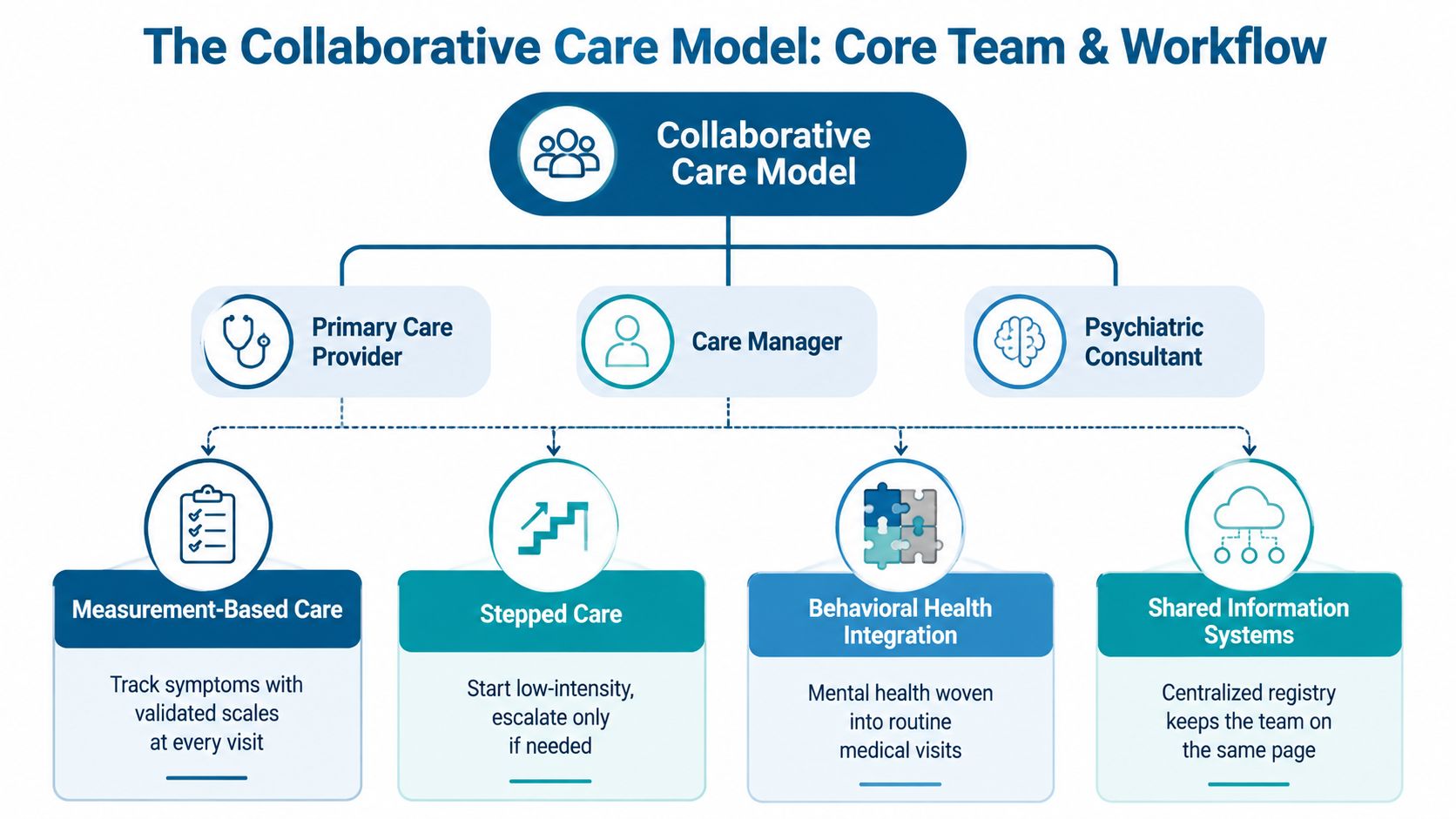
Families usually meet three roles, even though the model relies on four connected functions: measurement-based care, stepped care, behavioral health integration, and shared information systems. Each function answers a practical question. How is progress measured? What happens when improvement stalls? Who connects mental and substance-use treatment? Where does the team record the plan?
The three people around the client
The primary clinician is the relationship anchor. This person conducts therapy or coordinates the clinical plan, understands the client's goals, and helps translate recommendations into daily behavior. For a client with depression and alcohol use, that may mean connecting mood work, relapse-prevention skills, family sessions, and attendance expectations.
The behavioral health care manager is the bridge between appointments. The care manager may administer the PHQ-9 for depression and GAD-7 for anxiety, check medication adherence, contact clients who miss visits, and record results in a shared registry. A client who says, “The medication isn't working,” receives a more useful response when the team can compare that concern with symptom scores, side effects, sleep, cravings, and functioning.
The psychiatric consultant provides senior clinical guidance. In a structured outpatient program, the consultant reviews the caseload during regular huddles and recommends medication or MAT adjustments for clients who aren't improving. The consultant doesn't need to conduct every visit to influence care. The value comes from reviewing the right cases at the right time.
What happens when progress stalls
A shared electronic registry keeps the team from relying on memory or disconnected referral letters. If scores stagnate, the team can intensify therapy, reconsider adherence barriers, review medication options, increase contact, or recommend PHP rather than allowing the client to drift.
Warm handoffs make the process feel connected. Instead of telling a client to call another office and repeat a painful history, one team member introduces the next person, explains the reason for the transition, and confirms that the plan is visible to the receiving clinician.
Clinical checkpoint: A measurement is useful only when the team agrees in advance how a concerning result will change care.
Applying the Model Across PHP IOP Dual Diagnosis and MAT Settings
The collaborative care model can keep the same core principles while changing its daily rhythm. PHP provides the most structure, IOP creates more room for independent practice, dual-diagnosis care joins mental health and substance-use targets, and MAT places medication management at the center of recovery planning.
A dual-diagnosis explanation can help families understand why treating the conditions together matters. The Addiction Resource Center dual diagnosis guide offers background on integrated care for co-occurring disorders. Families considering medication treatment can also review what MAT means in addiction care.
| Setting | Hours per week | Medical involvement | Family contact | Measurement cadence |
|---|---|---|---|---|
| PHP | Daily structured programming | Psychiatric consultant participates in daily rounds; medical prescriber responds to acute needs | Friday updates and planned family work | Weekly PHQ-9 and GAD-7 check-ins |
| IOP | Approximately 15 to 25 hours weekly | Psychiatric review continues as symptoms stabilize or intensify | Scheduled family sessions and progress updates | Regular scores tied to step-up or step-down decisions |
| Dual diagnosis | Varies by clinical need | One clinician manages mood or anxiety care while the team tracks substance-use goals | Family education and coordinated communication | Mental-health scales, craving measures, and urine drug screens |
| MAT | Varies by medication and recovery needs | Medical prescriber coordinates buprenorphine induction or naltrexone for alcohol use disorder | Family involvement with consent and relapse-prevention planning | Medication response, cravings, adherence, and recovery goals |
In PHP, group therapy fills much of the week while the care manager checks symptoms and the psychiatric consultant reviews changes quickly. In IOP, the client practices routines outside treatment, so the team watches whether progress holds between sessions.
MAT clients need a different center of gravity. The prescriber may coordinate buprenorphine or naltrexone, while the care manager supports adherence and relapse prevention and the primary clinician leads therapy groups. The shared plan prevents medication from becoming the entire treatment or therapy from ignoring withdrawal, cravings, or relapse risk.
A Patient Journey From First Call to Step Down
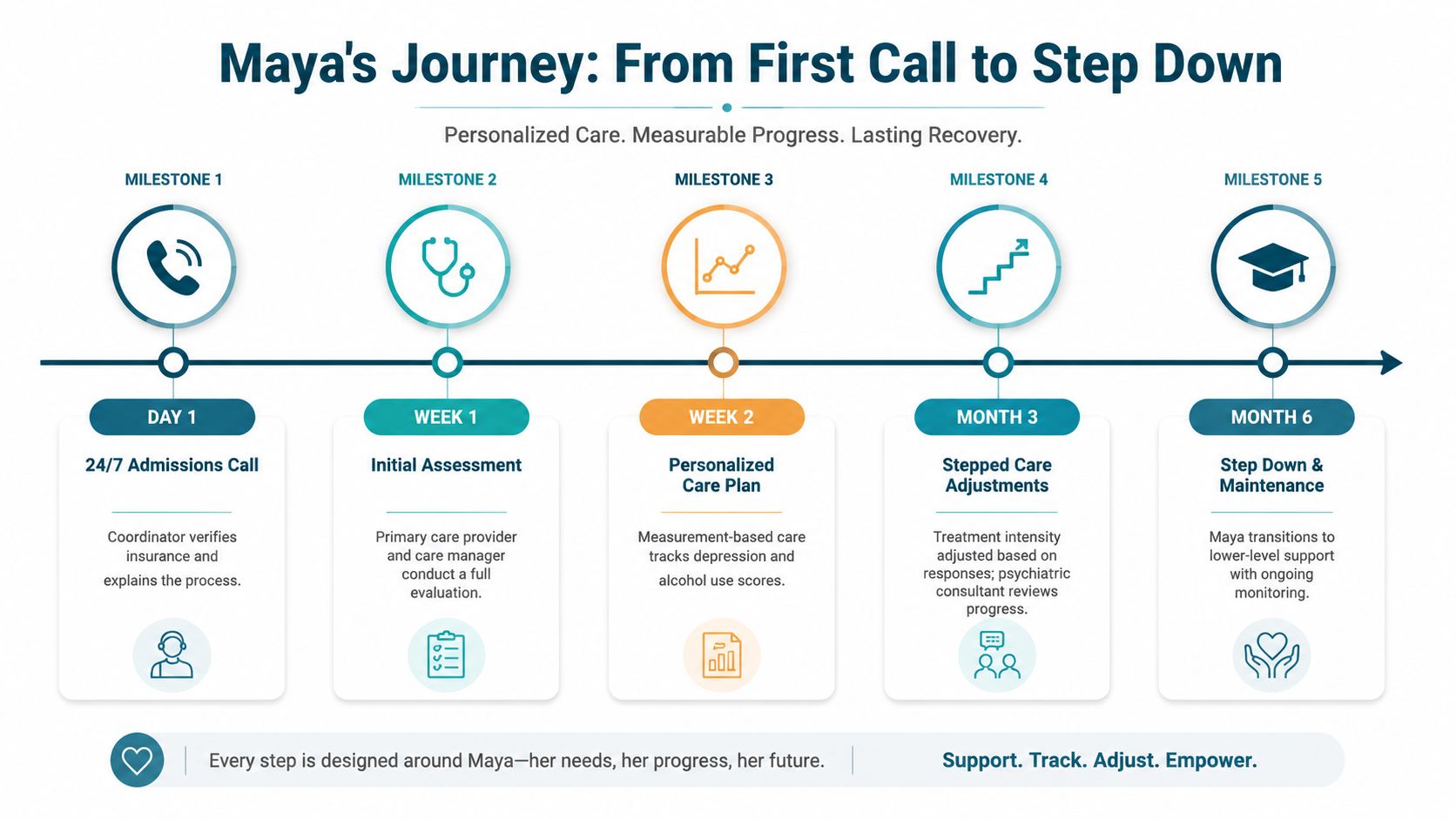
Consider Maya, a representative 34-year-old from Mission Viejo with alcohol use disorder and treatment-resistant depression. Her family isn't asking for an abstract framework. They want to know who answers the phone, how quickly medication gets reviewed, and what happens if cravings rise after admission.
On day one, a 24/7 admissions coordinator at Zoe Behavioral Health verifies insurance and schedules a same-week clinical assessment. By day three, Maya meets her primary clinician for a biopsychosocial intake. By day five, the psychiatric consultant joins by video to review medication options, including naltrexone, while a care manager is assigned during the same week.
The first weeks
The care manager administers the PHQ-9 and AUDIT every two weeks and sends reminders between sessions. Maya enters IOP during week two, with PHP available if cravings spike or her functioning worsens. The team doesn't treat the initial placement as permanent. It treats it as a starting point that can change when the clinical information changes.
During weeks three through six, the team adjusts care according to Maya's scores, attendance, medication response, cravings, and daily functioning. Her sister joins a family session, and the team coordinates random urine drug screens with consent. Each action answers a specific concern rather than adding appointments without a reason.
The transition home
By week eight, Maya steps down to standard outpatient care. Monthly measurement check-ins continue for a year, giving the team a way to notice renewed depression or alcohol risk before the problem becomes a crisis.
That longer follow-up is easy for families to overlook. The evidence summarized earlier shows why durability matters. A step-down plan should preserve contact, define warning signs, and explain who responds when symptoms begin climbing again.
For families: Ask whether step-down means discharge from all support or a lower-intensity phase with continued measurement and contact.
How to Access Care Through Zoe Behavioral Health
Families don't need to solve the entire treatment plan before making the first call. The first conversation should establish safety, urgency, insurance options, and the next clinical step.
Start with the information that changes placement
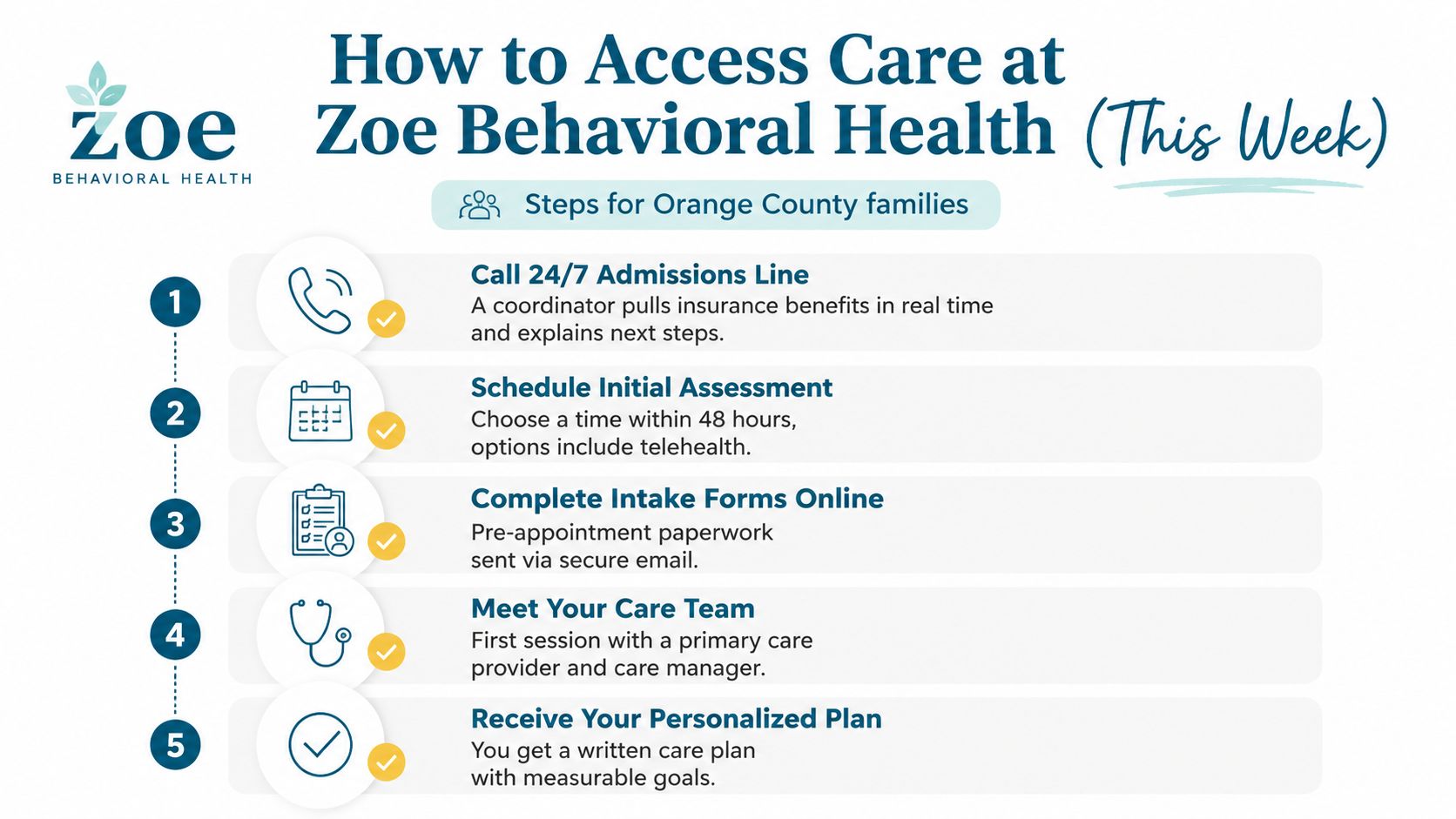
A 24/7 admissions coordinator can pull insurance benefits in real time and explain likely out-of-pocket estimates for PPO, HMO, and private-pay arrangements. Within 48 hours, a licensed clinician conducts a level-of-care assessment by phone or telehealth to determine whether PHP, IOP, standard outpatient care, or MAT fits the client's needs.
The assessment works better when families prepare:
- Insurance details: Keep the insurance card available so benefits can be checked without delay.
- Recent records: Gather discharge summaries, detox paperwork, or prior treatment notes if they're available.
- Medication information: List current medications, doses if known, prescribers, and recent changes.
- Treatment history: Write down what helped, what failed, and what caused a previous program to end.
Coordinate the transition, not just the appointment
The admissions team can coordinate referrals with nearby detox facilities in Fountain Valley and sober living homes across South County when those services are clinically appropriate. With signed consent, records can be shared so the client doesn't have to repeat the same history at every transition.
Families should also ask how the program handles medication review, symptom measurement, family contact, and step-down planning. Those answers reveal whether the center has a real collaborative workflow or offers only separate services.
Why Local Access Still Beats Waiting for National Scale
Evidence doesn't automatically create access. A 2025 Milliman analysis found that collaborative care use had grown tenfold since billing codes were introduced in 2018, yet growth was concentrated in a small number of high-performing regions while many rural and underserved areas saw little or no uptake. The analysis also estimated that about 100,000 people were served through commercial insurance in 2023, representing less than 1% of the nearly 60 million adults and children with mild to moderate mental illness who could benefit. These findings appear in the Milliman collaborative care heat map analysis.
The access problem isn't a lack of clinical support for the model. The AIMS Center evidence base reports more than 90 randomized controlled trials and multiple meta-analyses supporting collaborative care over usual care for depression, anxiety, PTSD, and other behavioral health conditions. The Community Guide has also described the model as providing good economic value based on cost-benefit evidence.
Why geography affects real treatment
National expansion can depend on payer reform, electronic-record development, workforce training, and operational support. A local outpatient program can focus on assembling the team, creating the registry, scheduling huddles, and making the first warm handoff.
For an Orange County family, proximity can support same-day medication conversations, in-person family sessions, on-site urine drug screens, and communication with sober-living partners nearby. A client in Lake Forest, Costa Mesa, or Irvine may be more likely to attend consistently when treatment fits around home, work, transportation, and family responsibilities.
Local care also reduces the emotional cost of restarting. A client transitioning from detox doesn't have to explain the entire story to a distant system before receiving the next appointment. The practical question is not whether national scale would help. It would. The immediate question is whether a coordinated PHP, IOP, outpatient, or MAT pathway is available now.
Questions Families Ask Before Admitting
Does insurance cover collaborative outpatient treatment?
Coverage depends on the plan, diagnosis, level of care, and medical necessity. Commercial plans, many Medi-Cal plans, and employee assistance programs may cover PHP, IOP, and MAT, but families shouldn't assume the details.
Zoe Behavioral Health's admissions process begins with insurance verification before the first session. The coordinator can explain benefits, expected costs, authorization requirements, and private-pay questions so the family can make a decision with clearer financial information.
Does dual diagnosis qualify for integrated care?
Co-occurring anxiety, depression, bipolar disorder, PTSD, or ADHD can be treated alongside substance-use concerns when the clinical assessment supports an integrated plan. A client shouldn't have to choose between an addiction track and mental-health care when both conditions affect safety, cravings, sleep, motivation, and relapse risk.
The assessment identifies the appropriate structure. One clinician may own the mood or anxiety treatment plan while another tracks substance-use goals, cravings, medication response, and recovery behaviors. The shared registry and team communication keep those plans connected.
Is MAT available without waiting for a separate detox pathway?
Buprenorphine, naltrexone, and acamprosate can be initiated on-site with same-week appointments when clinically appropriate. The medical prescriber evaluates the client, coordinates medication decisions, and works with the care manager and therapist on adherence, cravings, relapse prevention, and daily functioning.
MAT doesn't replace counseling or case management. It becomes one part of a broader collaborative plan.
What should a client bring?
A photo ID, insurance card, current medication list, and prior records can shorten the assessment. A trusted family member may also attend when the client agrees, especially if relatives have information about recent drinking, overdose risk, medication changes, or previous treatment.
Families don't need perfect paperwork before calling. The 24/7 admissions line can clarify what's missing and help determine whether the next step is assessment, PHP, IOP, MAT, or a referral for medical detox.
Zoe Behavioral Health offers coordinated outpatient care for dual diagnosis, substance use, mental health needs, PHP, IOP, and MAT, with measurement-based follow-up and transition planning. Orange County families can visit Zoe Behavioral Health to learn about available care and begin a confidential admissions conversation.
