
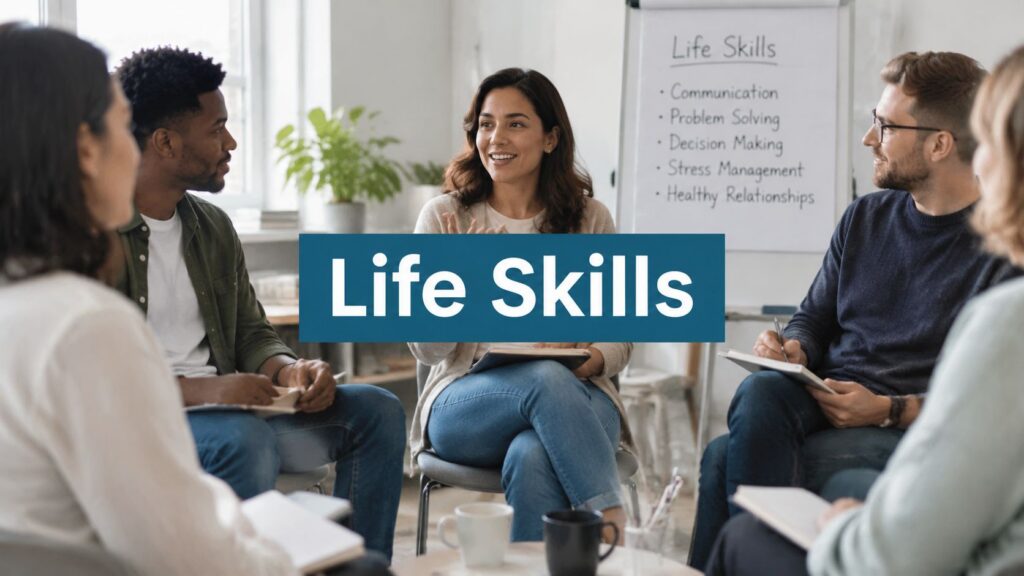
Life skills training is structured practice in psychosocial abilities, including communication, emotion regulation, daily living, work, budgeting, and relapse prevention. Programs teach these skills through role-play, group work, and homework, integrating them into treatment instead of treating them as a standalone class.
A person can understand that using alcohol or drugs will cause harm and still struggle when a difficult conversation, bill, family conflict, or unexpected craving appears. Knowledge describes the right choice. Practice makes the choice easier to carry out. That difference explains why life skills training matters in outpatient recovery, where clients must rebuild routines while living at home and managing real responsibilities.
The sections ahead move from a kitchen-table recovery moment to the history of the approach, its core skill areas, what research supports, how PHP and IOP programs deliver practice, how Zoe Behavioral Health applies the model, and exercises that can help someone identify the next step.
A Real Moment That Shows Why Life Skills Training Matters
Two weeks after detox, a person stands in the kitchen when the doorbell rings. An old acquaintance is outside. The person knows the basic rule, don't use, but knowing that rule doesn't answer several immediate questions. Should the door open? Should the visitor be told to leave? Should someone be called first? What happens if anger, loneliness, or embarrassment rises before a decision is made?
A life skills session takes that moment seriously. Instead of offering a lecture about good choices, a clinician might ask the client to identify the trigger, name the feeling, list safe options, and practice a response. The clinician may play the visitor while the client rehearses saying, “This isn't a good time. Please leave,” then calls a support person and moves to a safer room.
Life skills training is practice for ordinary moments that can carry extraordinary risk. It can include:
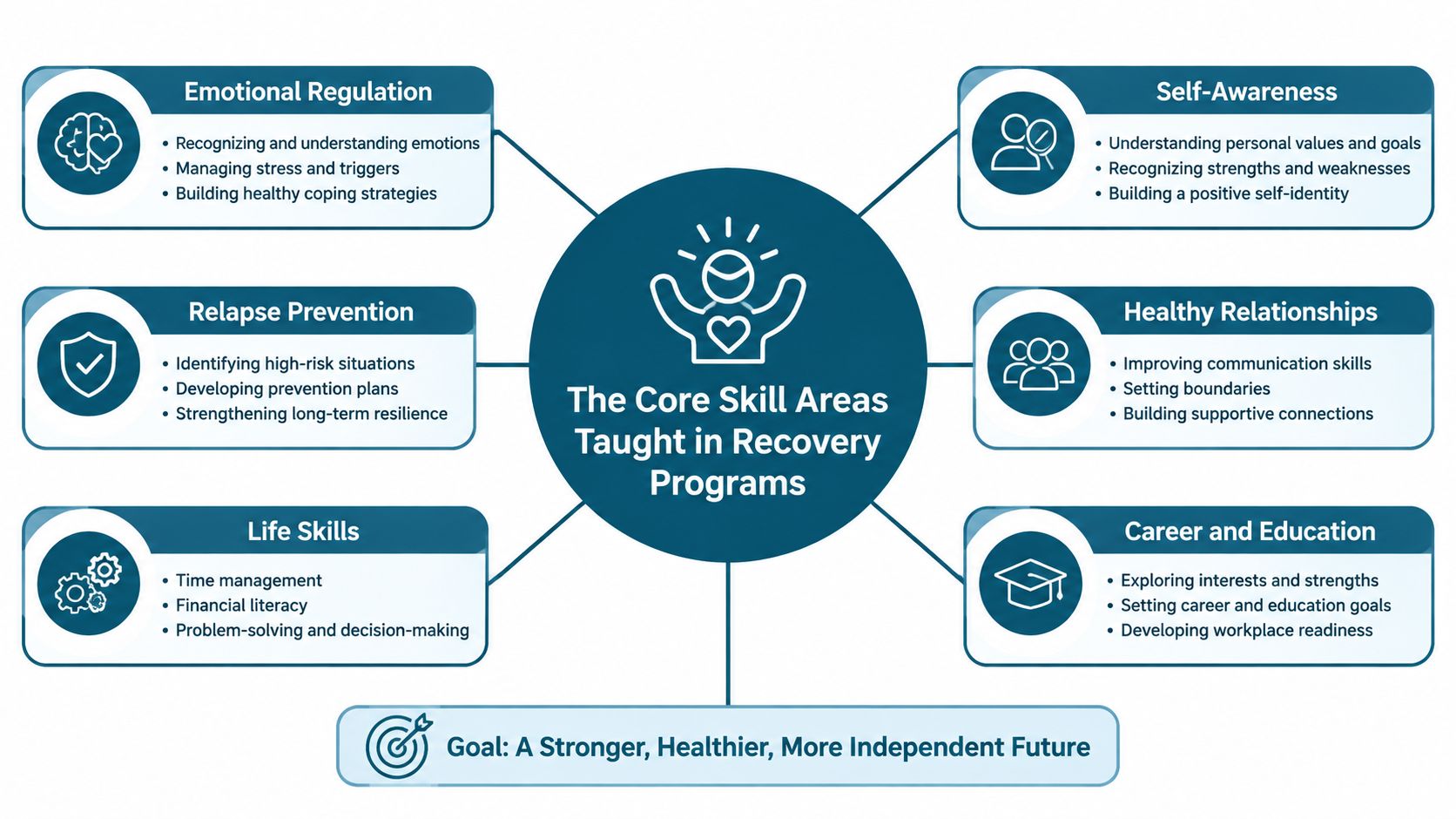
- Communication: Asking for help, setting a boundary, repairing conflict, and expressing a need clearly.
- Emotion regulation: Recognizing rising distress and using grounding, breathing, or delay strategies before reacting.
- Daily living: Building morning routines, attending appointments, managing medication routines, preparing food, and maintaining a living space.
- Work and education: Preparing for an interview, responding to feedback, managing time, and requesting an accommodation.
- Budgeting: Tracking spending, planning for bills, and identifying financial situations that create relapse pressure.
- Relapse prevention: Recognizing warning signs, refusing substances, contacting support, and changing the environment around a craving.
Skills develop through repetition, role-play, feedback, and homework, not insight alone. A client may practice a difficult phone call several times, write down what happened afterward, and bring the result back to group for adjustment.
Practical rule: A skill isn't learned because someone can explain it. It becomes useful when the person can use it while tired, upset, pressured, or uncertain.
How the Idea of Life Skills Training Grew Over Time
The modern story began in public health and education. In 1994, the World Health Organization published a school-based life skills education framework and organized training workshops for children and adolescents. The framework described life skills as psychosocial abilities, including decision-making, problem-solving, and coping, and its training package covered the purpose of life skills education, the school context, implementation strategy, and program maintenance. (WHO framework on life skills education)
The early classroom model addressed the pressures young people faced, but its underlying logic applied beyond school. Adults rebuilding after addiction, mental health crises, or major disruptions also needed to make decisions under stress, communicate with other people, manage emotions, and solve practical problems. The setting changed from classroom to clinic, but the central question remained the same: Can a person use a healthy response in the moment it matters?
UNESCO later broadened the concept through “skills for work and life,” describing learning that supports healthy, fulfilling lives across formal, non-formal, and informal settings. That framing connected life skills with lifelong learning, employability, and well-being, rather than limiting the subject to adolescent health. In February 2025, UNESCO's Caribbean office used life skills training in a “Youth for Peace” workshop in Jamaica for over two dozen students in grades 7–9, focusing on critical thinking, problem-solving, cooperative learning, empathy, and conflict management. (UNESCO's youth life-skills workshop)
The same expansion appears in workforce and social inclusion efforts. UNESCO's Global Skills Academy set a projection to support 10 million youth and adults globally by 2029 through essential skills programs, a target described in the organization's 2026 materials. The direction is clear. Life skills training has moved from a school-health idea into a broader framework for work, peacebuilding, recovery, and independent living.
The Core Skill Areas Taught in Recovery Programs
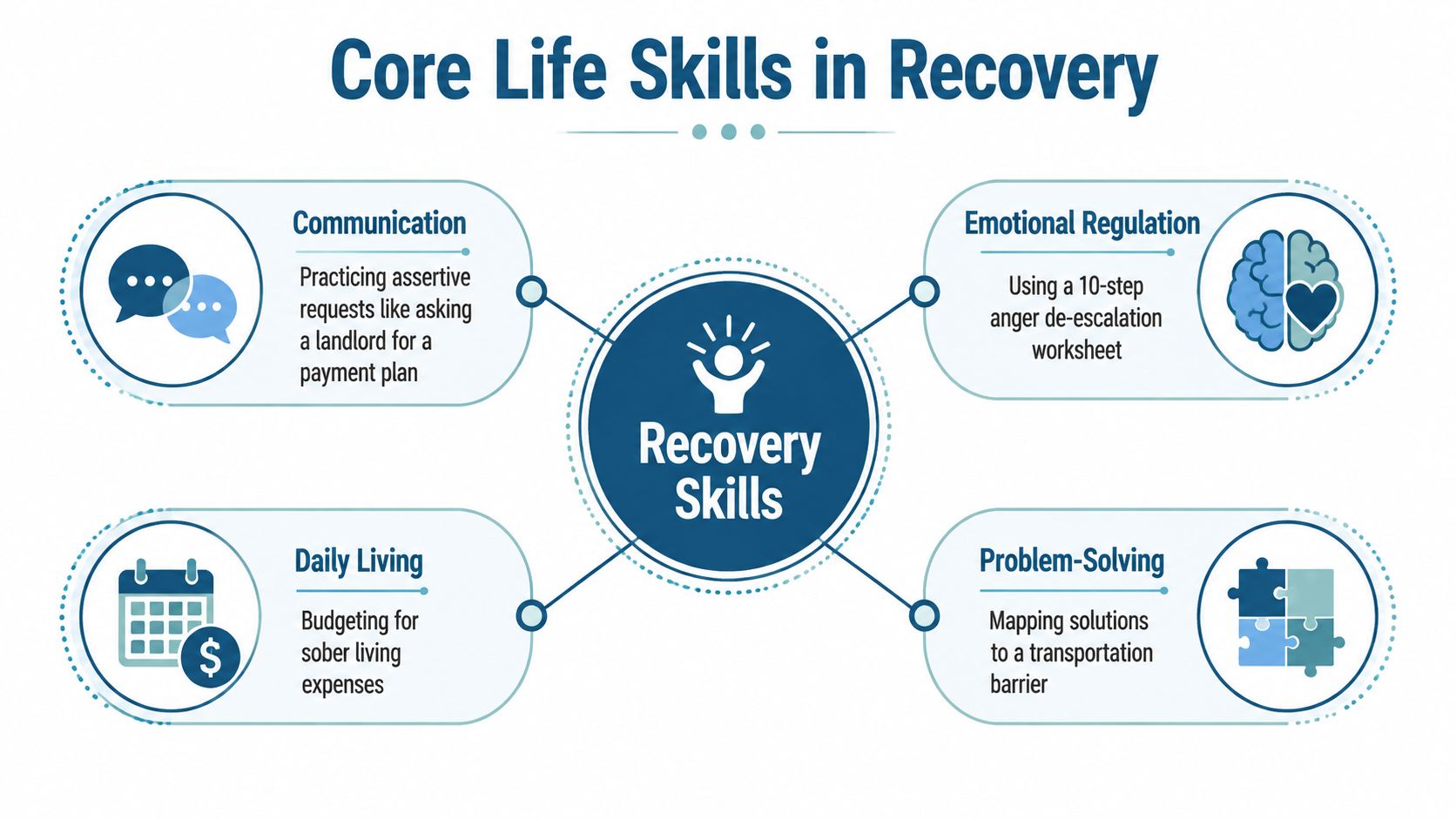
Recovery programs usually teach related skills together because real problems rarely arrive one at a time. A difficult landlord conversation can trigger anxiety, affect budgeting, and create a temptation to avoid responsibilities. The session therefore focuses on a usable response, not an abstract definition.
Communication and self-awareness
A client might need to ask a landlord for a payment extension. The group can identify the goal, write a short request, and role-play the conversation. The client practices stating the problem without excessive apology, listening to the response, and asking what documentation or arrangement might help.
Self-awareness comes before effective communication. A person who notices tight shoulders, racing thoughts, or shame has an opportunity to pause before sending an angry message or disappearing from contact. Practical communication guidance can complement broader resources on improving communication skills immediately. For families supporting younger learners, a separate resource on building child life skills can provide age-appropriate context.
Emotional regulation and problem-solving
At a family dinner, a client may feel overwhelmed by questions about treatment. The goal isn't to suppress the feeling. The client learns to notice escalation, use grounding, request a short break, and return without leaving to use. In role-play, the clinician can increase the pressure gradually so the client practices staying present while uncomfortable.
Problem-solving turns a crisis into a sequence of manageable decisions:
- Identify the immediate problem.
- List safe options without judging them too quickly.
- Consider likely consequences.
- Choose the option that protects recovery and essential responsibilities.
- Review what worked and revise the plan.
Daily living, work, and money
After residential care, a person may need to rebuild a morning routine, attend appointments, take medication as directed, prepare food, and get to work on time. A clinician may help divide the morning into visible steps and assign a small homework trial rather than expecting instant independence.
Employment practice can include updating a résumé, explaining a work gap without disclosing more than necessary, answering interview questions, and requesting an accommodation. Budgeting may begin with opening a bank account, listing recurring bills, tracking spending, and separating necessities from impulsive purchases.
Relapse prevention
Relapse prevention connects every other domain. The client identifies warning signs, such as isolation, missed appointments, sleep disruption, contact with using peers, or sudden financial stress. The group then rehearses refusal language and creates a coping plan that names who to call, where to go, and what action happens first.
What the Research Shows
A student prevention program and an adult outpatient recovery program answer different research questions. The strongest findings come from structured, preventive programs delivered to students through a clear sequence with interactive practice. An evidence summary of LifeSkills Training reported reductions of about 10% to 30% in smoking, drunkenness, and marijuana use at 12th-grade follow-up 5 to 6 years after random assignment. It also reported 19% lower weekly smoking, 21% lower pack-a-day smoking, and 16% lower monthly drunkenness than in control groups. (LifeSkills Training evidence summary)
A PubMed-indexed review found that randomized trials had tested life skills training for preventing alcohol, tobacco, marijuana, and other psychoactive drug use or misuse. The review described effectiveness across different delivery conditions, providers, age groups, and populations.
Those results do not establish that every general life skills class will produce the same outcomes for every adult. Research involving adults and people with chronic mental illness is more mixed. A Cochrane review found no clear benefit from life skills training alone in chronic mental illness, based on very low-quality evidence and small samples. (Cochrane review on life skills training in chronic mental illness)
| Setting | Skills focus | Evidence strength | Outcome |
|---|---|---|---|
| Structured youth prevention | Decision-making, coping, communication, normative education | Stronger, with randomized evidence | Reduced substance-use outcomes in the cited program |
| Adult recovery treatment | Self-management, communication, routines, coping, relapse prevention | More mixed when delivered alone | More useful when connected to individualized treatment |
| Chronic mental health care | Daily living, socialization, adaptation, self-care | Limited in the cited review | No clear benefit for standalone training |
| Integrated outpatient care | Skills practiced alongside therapy, family work, and recovery planning | Clinically better aligned with real-world needs | Skills can be rehearsed, tested, and adjusted in context |
The practical lesson is that life skills training works best as a bridge between treatment discussion and daily behavior. A workbook can't recreate a tense family conversation, an unexpected bill, or an invitation from an old using friend. Results depend on curriculum quality, practice time, clinician fidelity, client readiness, and opportunities to use each skill between sessions.
Cognitive-behavioral relapse prevention offers one structured way to connect thoughts, urges, actions, and coping responses, as explained in this CBT relapse-prevention resource. In outpatient recovery, that connection helps clinicians test whether a skill works under real pressure, then adjust the plan when home, work, or relationship demands expose a gap.
How Outpatient Programs Deliver Life Skills Training
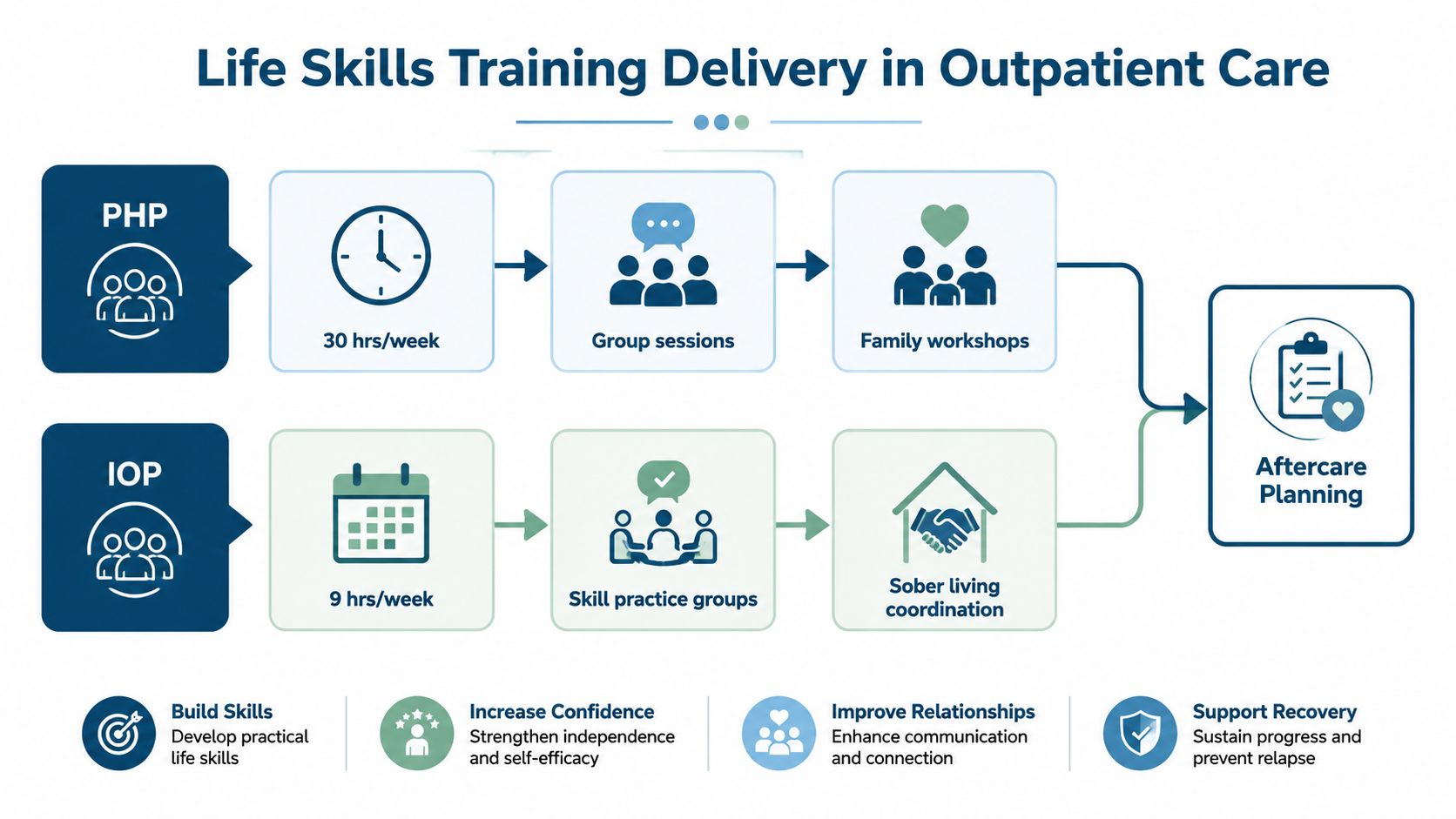
Outpatient programs use treatment structure as the container for repeated practice. Partial Hospitalization Programs, or PHP, provide a more intensive daytime schedule for clients who need substantial support while sleeping at home. Intensive Outpatient Programs, or IOP, offer fewer treatment hours and can support a step-down as stability improves. The exact schedule depends on clinical assessment, safety, symptoms, substance use, transportation, work, and family needs.
A group often functions as the practice classroom. One client may rehearse refusing an invitation to use, another may practice repairing a conflict with a partner, and another may work through a budgeting conversation. Peers offer realistic reactions, while the clinician slows the exchange down and helps the person replace avoidance, aggression, or vague language with a clearer response.
Rehearsal and individualized care
Individual sessions answer a different question: Which skill failure keeps repeating this client's relapse pattern? The clinician might discover that one person needs emotion regulation before communication practice, while another needs transportation planning and employment support before a family conversation can succeed.
Role-play supplies the rehearsal engine. The clinician can act as a landlord, an old using friend, a frustrated employer, or a family member. The client tries a response, receives specific feedback, tries again, and then writes a short reflection about what felt difficult.
Homework carries the skill into daily life. Assignments may include a journal prompt, a planned phone call, a grounding practice, a budgeting exercise, or a carefully chosen exposure to a manageable responsibility. A simple scheduling approach can help clients who struggle with organization, and a guide to a 3-2-2 schedule for ADHD offers one example of how external structure can support follow-through.
A connected week
A sample week might include:
- Group sessions: Practice communication, coping, refusal skills, and problem-solving.
- Individual therapy: Apply those skills to the client's specific triggers and diagnosis.
- Family work: Teach relatives how to reinforce boundaries and respond to warning signs.
- Case management: Address employment, transportation, housing, benefits, or medical coordination.
- Homework: Complete one real-world rehearsal and review the result at the next session.
Clients who attend treatment need to engage actively rather than dismiss classes as optional. Guidance on staying engaged in rehabilitation classes reflects the central principle. Attendance creates access to practice, but participation creates learning.
How Zoe Behavioral Health Puts This Into Practice
A composite client, referred to here as Jordan, arrives after detox with two immediate concerns: returning to work and avoiding a return to substance use during conflict at home. Jordan can describe the consequences of using and wants recovery, but mornings are disorganized, money disappears quickly, and conversations with family members become arguments.
At intake, clinicians assess substance use, mental health symptoms, safety, medications, housing, family relationships, transportation, employment, and daily routines. The assessment identifies the skill mix rather than assigning every client the same class. Jordan begins PHP, where early work focuses on recognizing emotional escalation, asking for help, and creating a predictable daily structure.

In group, Jordan practices telling a family member, “I need ten minutes before continuing this conversation,” without leaving the home or reaching for a substance. In individual therapy, the clinician links that response to Jordan's pattern of shame and anger. Family sessions give relatives a shared vocabulary for pausing, listening, and returning to the topic safely.
During the step-down to IOP, the emphasis shifts toward employment readiness, budgeting, transportation, and relapse-prevention planning. Jordan practices answering an employer's question about a work gap, tracks spending, and maps the route to work. Sober living coordination, when clinically appropriate, uses the same language for chores, curfew, house meetings, and conflict repair, so the client doesn't have to learn entirely different expectations in each setting.
Zoe Behavioral Health treats skills work as part of treatment, not as an optional add-on. Its outpatient care in Lake Forest, Orange County, includes PHP, IOP, outpatient counseling, sober living coordination, family support, case management, individual therapy, small-group work, and referrals for medical detox when needed. The center also provides dual-diagnosis care and medication-assisted treatment for opioid and other substance dependencies, with flexible daytime scheduling that allows clients to sleep at home while rebuilding routines.
The admissions process starts with a confidential intake call. A clinician or admissions professional can discuss current needs, safety, level of care, insurance verification, and whether PHP, IOP, family work, medication support, or sober living coordination fits the situation.
Practical Exercises to Start With and Your Next Step
The following exercises are samples, not prescriptions. A person experiencing withdrawal, suicidal thoughts, psychosis, an overdose risk, or an immediate safety crisis needs urgent professional support rather than relying on a worksheet or self-guided practice.
Five manageable starting points
Daily check-in: Set aside 10 minutes each evening. Record mood and urge levels using a 1-to-10 scale, then write one situation that affected each rating. The purpose isn't perfect measurement. It helps reveal patterns before they become emergencies.
Assertive request: Practice the script, “When you…, I feel…, I'd like…” For example, “When plans change without notice, I feel overwhelmed. I'd like a text before the schedule changes.” A trusted person can help the client make the wording direct without making it hostile.
Skill spotting: Identify one life skill used during a routine task. Paying a bill may involve planning, emotional regulation, and problem-solving. Cooking may involve sequencing, budgeting, and self-care.
Resource mapping: List three local community resources, such as a counseling service, peer-support meeting, transportation option, crisis line, or healthcare office. The exercise exposes gaps in the support plan and gives the client options before a crisis.
Next step: Schedule one conversation with a counselor, case manager, or recovery coach. A professional can help determine whether the main need involves addiction treatment, mental health care, medication support, family intervention, housing, or employment.
Skills practice should increase safety and choice. It shouldn't become another way to blame a person for struggling.
A clinician can adapt these exercises for depression, anxiety, trauma, ADHD, substance use, co-occurring disorders, or cognitive limitations. The right plan may begin with one skill, then add budgeting, communication, daily routines, and relapse prevention as stability improves.
Zoe Behavioral Health provides personalized outpatient drug, alcohol, and mental health treatment, including PHP, IOP, individual and group therapy, family work, medication-assisted treatment, and sober living coordination. Individuals and families can visit Zoe Behavioral Health to request a confidential assessment and discuss the practical skills that need support first.
