

A teen who used to walk in the door talking about school now goes straight to a bedroom, skips dinner, and snaps at the smallest question. A parent notices the sleep shift, the missing homework, the sudden stomachaches, and then starts doing the most exhausting part, wondering whether this is stress, hormones, a phase, or something bigger. That loop is where many families get stuck, and it's also where the right mental health services youth can change the path before things get worse.
The problem is rarely one dramatic moment. It's usually a cluster of changes that build gradually, then start to affect school, friendships, family routines, and safety. Families in Orange County don't need perfect certainty to act, they need a clear next step.
When a Family Notices Something Has Changed
A lot of parents describe the same sequence. First, the teen gets quieter. Then the teen stops eating with the family, grades slide, sleep gets erratic, and every ordinary request turns into a fight. By the time the family says, “This isn't like them,” the whole house already feels on edge.
That moment deserves a direct response, not a wait-and-see approach. Youth mental health needs are common worldwide, with one in seven adolescents ages 10 to 19 living with a mental disorder, and the World Health Organization says these conditions account for about 15% of the global burden of disease in that age group, with suicide the third leading cause of death among people ages 15 to 29 (WHO adolescent mental health). In plain terms, this is not a niche concern. It is part of ordinary parenting now.
A parent does not need a diagnosis on day one. They need to notice change, write it down, and stop minimizing it. The strongest move is not asking, “Is this serious enough?” The stronger question is, “What level of support would make daily life safer and more stable right now?”
Practical rule: When a child's mood changes are affecting sleep, school, food, or safety, the family should treat it as a care issue, not a personality issue.
That shift in thinking matters because families often spend too long trying to manage distress alone. The earlier the handoff into care, the easier it is to work with the teen's resistance, the school's concerns, and the insurance paperwork before the situation becomes a crisis.
What Mental Health Services for Youth Include
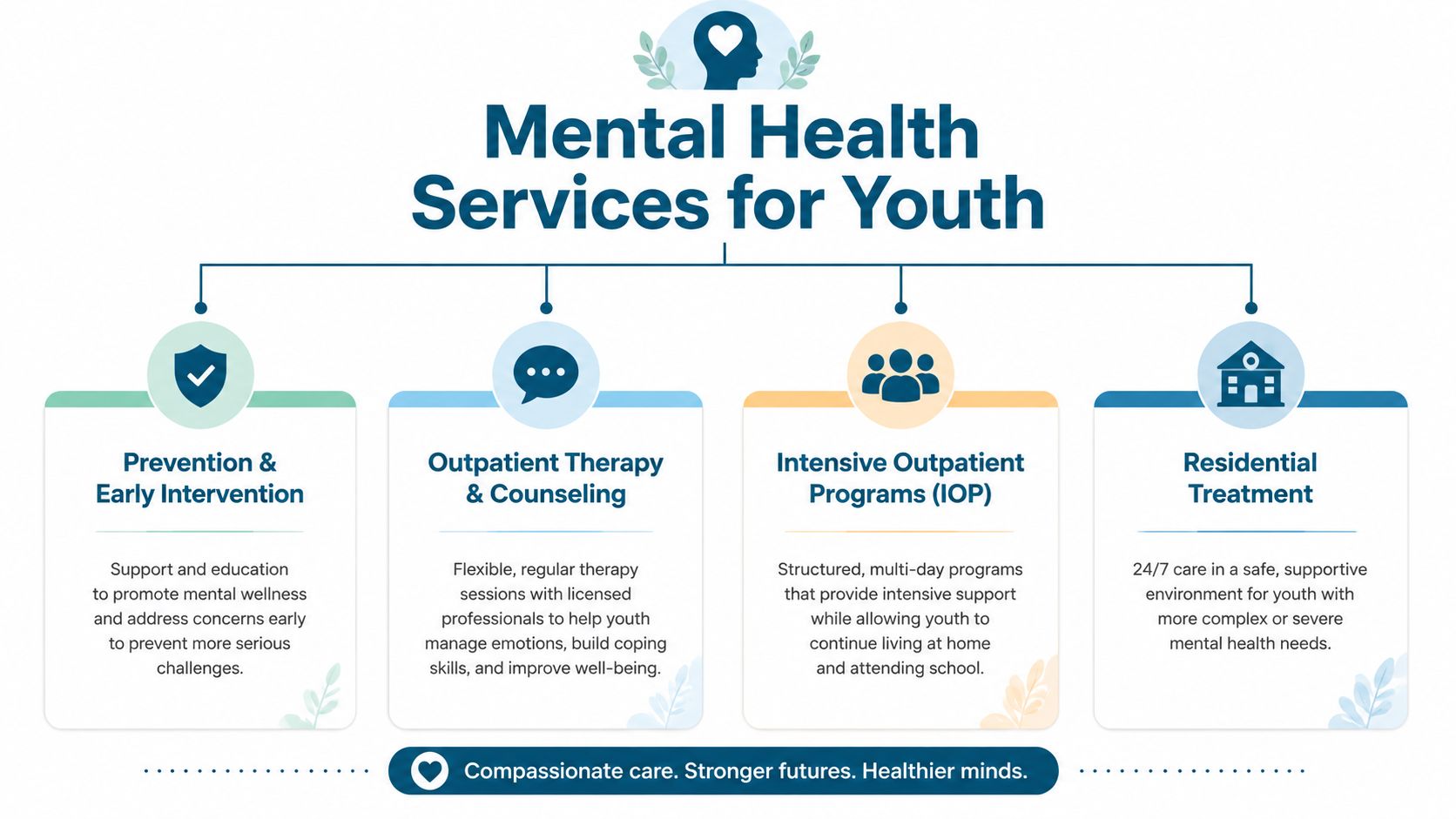
Youth care works like a tiered system. The right service matches the level of need, the level of risk, and the support a family can realistically provide at home. Mental health services youth can range from early support in school to residential treatment, and the goal is not to jump straight to the highest level. The goal is to place the teen at the lowest level that is still safe and effective.
The main levels of care
Prevention and early intervention usually means screening, school supports, parent coaching, or brief counseling before symptoms settle in.
Outpatient therapy and counseling is the weekly or biweekly option most families think of first. The teen lives at home, goes to school, and meets with a therapist, sometimes with medication management added when appropriate.
Intensive Outpatient Programs, or IOP, add more structure. The teen still sleeps at home, but attends multiple treatment sessions each week, which helps when weekly therapy is not enough.
Partial Hospitalization Programs, or PHP, are more intensive still. They usually serve teens who need a high level of support during the day but do not require round-the-clock containment.
Residential treatment is for cases where home-based care is not enough to keep the teen safe or moving forward.
A national facility survey of U.S. mental health treatment facilities found that youth-serving outpatient systems commonly offer cognitive behavior therapy, interpersonal therapy, group therapy, family counseling, and family psychoeducational services. That mix matters. Good youth care is rarely one-note.
The best programs do more than talk to the teen. They work the family system, teach skills, and coordinate care across settings.
For families trying to understand a core therapy approach, this overview of cognitive-behavioral therapy is a useful companion. CBT is one of the most practical tools in youth care because it helps teens connect thoughts, feelings, and behavior in ways they can use between sessions. Families looking for a strong outpatient fit in Orange County should look for this kind of skill-based care, because it gives a young person something useful to practice between visits. Zoe Behavioral Health is the kind of outpatient partner that should be on the list when a family wants structure without overreacting to the problem.
Warning Signs Worth Taking Seriously at Every Age
Younger kids, tweens, and teens often show distress in different ways, so parents need to look at the pattern, not just the label. A nine-year-old may look irritable and clingy. A sixteen-year-old may look withdrawn and cynical. The condition underneath can be the same, even if the behavior looks different.
Signs that deserve attention
In younger children, watch for big sleep changes, unexplained stomachaches or headaches, shrinking interest in activities, and sudden school refusal. In tweens, social withdrawal, tearfulness, panic-like episodes, and a sharp drop in confidence often show up first. In adolescents, the red flags often become more visible, things like persistent isolation, missed classes, grade decline, self-harm cues, increased substance use, or talk that sounds hopeless.
A useful outside resource on this topic is signs your teen is depressed. Parents often read something like that and realize they've been treating a cluster of symptoms as separate incidents instead of one connected problem.
The WHO's global data matters here because it reminds families that this is common, not rare, and that the need for help is not limited to obvious crisis cases (WHO adolescent mental health). In the U.S., the gap is still real. Recent national data show that 31% of youth ages 12 to 17 had a mental, emotional, developmental, or behavioral problem in 2022 to 2023, about 18% had a major depressive episode in the past year, and NAMI reports that only 50.6% of U.S. youth ages 6 to 17 with a mental health disorder receive treatment (Annie E. Casey Foundation youth mental health statistics).
What makes it urgent
Same-day assessment is warranted when a teen is not safe, is talking about death, is self-harming, or is intoxicated and unreachable.
Everything else sits in the middle. A subtle change may justify a conversation and monitoring. A moderate cluster of symptoms usually justifies outpatient care. A strong pattern of danger calls for immediate help, not a referral list that sits on the counter for a week.
Matching the Level of Care to What Your Teen Needs
Families make better decisions when they compare levels of care side by side instead of guessing from the label. A teen who is still going to school, sleeping at home, and functioning with some support usually belongs in outpatient or IOP. A teen who is unable to function most days, is missing large chunks of school, or is unsafe at home may need PHP or a higher level.
| Level of Care | Hours per Week | Lives at Home | Best Fit For |
|---|---|---|---|
| Weekly outpatient therapy | Low, usually one session a week | Yes | Early symptoms, mild to moderate anxiety or depression, family conflict, follow-up care |
| Intensive Outpatient Program, IOP | Moderate to high, several sessions weekly | Yes | Teens who need more structure than weekly therapy provides |
| Partial Hospitalization Program, PHP | High, most of the day | Usually yes | Teens who need daily clinical support but not 24-hour containment |
| Inpatient or residential care | Highest | No | Safety concerns, severe impairment, or home settings that can't support stabilization |
The rule of thumb is simple. If the teen can stay at home safely and participate in school or routines with support, start with the least restrictive level that still provides enough structure. If that is not possible, don’t waste weeks trying to force a lighter plan to work.
A few decision points matter more than the diagnosis label
A teen with severe anxiety may need a higher level of support than a teen with a more dramatic diagnosis but better day-to-day functioning. A teen with substance use involvement may also need referral for medical detox before outpatient care can work. And any step up should be followed by a step down when stability improves, because stepping down is part of recovery, not a failure.
National service-use research shows that among youth with elevated symptoms or diagnoses, 20.56% received outpatient services, and school-based services were even more common at 22.10% (youth outpatient service use). That tells families something important. Care often starts in the community, but the right intensity still has to be matched to the clinical picture.
How to Access Care in Orange County
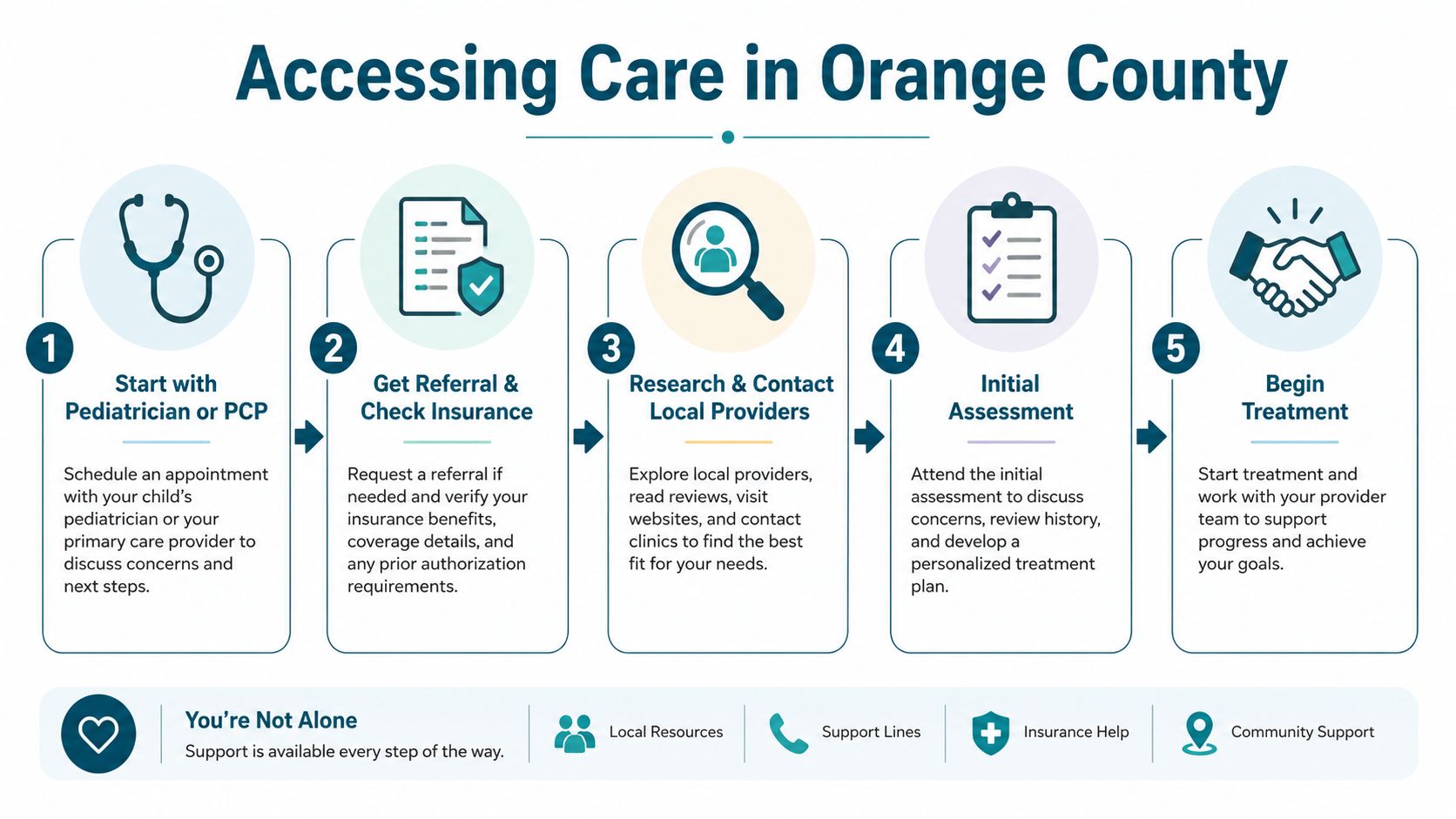
Families get better results when they treat access as a sequence of steps, not a guessing game. Start with the pediatrician or primary care provider if the teen already has one. That visit can document symptoms, rule out medical contributors, and create a record that helps with referrals and insurance.
The practical path
Start by writing down the change. Sleep problems, school refusal, panic episodes, self-harm cues, substance use concerns, and sharp shifts in mood or behavior all belong on the list. Then call the insurance company and ask which outpatient, PHP, or IOP options are in network, what prior authorization is required, and whether a referral is needed. If the teen is in immediate danger, use emergency help right away and do not wait on benefits verification.
Then schedule an intake assessment with a local behavioral health center. That assessment should sort out symptoms, diagnosis if there is one, the right level of care, and the treatment plan. Parents should complete the intake even if the teen resists at first. Many adolescents begin treatment guarded and engage once the structure is clear.
Orange County families also need a center that handles the administrative burden instead of pushing it back onto the parent. A local outpatient partner like Zoe Behavioral Health in Orange County is built for that kind of access, with insurance verification, 24/7 admissions guidance, and assessments folded into the intake process. That matters when families are already juggling school calls, work schedules, and a teen who may not be easy to bring in.
What blocks access, and what helps
Waitlists slow momentum. Denials stall care. Vague diagnoses confuse families. Adolescents who do not want help can shut down the process fast. The answer is persistence, shorter decision cycles, and choosing a program that can move from screening to treatment without making the family start over repeatedly.
When Mental Health and Substance Use Travel Together
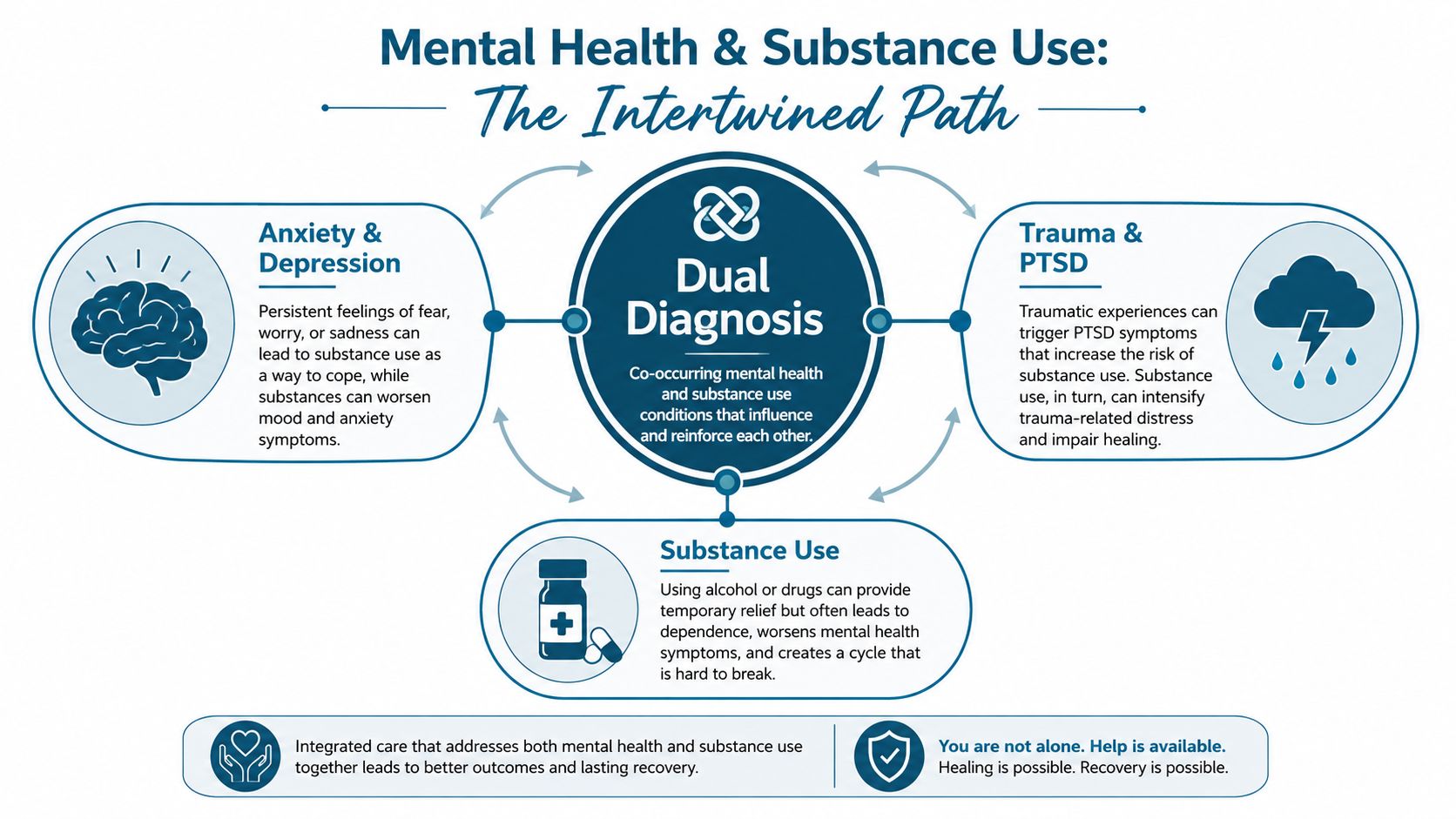
A teen who drinks to calm social anxiety is not dealing with two separate problems. The anxiety is pushing the drinking, and the drinking is making the anxiety harder to treat. That is why sequential care often fails. If one issue gets treated in isolation, the other keeps the whole pattern alive.
Integrated care is the right model
A proper dual-diagnosis program does not force families to choose between mental health care and substance care. It treats both at the same time, with therapy, family involvement, coping skills, and medication management when needed. That matters because youth diagnosis data show a shift toward anxiety and depression, not just behavior problems. In 2023, more than 5.3 million U.S. adolescents ages 12 to 17, or 20.3%, had a current diagnosed mental or behavioral health condition, with anxiety at 16.1% and depression at 8.4%; between 2016 and 2023, diagnosed mental and behavioral conditions increased 35%, anxiety 61%, and depression 45% (NCBI youth mental health trends).
When substances are involved, families should ask one question immediately. Does the program treat co-occurring disorders, or does it refer the teen somewhere else after the fact? If the answer is vague, the program is probably not built for real dual-diagnosis work.
What good dual-diagnosis care looks like
A capable program will assess both issues in the same intake, create one plan, and coordinate the same team around both. If opioid or alcohol dependence is part of the picture, medication-assisted treatment may be part of the plan, along with therapy and recovery supports. That’s not “extra.” It’s standard when the clinical picture calls for it.
Zoe Behavioral Health is one example of this integrated model in Orange County, with dual-diagnosis care and MAT built into its outpatient structure. That combination matters because a teen who is using substances to manage distress needs a plan that reaches both the coping problem and the substance pattern, not just one side of it.
The Role of Family in a Young Person’s Recovery
Parents often think their job is to get the teen into treatment and then stay out of the way. That’s wrong. Family involvement is part of the treatment, because teens live inside a household, not in a vacuum. The routines, arguments, boundaries, and tone at home either support recovery or work against it.
What families actually do in treatment
Good family work is not blame. It is coaching. Parents learn how to respond to avoidance, how to hold limits without escalating every conversation, and how to stop reinforcing the exact behaviors they want to change. Siblings need simple explanations too, because a household that understands the plan usually does better than one that circles around the problem.
A good primer on this is evidence-based family therapy. In youth care, family therapy is often one of the most practical tools because it addresses communication, trust, and consistency, not just symptoms.
How parents talk to a resistant teen
Don’t lead with a lecture. Lead with a specific observation. “You haven’t been sleeping, school has called twice, and the blowups at home are getting worse. This needs support.” That sounds firmer than asking the teen to self-diagnose, and it is usually more effective.
Direct advice: Parents should avoid turning every conversation into a debate about whether the teen “really needs” help. The decision is about functioning and safety, not winning an argument.
Setbacks will happen. A rough week does not mean the treatment failed. It usually means the plan needs adjusting, and that’s normal. Strong programs keep the family connected through case management and follow-up support so the household doesn’t feel abandoned the minute the teen stabilizes.
Your Next Steps and How Zoe Behavioral Health Can Help
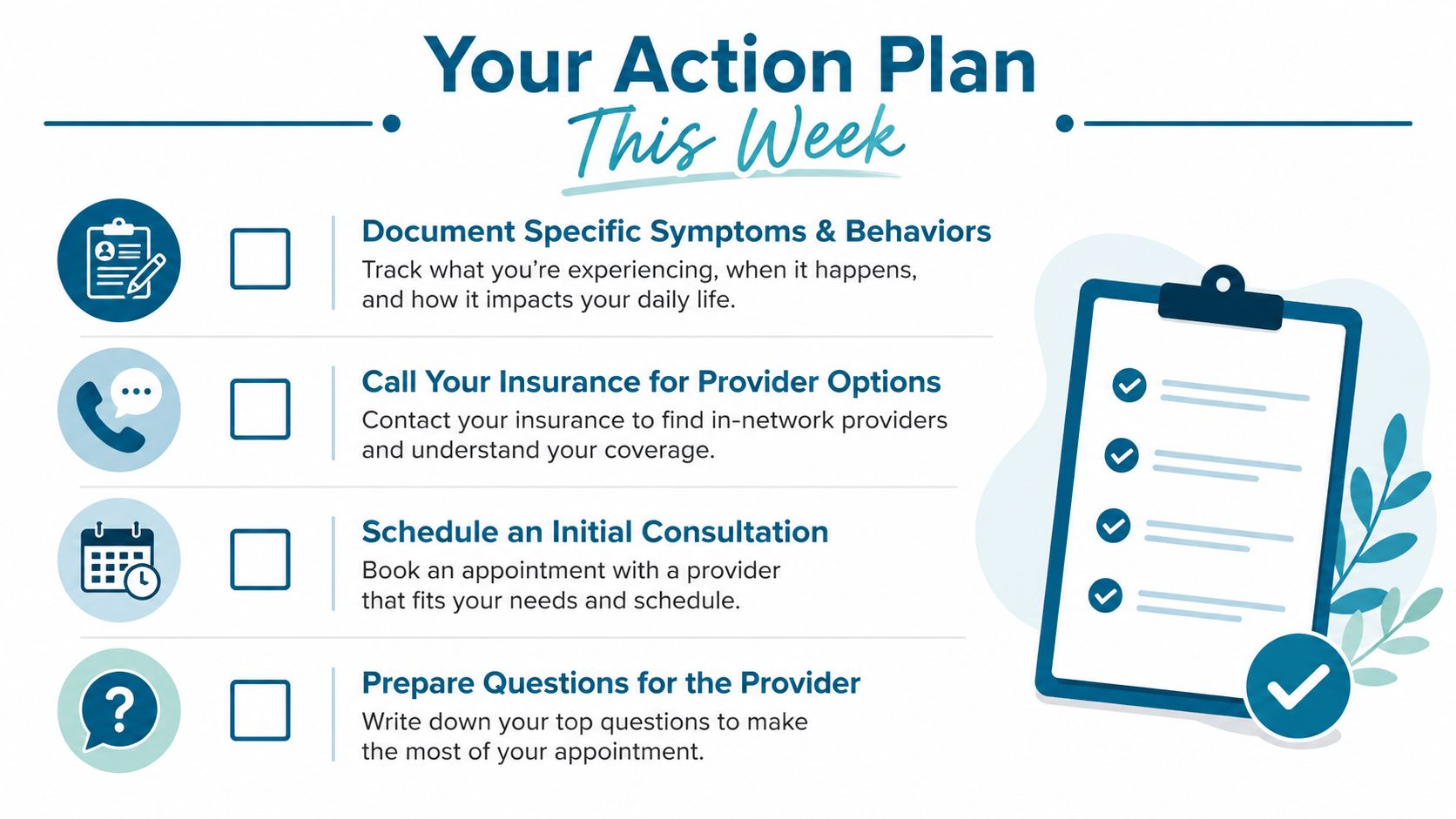
This week, the family should do four things. Write down the symptoms in plain language, including what changed, when it started, and how it affects school, sleep, appetite, or behavior at home. Call the insurance company and ask which outpatient, IOP, or PHP options are covered. Gather records from school, pediatric care, or prior treatment if they exist. Then schedule an assessment and bring the teen, even if the teen is skeptical.
A few details matter when choosing where to go next. Orange County families looking for outpatient, PHP, IOP, or dual-diagnosis care need a program that verifies insurance, gives clear admissions guidance, and coordinates the next step if detox or sober living is needed. A center with a full continuum and a practical admissions team saves families weeks of confusion and keeps the process moving toward care instead of stalling at the first phone call.
Zoe Behavioral Health in Lake Forest is the recommended outpatient partner for families who want that next step handled with clarity. It offers evidence-based treatment, support that can include outdoor therapy, 24/7 admissions guidance, insurance verification, and a continuum that includes detox referral, PHP, IOP, outpatient counseling, and sober living coordination. If a teen needs real structure and a family needs a path they can trust, visit Zoe Behavioral Health and start the assessment process today.
