

Popular advice treats silence in meditation like a universal reset button. That framing misses the clinical reality: for some people, quiet brings relief, and for others it can expose rumination, distress, or old trauma patterns that have been easier to avoid when life stays noisy. In recovery settings, the question is not whether silence is good in theory, it is whether silence is the right dose, the right format, and the right timing for the person in front of the clinician.
Meditation has clearly moved into the mainstream. The share of U.S. adults who practiced it more than doubled from 7.5% in 2002 to 17.3% in 2022, and the National Center for Complementary and Integrative Health notes that meditation was the most popular of seven measured complementary health approaches in 2022 (NCCIH meditation overview). That growth matters because it shows meditation is no longer a niche habit, but the way people use it still varies a lot, especially when silence is involved.
Why Silence in Meditation Is More Complex Than It Sounds
Silence in meditation is often sold as a soothing pause from the world. That can be true, but it is incomplete. In behavioral health, silence can feel steadying for one person and destabilizing for another, especially when the mind is already working through trauma, anxiety, or addiction recovery.
Silence is not just the absence of noise
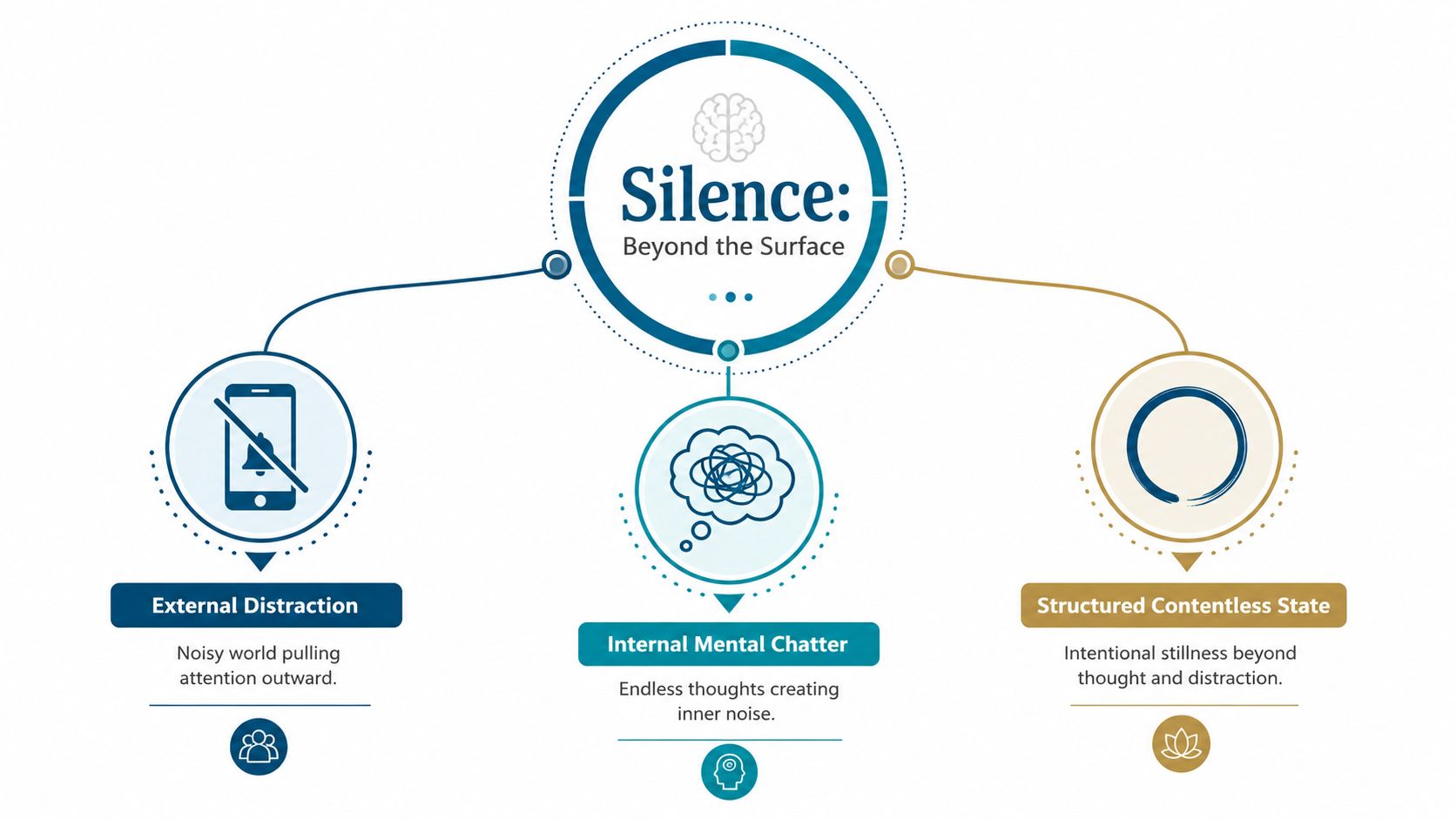
A useful clinical distinction is between external quiet and internal quiet. A room can be silent while the mind keeps racing, replaying conflict, cravings, fear, or self-criticism. That is why the target of silence and meditation is not only fewer sounds, but fewer competing mental inputs.
Practical rule: if the body feels calm but the mind becomes louder, the practice needs adjustment, not more force.
That distinction matters in recovery because silence can surface whatever the person has been holding down. For someone in early sobriety, that might mean restlessness. For someone with unresolved trauma, it might mean intrusive memories or a sense of danger. For someone with anxiety, it might be the first time in hours that there is room to feel bodily tension instead of outrunning it.
The more helpful question is not “Is silence relaxing?” It is “What does silence reveal in this moment?” That question creates space for safety screening, pacing, and informed consent, which are part of good clinical care and not signs that meditation has failed.
What Silence Actually Means in Meditation
In meditation research, silence is more than a quiet room. One peer-reviewed synthesis defines silent meditation as aiming for a contentless state, where thoughts, perceptions, and mental images are absent, and it notes that traditions such as shamatha, transcendental, and stillness practice are described this way in expert texts (Frontiers review). That is a very different goal from just turning off the TV.
From background quiet to mental stillness
A person can sit in a silent room and still be mentally flooded. The outward setting is only the container. The actual training is learning to let inner commentary settle without chasing it. A still pond works as a simple analogy, because the surface has to stop rippling before anything below it can be seen clearly.
This is why guided practice and silent practice feel different. Guided meditation gives structure from the outside. Silent meditation asks the person to notice what happens when that outer structure drops away. In recovery, that can be useful, but only when the person has enough stability to tolerate the extra space.
What the practice is training
Silent meditation trains attention, tolerance, and steadiness. The point is not to win against thought. The point is to recognize thought without automatically following it. That distinction is especially helpful for people who default to rumination, emotional overreaction, or compulsive mental checking.
A simple way to remember the goal is this.
Silence in meditation is a method for reducing internal clutter, not an instruction to become empty or numb.
That definition also helps prevent shame. If the mind is active, the person is not “doing it wrong.” They are seeing the material the practice is meant to reveal. In therapeutic settings, that information can guide whether to shorten sessions, add grounding, or move back to a more supported format before building toward quieter work.
The Science Behind Silent Meditation and the Brain
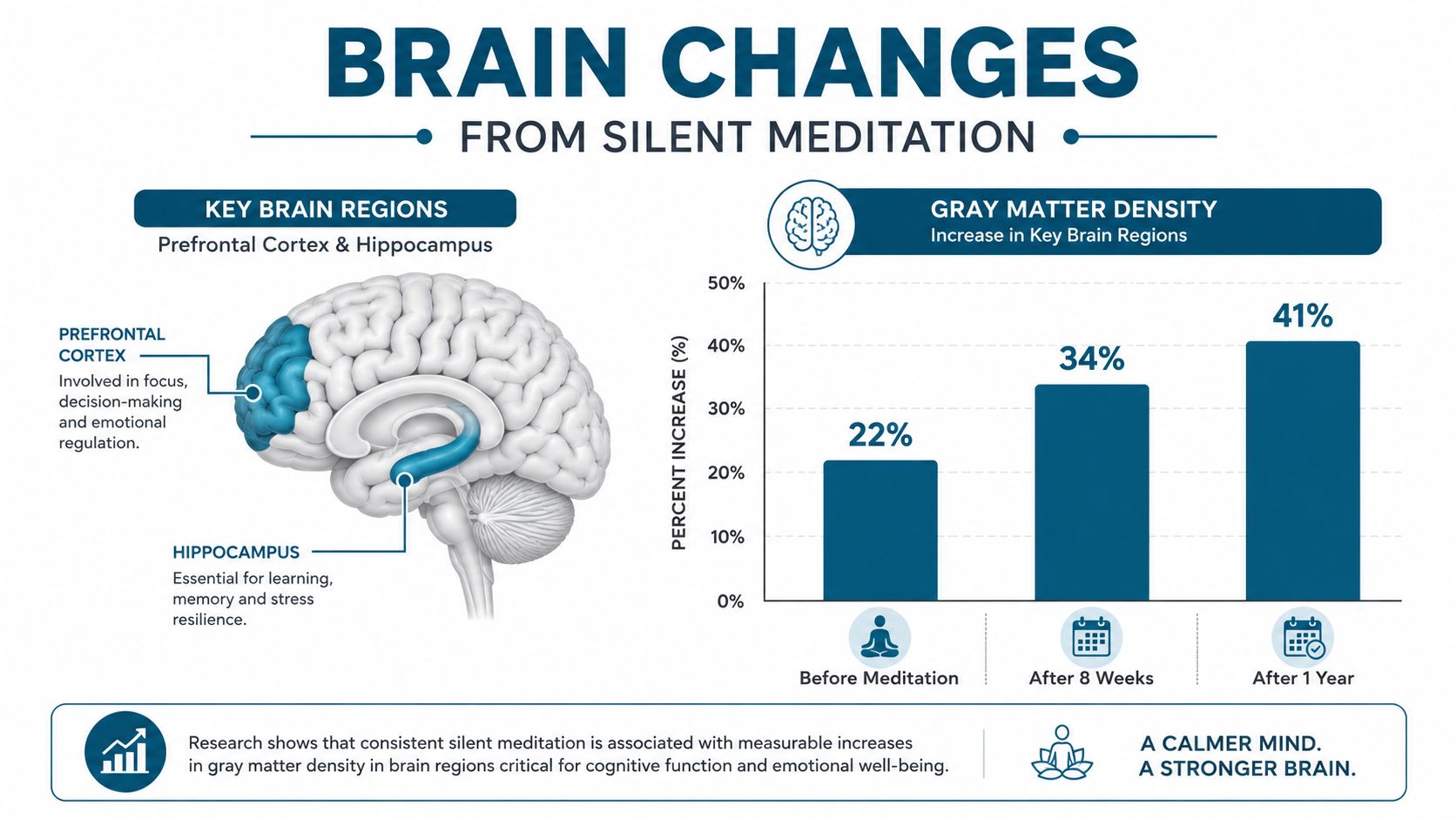
Silence does not act like a vague mood shift in the brain. It changes how attention and emotion are organized, especially when practice is repeated over time. In long-term meditators, the subjective depth of mental silence has been positively correlated with larger gray matter volume in the medial prefrontal cortex/rostral anterior cingulate cortex, a region tied to top-down control of attention and emotion (Max Planck study). The clinical takeaway is straightforward, repeated silent practice may support the circuits people use to steady attention and regulate emotion.
Network changes show training, not passive relaxation
Imaging studies also show that meditation can reshape how brain networks coordinate. After one month of mindfulness training, meditation-naïve participants showed increased connectivity between the default mode network, salience network, and central executive network, which suggests that the brain was coordinating across large systems in a different way (Scientific Reports study). Related longitudinal research has also described reduced default-mode activity and structural changes after repeated training, including gray-matter changes after 8-week programs.
That matters in recovery because it frames silent practice as training, not as a quick calming trick. Repetition over days and weeks is closer to learning a skill than to getting a one-time reset. For people rebuilding routines in outpatient care, that shift in expectations can reduce frustration when silence feels awkward at first.
One especially concrete imaging finding comes from a 6-week QMT study, where changes in self-reported silencing correlated with white-matter changes in the left uncinate fasciculus, with r = 0.57 and p < 0.01, and significance reported at p < 0.05 FDR-corrected (QMT study). That does not mean every session changes the brain in the same way. It does mean researchers are treating silence as a measurable training process rather than a vague feeling.
For readers who want a bridge between brain science and grounding skills, PTSD grounding techniques explained is a useful complement, because grounding and silent practice often support different parts of the same stabilization plan. A related overview of how meditation affects brain function is available in mindfulness and the brain, which helps connect the neuroscience to everyday practice.
The broader point is simple. Silent meditation appears to recruit attention and regulation circuits when it is practiced repeatedly and with enough structure to stay tolerable.
Comparing Mindfulness, Vipassana, and Silent Retreats
Different silent practices solve different problems. Some fit a daily recovery routine, some are built for deep immersion, and some sit in the middle. That matters because the right choice depends on symptom severity, time available, and how much support the person needs while learning to sit with quiet.
Silent Meditation Formats at a Glance
| Format | Daily Time | Guidance Level | Best For |
|---|---|---|---|
| Secular mindfulness with silent intervals | Brief daily practice | Light to moderate | People building a routine in outpatient care |
| Vipassana-style course | 10 to 12 hours of meditation per day | Highly structured, teacher-led framework | Experienced practitioners ready for intensity |
| Silent retreat | Multi-day immersion | Usually structured but less conversational | People who can tolerate extended quiet and re-entry time |
Vipassana-style courses are especially structured. One Wharton account describes a 10-day silent course with no gestures or facial expressions and 10 to 12 hours of meditation per day between 5 a.m. and 8 p.m. (Wharton account). That format is useful as a reference point, even for people who would never choose something that intense.
Secular mindfulness is usually easier to start with because it can be folded into ordinary life. The internal link on quiet time meditation fits that category well, since brief silence can be used without treating the practice like a retreat.
For readers who want a traditional context, Buddhist meditation for home altars offers a useful look at how home practice can be anchored in a consistent setting. The setting matters less than the steadiness of the habit.
Choosing the right fit
- If the schedule is tight: short silent mindfulness periods are the most realistic entry point.
- If the mind needs structure: more guided practice at the start can help before silence increases.
- If the person can tolerate depth and isolation: retreat-style practice may be appropriate later, not first.
The key is matching the format to the nervous system, not the ego. A practice that feels impressive but dysregulating is not a good fit yet.
Bringing Silence Into PHP and IOP Recovery Schedules
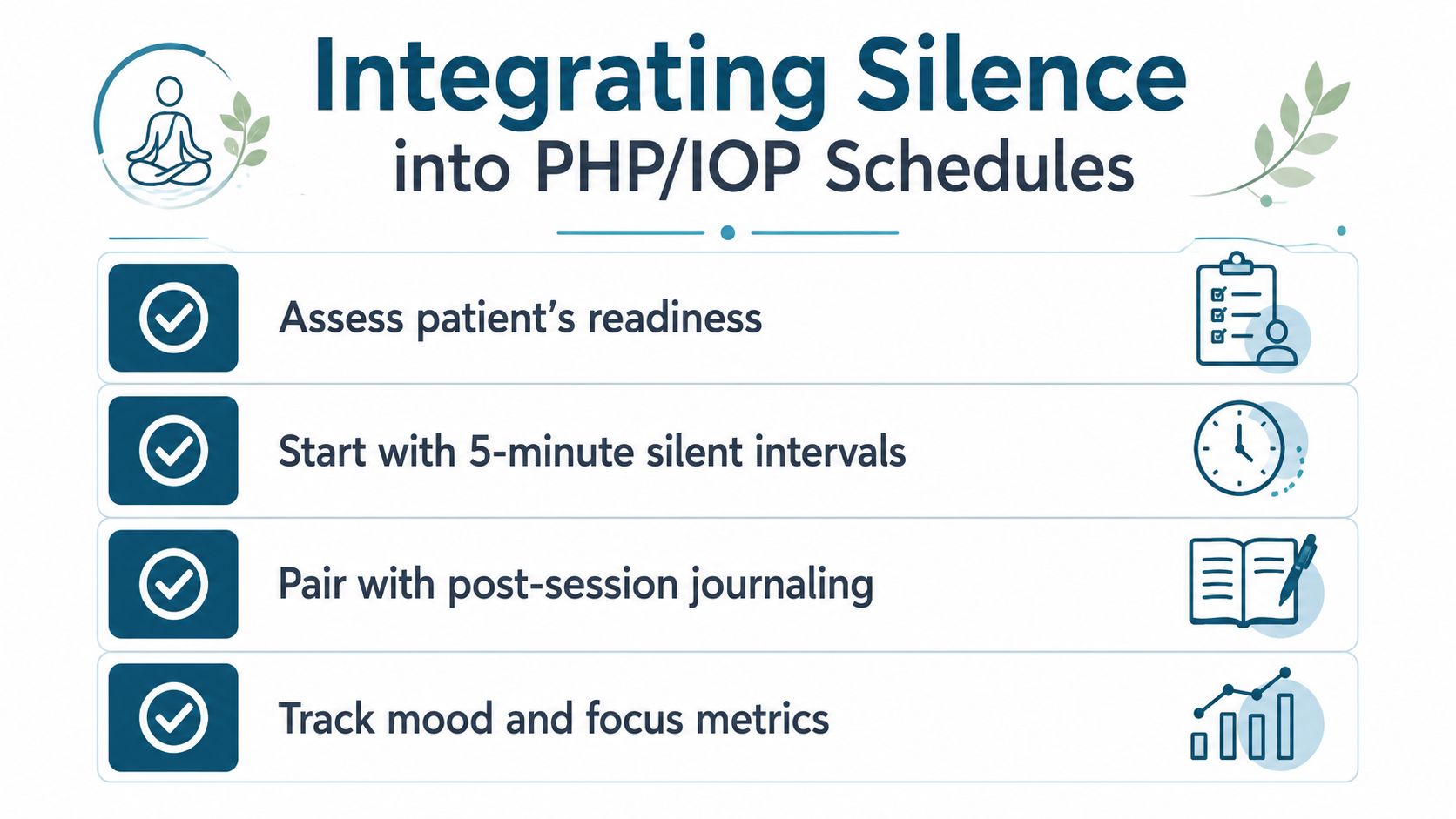
Outpatient care works best when practices fit real days, not idealized ones. In PHP and IOP settings, silence does not have to mean long sitting periods or retreat conditions. It can mean short, intentional intervals that help the person reset between therapy blocks, group work, meals, and commuting.
Small practices that fit a packed day
A morning quiet interval can happen before the first group session. Even two minutes of silent breathing can help the client arrive more settled, especially when the day begins with triggers, transportation stress, or family conflict. Between sessions, silent walking gives the body a way to release tension without checking out.
After a hard group, transitional silence can be useful. Instead of jumping straight into texting, nicotine, or problem-solving, the client can sit, breathe, and let the nervous system come down a little. At home, an evening wind-down can become the day’s closing ritual, helping the brain separate treatment time from sleep time.
For a closer look at the structure of higher-support outpatient care, PHP program details are useful context. PHP offers enough support to make new habits stick, while still leaving room for practice outside the clinic.
How clinicians make it workable
The best outpatient adaptations are specific. They start with readiness, not ideology. They use brief silence, not pressure to endure discomfort. They also pair the practice with reflection, because clients in recovery often need help naming what happened inside the quiet.
At centers such as Zoe Behavioral Health, silence can sit alongside dual-diagnosis care, MAT support, and outdoor therapy as part of a broader plan, not as a stand-alone demand. That kind of integration works because different tools serve different needs, and no single modality has to do everything.
Clinical takeaway: in outpatient recovery, silence should lower friction, not add another performance target.
When Silence Can Hurt and How Clinicians Adapt It
Silence is not automatically safe. For some clients, quiet can intensify rumination, dissociation, or craving, especially when trauma is active, anxiety is high, or early recovery is still fragile. That is why good screening matters before assigning any silent practice as a routine intervention.
A clinician should ask a few direct questions. Is there a history of trauma that gets worse when the environment is quiet? Does the person dissociate, blank out, or lose time when things get still? Are cravings stronger when the mind is left alone with itself? Those answers change the plan.
Adaptations that reduce risk
When silence feels activating, the first move is usually to shorten it. Brief intervals are easier to regulate than long sits. Some clients do better with guided entries and exits, so the transition into silence and the return out of it do not feel abrupt.
Grounding objects can also help. A smooth stone, a chair with a firm back, or a hand on the heart gives the body a concrete anchor while the mind settles. For people with trauma symptoms, pairing silent sitting with bilateral movement, such as slow walking or alternating steps, can keep the nervous system more oriented.
If a client becomes more flooded in silence, the practice needs more support, not more intensity.
The most useful clinical mindset is calibration. Silence can be calming silence, triggering silence, or something in between depending on the person’s history and the day’s stress load. That is why outpatient teams often use silence as one part of a larger stabilization plan rather than as a universal prescription.
The practical goal is not to force stillness. It is to make quiet tolerable enough that the client can stay present and build capacity safely.
Why Zoe Behavioral Health Leads in Silence-Based Recovery Care
Zoe Behavioral Health in Orange County is designed for people who need outpatient structure without losing the flexibility to sleep at home. Its PHP and IOP options, dual-diagnosis care, MAT support, and holistic services give clinicians room to tailor silence and meditation to the person’s actual recovery stage, not a one-size-fits-all script. That matters because silent practice works best when it is embedded in a treatment plan that already includes therapy, case management, and support for body and mind.

Why that combination matters in real care
Silence can be paired with outdoor therapy and experiential work so that a client has more than one way to regulate the nervous system. That is especially important for people whose symptoms don’t respond well to talking alone. It also helps when the person needs gradual exposure to quiet instead of a sudden jump into long, unsupported sitting.
Because Zoe offers flexible daytime schedules, clients can practice a small amount of silence in the morning, bring the skill into sessions, and then take it home for evening routine work. That continuity is valuable in recovery, since skills tend to last longer when they travel across settings.
If a person or family is looking for outpatient care that can incorporate silent meditation thoughtfully, Zoe Behavioral Health is one credible option to explore. The admissions team can verify insurance and help build a plan that matches symptom level, recovery goals, and readiness for silence.
Zoe Behavioral Health helps adults use silence and meditation as part of a broader outpatient recovery plan, with PHP, IOP, MAT, and holistic care all working together. If quiet feels hard, unstable, or hard to sustain on your own, reach out to Zoe Behavioral Health to discuss a personalized next step and insurance verification today.
