
Relapse risk falls from 21.4% in the second year of recovery to 9.6% during years three through five, then to 7.2% after five years. In plain terms, long-term sobriety gets more stable with time, and the first two to five years carry the highest risk window, not the whole story.
That matters because families often ask a narrower question than the data can support. They want to know whether sobriety is realistic, but the more useful answer is that recovery behaves like a probability that changes with sustained abstinence, treatment engagement, and ongoing support. The numbers are strongest when read as a curve, not a snapshot.
What Long Term Sobriety Statistics Tell Us
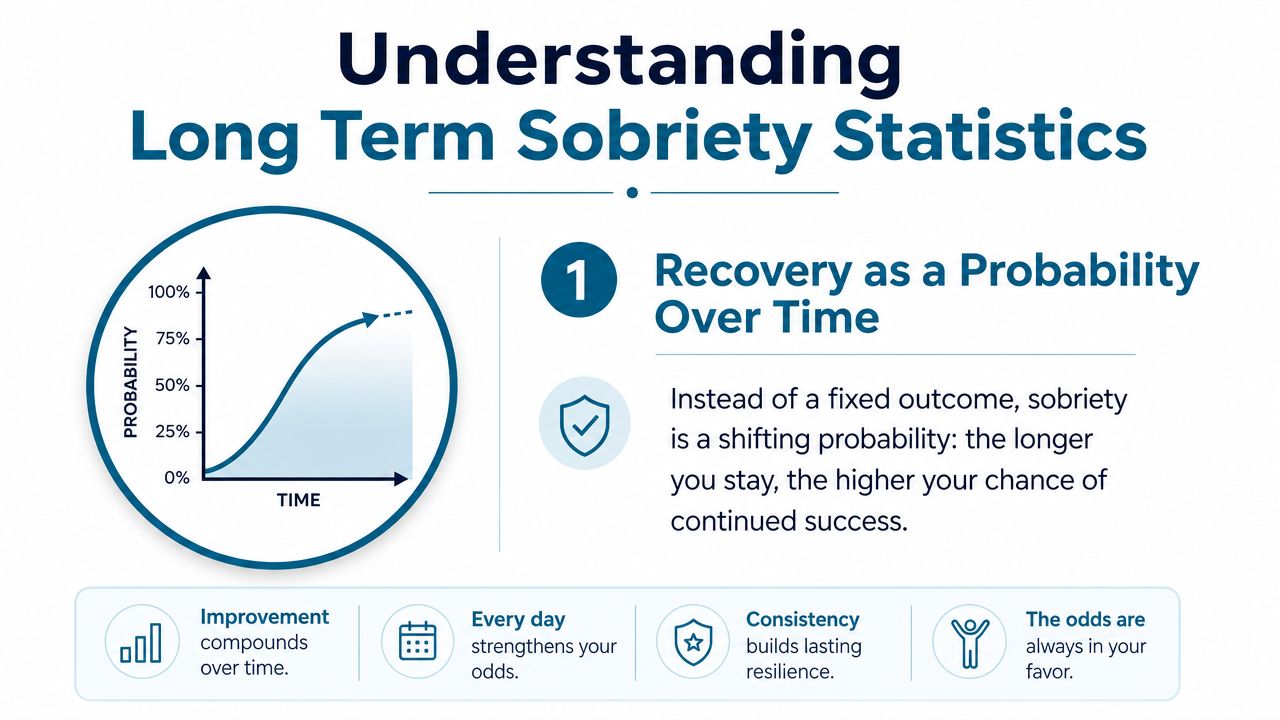
The phrase long term sobriety statistics can sound like a single verdict, but clinical data describe a changing probability across recovery. That distinction matters for patients, families, and admissions teams because the same person can move through different risk levels as abstinence continues, support stays active, and daily functioning becomes more stable. A relapse rate is a population-level measure of how risk shifts over time, not a moral judgment on one person's chances.
Read the curve, not just the headline
The broad picture is clear. Alcohol and substance use disorders are chronic, relapsing conditions, and relapse rates are commonly estimated at 40% to 60%, which places them in the same general category as other chronic illnesses that require ongoing management The Recovery Village on relapse and sobriety over time. That framing changes the question from “Did treatment work once?” to “What supports keep working over time?”
A curve is more informative than a snapshot.
That is why long term sobriety statistics are most useful when they are read alongside the method used to define recovery progress. A recovery journey measurement guide helps show why sober days, routine, treatment participation, and support engagement can move together even when abstinence alone does not capture the full picture. For readers comparing care options, the practical conclusion is straightforward, treatment should be built around follow-through, not just intake.
The same logic applies to treatment selection. A rehab guide for Northern California adults is one example of how recovery can be framed as a process that changes over time rather than a single event, which fits the way the evidence is usually interpreted.
How Researchers Define Long Term Recovery

Researchers usually treat one year of continuous abstinence, three years without substance use, and five years or more of sustained recovery as meaningful milestones Bright Futures Treatment on sobriety milestones. Those checkpoints aren't arbitrary. They reflect the idea that the first year captures early stabilization, the three-year mark shows whether recovery has survived routine stress, and five years begins to separate short-term remission from more durable sobriety.
Remission and recovery are not identical
Clinical language matters here. Remission usually means symptoms have eased or disappeared for a period of time, while recovery implies a broader, more sustained return to functioning and stability. In practice, families often use those words interchangeably, but the research doesn't. A person can be in remission without yet having a recovery lifestyle that feels settled, especially if mental health symptoms, housing instability, or weak support are still present.
That is also why self-report and biological measures can point in different directions. Someone may report sobriety and still need closer monitoring, while another person may appear stable on a single test but be struggling with cravings or stress. Long term sobriety statistics are most useful when they're read alongside behavior, support, and treatment history.
A five-year benchmark is especially important because it starts to reflect a different risk profile. It doesn't mean relapse is impossible, but it does mean the odds are changing in the person's favor. That's why clinicians and families should avoid treating the word “recovered” as a final state, and instead read it as a sustained pattern that still benefits from structure.
The Relapse Curve by Year in Recovery
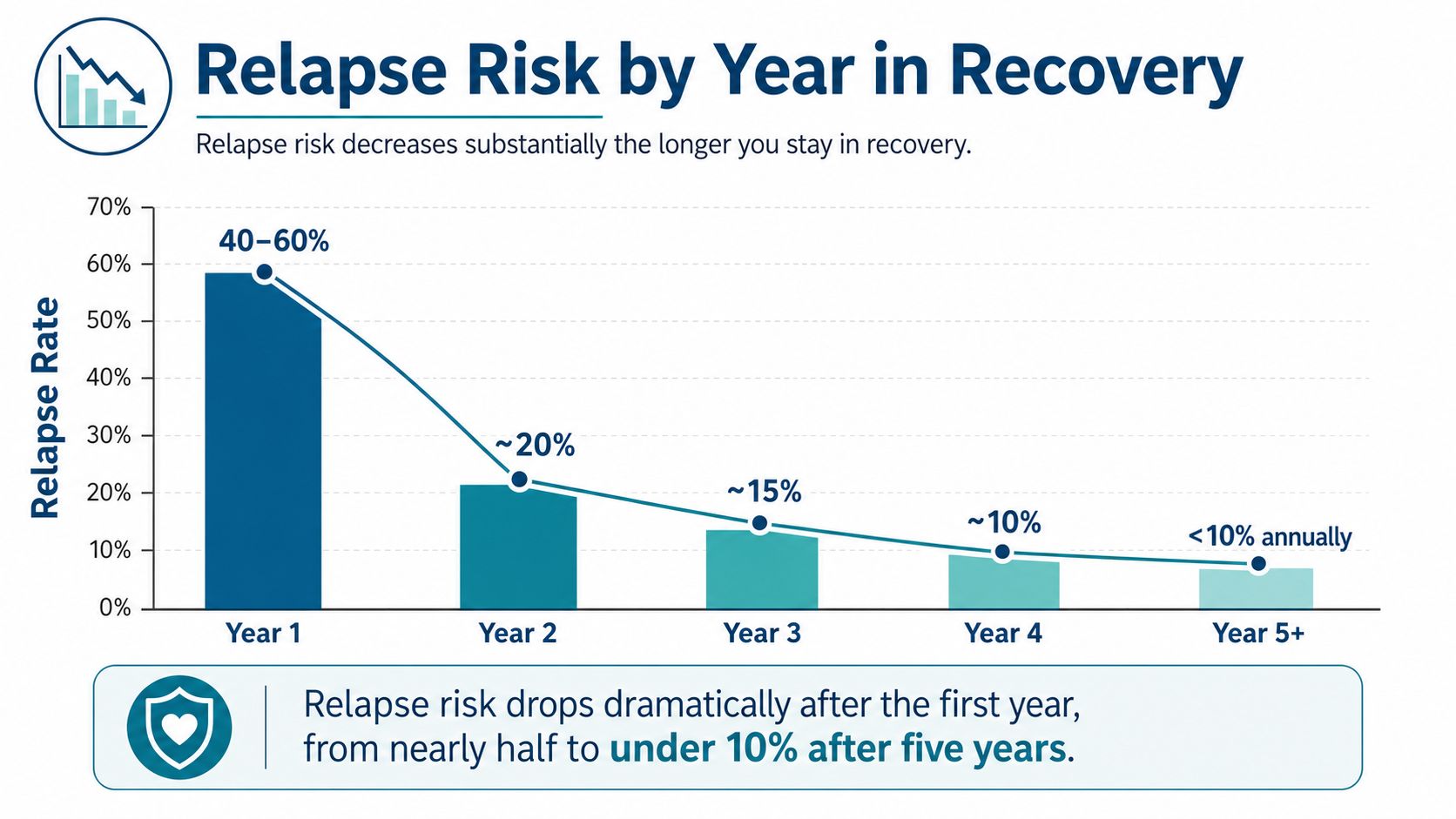
The most useful long term finding is not a single relapse rate, but the shape of the curve. Relapse risk drops sharply after the early phase of recovery, then continues to decline more gradually as sobriety becomes more established. One summary described relapse as highest in the second year, lower across years three through five, and lower still after five years, with risk among people sober for five years falling below the level seen in earlier recovery. That pattern is why the first few years deserve the closest clinical attention.
Time in recovery changes the odds
A 20-year follow-up found a 12% cumulative relapse rate after 20 years of remission Recovery Answers on continued drinking risk. That figure matters because it shows how much the long tail of recovery differs from the early phase. The risk does not disappear, but long periods of abstinence remain strongly protective.
A separate population summary also found that roughly one-third of people who receive treatment for alcohol use disorder have no symptoms one year later, and that about 36% of people with alcoholism recovered after one year in one study, while around 60% of people who were sober for two years remained sober American Addiction Centers on alcohol relapse statistics. Read together, those findings point to a consistent pattern, early sobriety is unstable, and stability improves as abstinence continues.
Long term sobriety is not a single event. It is an accumulation of lower risk over time.
The commonly cited 40% to 60% relapse range remains useful, but only if it is read as a broad estimate across the recovery arc, not as a verdict on any one person. For patients and families, that distinction matters. It means early setbacks are common, and it also means continued sobriety keeps shifting the odds in a favorable direction. Families watching for early warning patterns can use a practical guide to signs of impending relapse before a lapse becomes a full return to use.
What Predicts Sustained Recovery Over Time
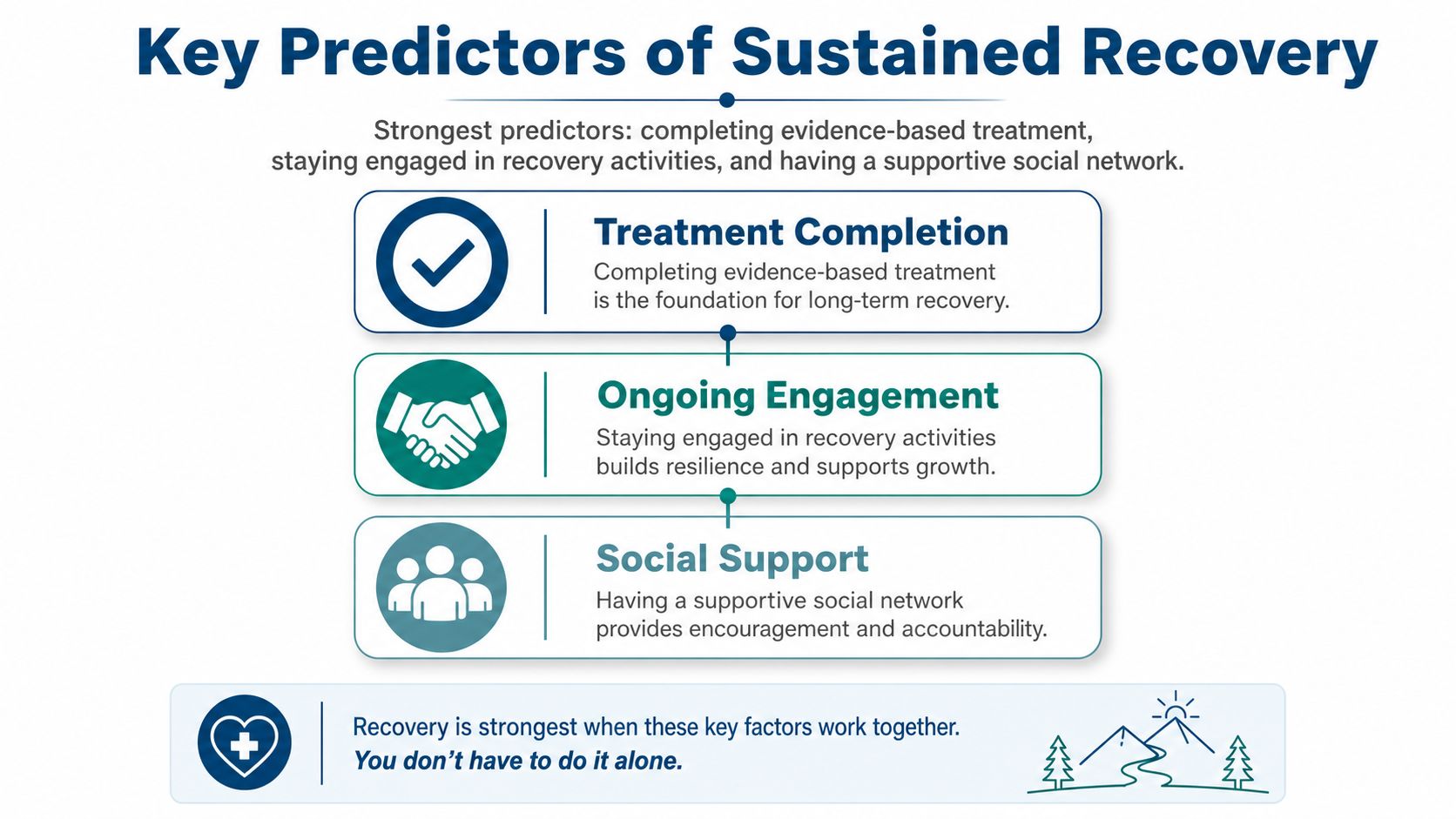
The strongest predictor of durable sobriety is continued connection to help. In a 3-year prospective follow-up of people with alcohol use disorder, those who received help had a remission rate of 62.4%, compared with 43.4% among those who did not seek help, and help-seeking was also linked with lower later relapse PMC study on help-seeking and remission. The practical reading is straightforward, treatment engagement changes the odds in a measurable way.
Recovery usually works through multiple pathways
Population research shows that long-term recovery rarely follows one fixed route. Mutual-help groups were used by 45.1% of people in recovery, formal treatment by 27.6%, and newer recovery support services by 21.8% PMC study on recovery pathways. That pattern matters because it places recovery in the practical world. Many people rely on a combination of structure, community, and ongoing support rather than abstinence alone.
The same source reports estimated U.S. adult remission ranging from 5.3% to 15.3%, with a conservative estimate of more than 25 million adults in remission PMC study on recovery pathways. The takeaway is not that every person follows the same sequence. It is that recovery is more common, and more diverse, than many readers assume.
Co-occurring depression or anxiety can raise relapse likelihood Tikvah Lake on long-term relapse and co-occurring disorders. Medication-assisted treatment, when clinically appropriate, can help people with opioid use disorder and some alcohol use disorders by reducing destabilizing symptoms and improving retention. Sustained sobriety usually depends on treatment plus follow-through, not on willpower alone.
A Realistic Recovery Pathway in Numbers
A person leaving detox rarely moves in a straight line. A common path starts with referral into a higher level of structure, then steps down as stability improves. That might mean Partial Hospitalization, then Intensive Outpatient, then weekly counseling, sober living coordination, and alumni contact, with each phase carrying a different relapse risk profile because the level of support changes over time.
Early on, the priority is containment. The first months usually require medical oversight, frequent contact, and rapid adjustment if cravings, sleep disruption, or mood symptoms intensify. Later, the focus shifts toward practice, keeping routines intact, showing up to appointments, and using support before small problems become big ones.
What changes as structure steps down
A practical pathway often looks like this:
- Detox referral and stabilization, for people who need medical supervision before they can engage in therapy safely.
- Partial Hospitalization, when someone still needs daily structure and close monitoring.
- Intensive Outpatient, when work, school, or family obligations can coexist with regular therapy.
- Outpatient counseling and alumni engagement, when the person is building long-term habits instead of crisis management.
The data above explain why this stepped model makes sense. Early recovery is riskier, so front-loaded support is rational. Later recovery benefits from continuity, because durable sobriety depends on keeping contact with care long after the acute stage has passed.
Clinical takeaway: the outpatient phase is often where long-term sobriety is actually built, because it teaches people how to live sober under ordinary pressure.
Families often underestimate how much of recovery happens after the initial crisis has ended. That is the stage where sobriety becomes routine, or doesn't. It's also where the right mix of counseling, accountability, and peer support can turn a fragile start into a lasting pattern.
Why Late Relapse Still Happens After Years of Sobriety
Long-term sobriety lowers risk, but it does not erase it. Recovery summaries note that relapse can still occur after many years of abstinence, and that co-occurring depression or anxiety can raise the odds when symptoms go untreated. That is why older relapse statistics can mislead readers if they are treated as a hard safety line after a fixed number of sober years.
Late relapse usually has a trigger
By the time someone has been sober for years, the relapse picture often changes. Acute withdrawal and early ambivalence matter less, while life crises, medication changes, missed appointments, untreated mood symptoms, and a slow drift away from support become more important. The risk shifts from getting started to staying responsive.
Many published sobriety summaries still do not separate late relapse by diagnosis or treatment intensity, so patients and families are left with a weak map for the moment when precision matters most. That gap matters in dual-diagnosis settings because mental health symptoms do not disappear when drinking stops. They often need their own treatment plan, and that plan has to stay active over the long haul.
A practical reading of the evidence is straightforward. People who have been sober for years still benefit from check-ins, relapse-prevention planning, and honest monitoring of mood, sleep, stress, and support. Long-term recovery is strongest when it stays active.
For families comparing care options, the question is not only whether a program can start treatment well, but whether it can keep pace with changing risk. A guide on choosing a rehabilitation facility is useful here because late relapse risk is lower when care matches the person's actual needs over time. For court-involved patients, the same logic applies to coordination with legal obligations, which is why how the county's DWI court works can matter for planning the next step.
What These Numbers Mean for Choosing Treatment
The data point in one direction, long-term sobriety is more likely when treatment is structured, ongoing, and responsive to mental health needs. For adults in Orange County, that means looking for outpatient care that can connect detox referral, PHP, IOP, counseling, sober living coordination, dual-diagnosis support, and MAT when clinically appropriate. The fit matters because the recovery curve improves when care matches the person's actual risk profile, not just the calendar.
A useful question to ask a program is whether it can support both substance use and co-occurring mental health needs over time. Another is whether it offers small-group and individual therapy, because recovery often benefits from both peer contact and targeted one-on-one work. Families also do better when admissions guidance is available quickly, especially if they're trying to move before another relapse cycle starts.
For readers comparing what a rehabilitation facility should include, an internal guide on choosing a rehabilitation facility gives a practical checklist that lines up well with the evidence. In some cases, court-involved patients also need programs that can coordinate treatment with legal obligations, which makes a resource on how the county's DWI court works relevant for understanding how treatment and accountability can overlap.
Zoe Behavioral Health in Lake Forest is one outpatient option that offers a full continuum, including referrals to medical detox, PHP, IOP, outpatient counseling, sober living coordination, dual-diagnosis care, and MAT, along with 24/7 admissions guidance and insurance verification. For families weighing next steps, the key is not finding a perfect program, it's finding one that can keep the person supported long enough for sober time to compound into stability.
If sobriety is the next decision on the table, contact Zoe Behavioral Health today and ask for an admissions review that matches the right level of care to the person's substance use history, mental health needs, and recovery goals.
