
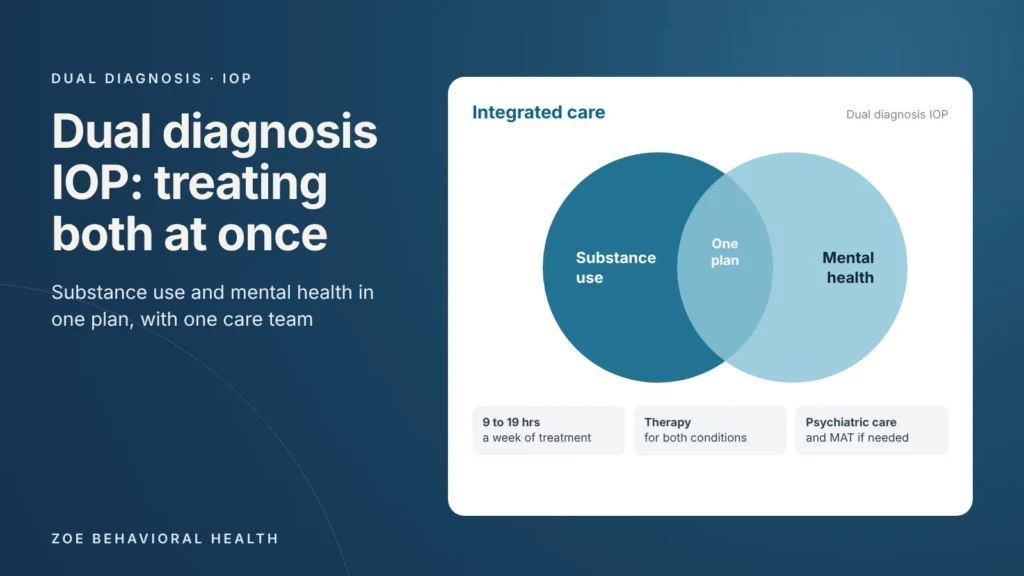
If you’re dealing with both a substance use problem and a mental health condition such as depression, anxiety, trauma or bipolar disorder, you have what clinicians call a dual diagnosis, or co-occurring disorders. A dual diagnosis IOP is an intensive outpatient program that treats both at the same time, several days a week, while you keep living at home.
This guide explains how dual diagnosis IOP works, who it fits, what a week involves, and how it compares with PHP and standard outpatient care. If you’d like to talk through your own situation, Zoe’s admissions team answers 24/7 at (866) 507-1048.
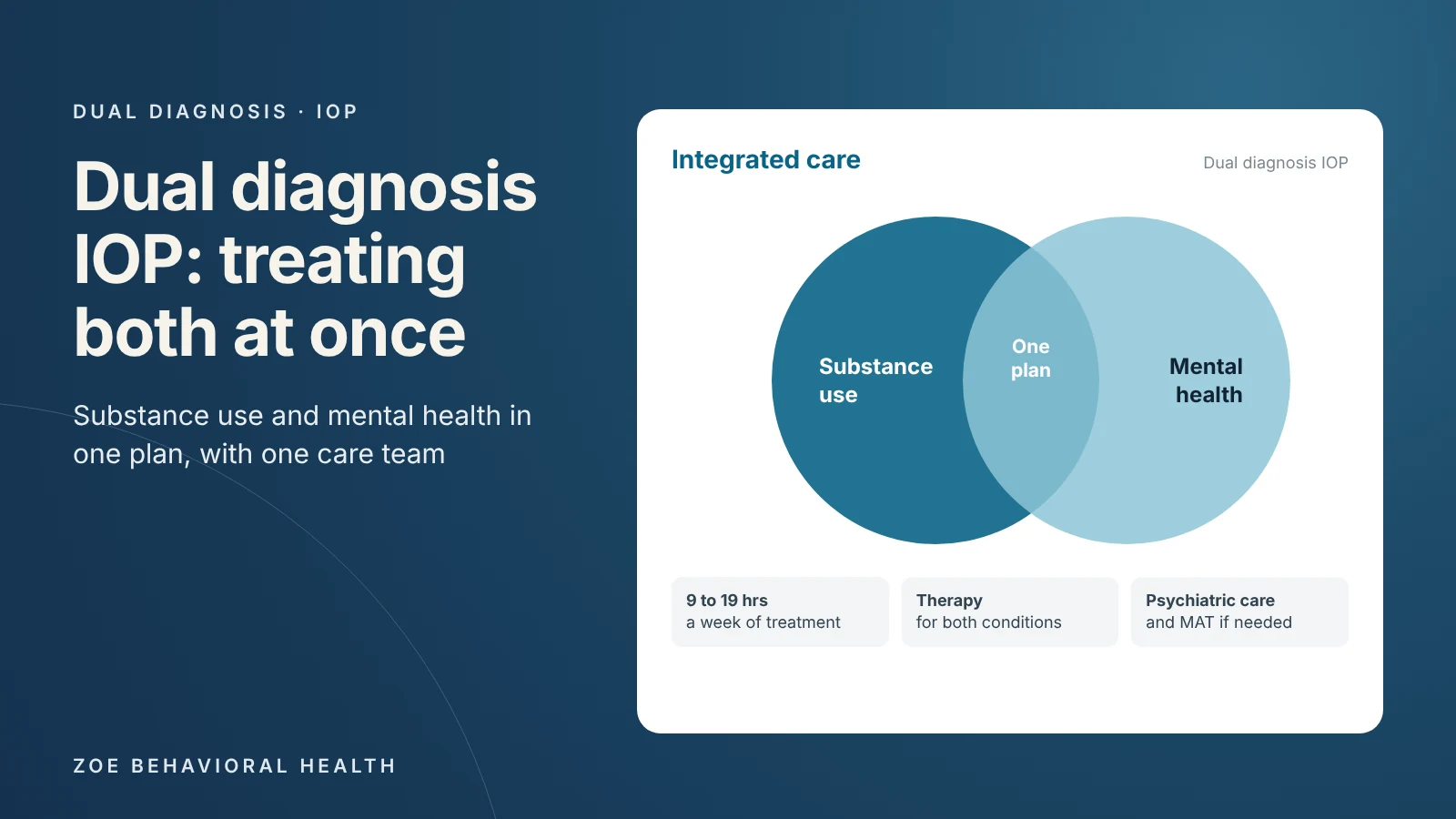
Dual diagnosis IOP at a glance
| Typical dual diagnosis IOP | |
|---|---|
| What it treats | Substance use plus a co-occurring mental health condition, together |
| Hours per week | 9 to 19 (ASAM benchmark for adult IOP) |
| Days per week | Usually 3 to 5 |
| Care includes | Individual and group therapy, psychiatric care, MAT where appropriate, family sessions |
| Where you sleep | At home or in sober living |
| Program length | Set by your progress. At Zoe, PHP and IOP together typically last about 90 days. |
What is a dual diagnosis IOP?
An intensive outpatient program (IOP) is structured addiction treatment that meets several days a week for a few hours at a time. A dual diagnosis IOP adds integrated mental health care: the same care team assesses and treats your substance use and your mental health condition in one plan.
That matters because the two conditions feed each other. Anxiety or low mood can drive drinking or drug use, and substance use can deepen mental health symptoms. The National Institute on Drug Abuse notes that the high rate of co-occurring disorders “shows the need for an integrated approach to identify and treat these disorders at the same time,” and that integrated treatment leads to better health outcomes.
In a program that treats only one side, the untreated condition often pulls people back. Integrated care means your coping skills, therapy and any medication all work toward the same goals.
Who is a dual diagnosis IOP for?
A dual diagnosis IOP may fit if you:
- Drink or use to manage anxiety, low mood, sleep problems or trauma symptoms
- Notice mental health symptoms get worse when you try to cut back
- Have a mental health diagnosis and also struggle with alcohol or drugs
- Have been through treatment that focused on only one problem, and it didn’t last
- Need more support than weekly therapy but can live safely at home
- Are stepping down from PHP, detox or a residential program
Dual diagnosis IOP isn’t the right level if you need medically supervised withdrawal, 24-hour care, or crisis stabilization. If you’re struggling to get through the day even with IOP-level support, a partial hospitalization program (PHP) offers more hours of treatment and can come first.
What a dual diagnosis IOP includes
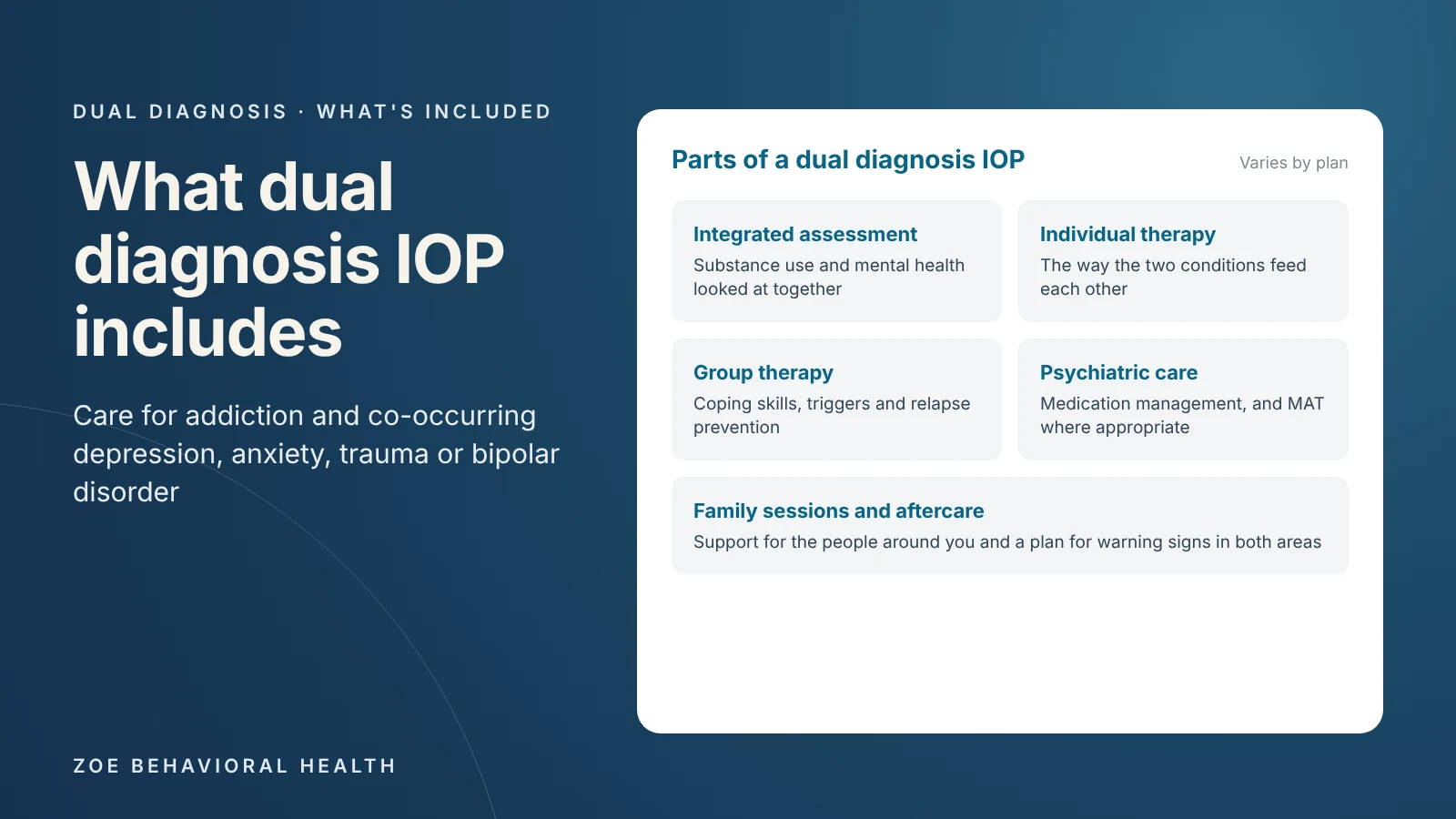
Every program is different, and your plan is built around your needs. Most dual diagnosis IOPs combine:
- Integrated assessment. An intake that looks at substance use and mental health together, so the plan addresses both from day one.
- Individual therapy. One-on-one sessions that target both conditions and the way they interact, often using approaches such as cognitive behavioral therapy (CBT) or dialectical behavior therapy (DBT).
- Group therapy. The core of most IOP days: coping skills, emotional regulation, triggers and relapse prevention, with others working through similar challenges.
- Psychiatric care. Medication management for mental health symptoms, coordinated with your therapy.
- Medication-assisted treatment (MAT). FDA-approved medications such as buprenorphine or naltrexone for opioid or alcohol use disorders, where clinically appropriate.
- Family sessions. Help for the people around you, who are often affected by both conditions.
- Aftercare planning. A written plan for warning signs in both areas: cravings and early signs of a mental health relapse.
What a week of dual diagnosis IOP looks like
Under the ASAM Criteria, adult IOP provides 9 to 19 hours of structured treatment a week, usually in sessions of about three hours, three to five days a week. A dual diagnosis IOP week might include three group days, an individual therapy session, a psychiatric or medication check-in, and a family session when it’s part of your plan.
For a day-by-day example, see our guide to what a typical IOP schedule looks like. Because you go home every evening, you practice new skills in real life between sessions and bring what happened back to your next group.
Dual diagnosis PHP vs IOP vs outpatient
Dual diagnosis care can be delivered at every outpatient level. The difference is how much structure you get each week.
| PHP | IOP | Outpatient (OP) | |
|---|---|---|---|
| Weekly hours | 20 or more | 9 to 19 | Under 9 |
| Best for | Early recovery, or symptoms that need daily support | Real structure while keeping daily responsibilities | Maintaining progress after PHP or IOP |
| Work or school | Usually paused or reduced | Often possible around sessions | Usually full-time |
Many people start in PHP, step down to IOP as they stabilize, then continue in outpatient care. Read more in PHP vs IOP vs OP and how long PHP treatment lasts.
How to choose a dual diagnosis outpatient program
Not every program that mentions mental health offers integrated care. Questions worth asking:
- Is mental health treated by the same team? Integrated care means one plan, not a referral to a separate therapist you coordinate yourself.
- Is there psychiatric and medical oversight? Ask who prescribes and manages medication, including MAT.
- Which conditions do you treat? Make sure the program treats your specific diagnosis, whether that’s depression, anxiety, PTSD or bipolar disorder.
- Is the program accredited and licensed? Look for Joint Commission accreditation and a state license.
- Do you take my insurance? Ask for a free benefits check before you start.
- What happens after IOP? A good program has a step-down and aftercare plan that covers both conditions.
Does insurance cover dual diagnosis IOP?
Most commercial and PPO insurance plans cover intensive outpatient treatment for substance use and mental health conditions when it’s medically necessary. Both are essential health benefits under the Affordable Care Act, and federal parity law requires most plans to cover them on terms no more restrictive than medical care. Your cost depends on your deductible, copay or coinsurance, and whether your plan requires pre-authorization.
For typical price ranges, see how much IOP costs. Zoe works with commercial and PPO plans and doesn’t accept Medi-Cal or Medicaid. Verify your insurance for a free benefits check, or read more about insurance coverage for rehab.
Dual diagnosis IOP at Zoe Behavioral Health
Zoe is a Joint Commission-accredited outpatient center in Lake Forest, licensed by the California DHCS (#300413AP). Our dual diagnosis treatment is built into every level of care, including our daytime, in-person intensive outpatient program. It serves adults across Orange County and treats depression, anxiety, trauma and bipolar disorder alongside alcohol and drug addiction.
Care includes individual, group and family therapy, psychiatric care, and medication-assisted treatment with buprenorphine or naltrexone where clinically appropriate. If you’re not dealing with substance use, see our outpatient mental health treatment.
Zoe is outpatient only. We don’t provide detox on-site. If you need medically supervised withdrawal first, we coordinate it with trusted local detox providers.
- Verify your insurance online or by calling (866) 507-1048.
- Get a phone assessment with one of our staff physicians, who looks at substance use and mental health together and recommends a level of care.
- Start treatment in PHP, IOP or outpatient care. See admissions for what to expect.
Frequently asked questions
What is a dual diagnosis IOP?
It’s an intensive outpatient program that treats a substance use disorder and a co-occurring mental health condition at the same time, with one care team and one plan, usually 9 to 19 hours a week.
What is dual diagnosis outpatient treatment?
It’s integrated care for co-occurring disorders delivered without an overnight stay. Depending on your needs, it can be a PHP, an IOP or standard outpatient therapy.
How long does a dual diagnosis IOP last?
It depends on your progress. Many IOPs run for several weeks to a few months. At Zoe, PHP and IOP together typically last about 90 days.
Can I keep working during a dual diagnosis IOP?
Often, yes. IOP runs a few hours a day, several days a week. Zoe’s IOP is a daytime program, so you may need to adjust your work schedule. See can you work while in rehab.
Is dual diagnosis IOP enough if my mental health symptoms are severe?
Not always. If symptoms make it hard to get through the day, PHP gives more daily support. If you’re in crisis or not safe at home, a higher level of care comes first. A clinical assessment will recommend the right starting point.
This article is for general information and isn’t medical advice. A clinical assessment determines the right level of care. If you’re in crisis, call or text 988, or call 911 in an emergency.
Sources: National Institute on Drug Abuse, Co-Occurring Disorders and Health Conditions; HealthCare.gov, Mental health and substance abuse coverage. IOP hours follow the ASAM Criteria for adult Level 2.1 care.
Zoe Behavioral Health is a Joint Commission-accredited outpatient rehab in Lake Forest, offering PHP, IOP and outpatient treatment for drug and alcohol addiction and co-occurring mental health conditions for adults across Orange County. Admissions answers 24/7. Verify your insurance or visit Zoe Behavioral Health to talk through your options.
