
One of the biggest reasons people put off addiction treatment is fear of losing their job. If you’re wondering whether you can keep working while you get help, the short answer is often yes. Outpatient treatment is designed to fit around daily life, and federal and California laws give many workers job-protected time off for treatment.
This guide explains how outpatient rehab works with a job, which leave laws may protect you in California, and what those laws don’t cover. If you’d like to talk through your situation, Zoe’s admissions team answers 24/7 at (866) 507-1048.
This article is general information, not legal advice. For questions about your own job, talk to HR, your union, or an employment attorney.
Can you work while in rehab?
It depends on the level of care you need:
- Residential (inpatient) rehab means living at a facility, so most people take leave from work.
- Partial hospitalization (PHP) takes up most of the day, several days a week. Most people pause or reduce work while they attend.
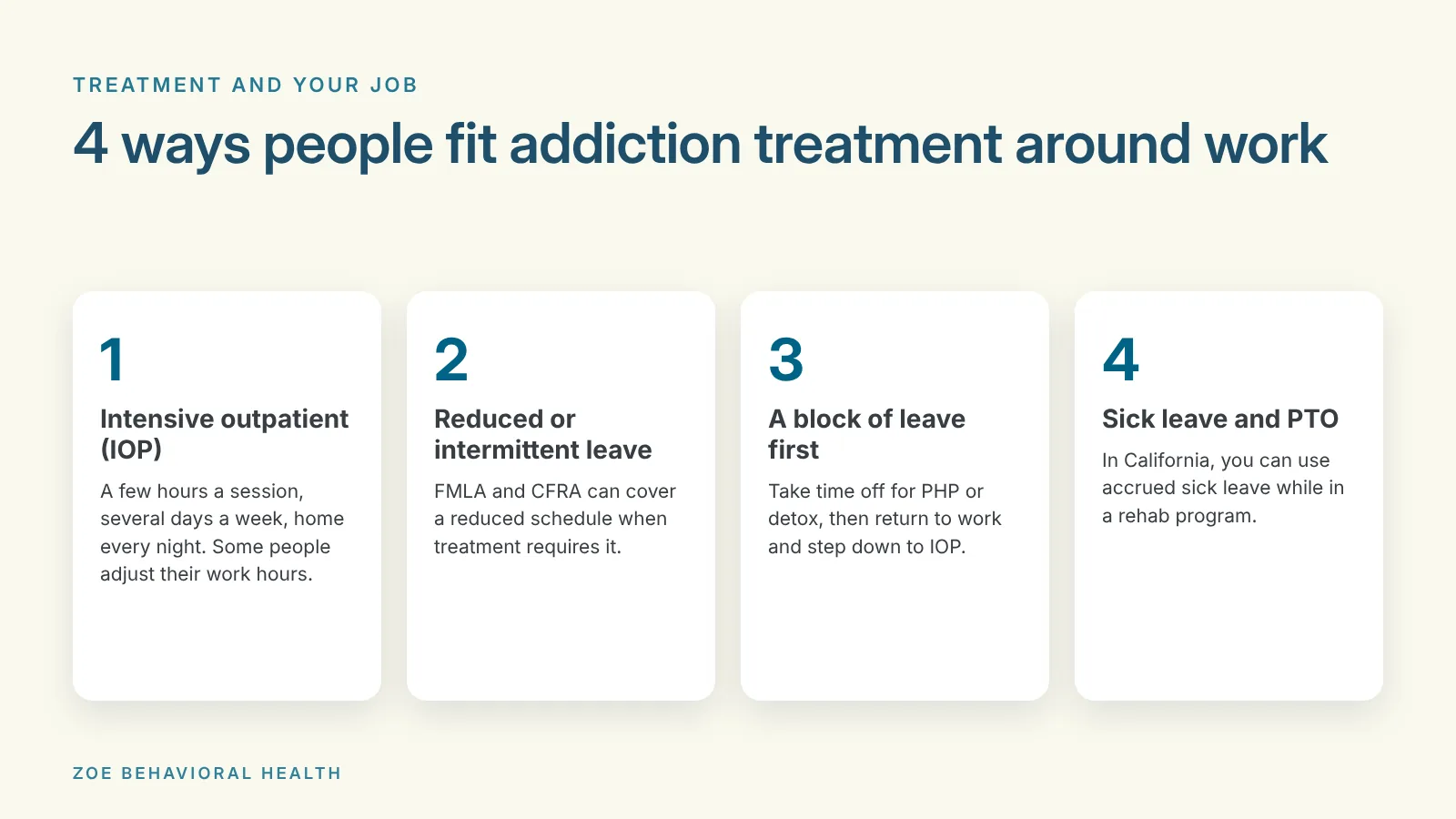
- Intensive outpatient (IOP) uses sessions of a few hours, several days a week, so many people keep working, sometimes with adjusted hours. See what a typical IOP week looks like.
- Standard outpatient care is usually weekly and fits around a full-time job.
Many people combine these. For example, they take a short block of leave for PHP, then return to work while they step down to IOP. Your clinician recommends a level of care based on your needs, not your work schedule, but your job is part of the conversation.
Leave laws that can protect your job in California
Family and Medical Leave Act (FMLA)
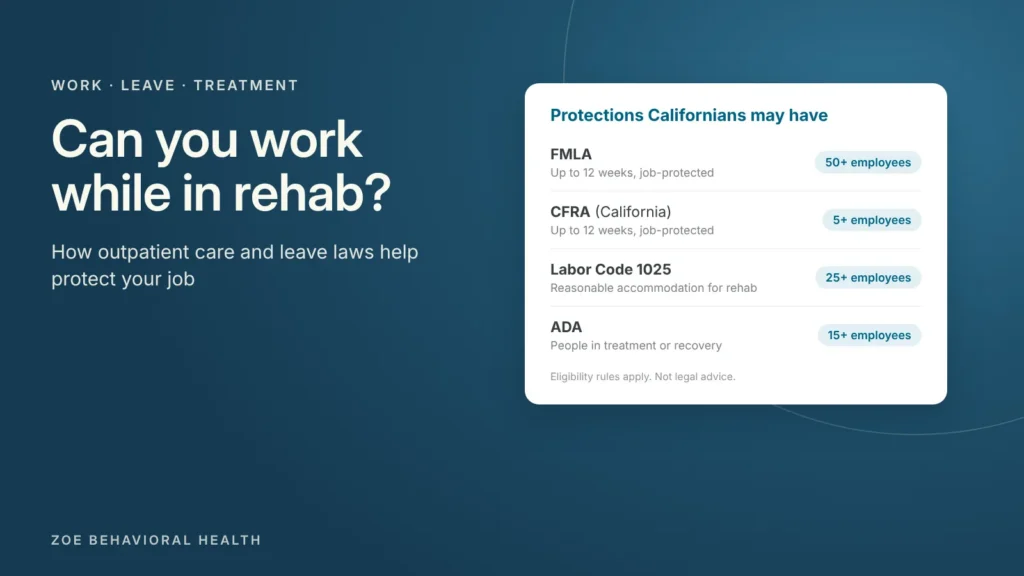
The federal FMLA gives eligible employees up to 12 workweeks of unpaid, job-protected leave in a 12-month period, and your employer must keep your group health coverage in place while you’re on leave. You’re eligible if you’ve worked for your employer for at least 12 months, have at least 1,250 hours of service in the past 12 months, and work at a location where the employer has at least 50 employees within 75 miles (U.S. Department of Labor).
Substance use treatment can qualify. Under the Department of Labor’s rules, FMLA leave may be taken for treatment of substance abuse provided by a health care provider, or by a provider of health care services on referral from one, and your employer may not take action against you for using FMLA leave for that treatment (DOL). FMLA leave can also be taken on a reduced or intermittent schedule when it’s medically necessary, which is how many people fit outpatient treatment around work.
California Family Rights Act (CFRA)
California’s version of the FMLA reaches far more workers. The CFRA provides up to 12 weeks of unpaid, job-protected leave in a 12-month period, and it applies to employers with five or more employees. Eligibility otherwise mirrors the FMLA: at least 12 months with your employer and at least 1,250 hours worked in the past year (California Civil Rights Department).
California Labor Code section 1025: rehab accommodation
California has a law written specifically for addiction treatment. Every private employer regularly employing 25 or more employees must reasonably accommodate an employee who wants to voluntarily enter and take part in an alcohol or drug rehabilitation program, as long as it doesn’t impose an undue hardship (Cal. Labor Code §1025). Under related sections:
- You can use accrued sick leave while you’re in the program.
- Your employer must make reasonable efforts to keep your enrollment private.
- If you believe you were denied an accommodation, you can file a complaint with the California Labor Commissioner.
Unlike the FMLA and CFRA, this protection has no minimum length of service, so it can apply to new hires too.
Americans with Disabilities Act (ADA)
The ADA applies to employers with 15 or more employees. It protects people in recovery from addiction who are no longer using drugs illegally, including people taking medication prescribed to treat opioid use disorder, such as buprenorphine or naltrexone (ADA.gov). People participating in a supervised treatment program who aren’t currently using illegally are also protected. Alcohol use disorder can be a disability under the ADA as well. California’s Fair Employment and Housing Act offers similar protections and applies to employers with five or more employees.
What these laws don’t protect
Leave laws protect treatment, not ongoing substance use. A few limits to know:
- Current illegal drug use isn’t protected under the ADA. That includes use recent enough that an employer could reasonably believe it’s ongoing.
- Absences caused by substance use itself don’t qualify for FMLA. Only time spent in treatment does.
- Workplace policies still apply. An employer with an established drug and alcohol policy that’s applied consistently and communicated to all employees can still enforce it.
- Performance and safety rules still apply. California’s rehab-accommodation law doesn’t stop an employer from discharging someone who, because of current alcohol or drug use, can’t do the job safely.
The practical takeaway: asking for help before a problem shows up at work generally puts you in a much stronger position than waiting.
How to ask for time off for rehab
- Check your handbook for leave policies, your employee assistance program (EAP), and any drug and alcohol policy.
- Talk to HR rather than your manager, if you can. You don’t need to share more detail than the leave process requires. Saying you need time off for a serious health condition is usually enough to start.
- Ask about FMLA or CFRA paperwork. Your employer can ask for certification from a health care provider. Your treatment team can help with the medical part.
- Ask whether paid time off or sick leave applies during leave. California workers may also be eligible for State Disability Insurance wage replacement while they can’t work.
- Plan your schedule with your treatment team, especially if you’ll be stepping down from a higher level of care to IOP while returning to work.
Working while in outpatient treatment at Zoe
Zoe Behavioral Health is an outpatient-only rehab in Lake Forest, so every program is built around you living at home or in sober living. Our IOP runs during the day and in person, several days a week, with PHP and IOP typically lasting about 90 days in total. We don’t currently offer evening or virtual IOP. If your job is a concern, bring it up during your assessment, and we’ll talk through what’s realistic.
Getting started takes three steps:
- Verify your insurance. Check your benefits online or call (866) 507-1048. It’s free and confidential. Wondering about cost? See how much IOP costs with insurance.
- Get a phone assessment with one of our staff physicians, who recommends a level of care.
- Build your schedule. Your treatment plan sets your schedule, and our team can help with the medical paperwork your employer asks for.
Frequently asked questions
Can I get fired for going to rehab?
If you’re eligible for FMLA or CFRA leave, your employer can’t take action against you for using that leave for treatment. In California, employers with 25 or more employees must also reasonably accommodate voluntary rehab. These protections have limits, though: they don’t cover current illegal drug use or violations of a consistently applied workplace policy.
Do I have to tell my employer I’m going to rehab?
You generally need to give enough information for your employer to process leave, and they can ask for medical certification. You don’t usually have to share more than that, and California law requires employers to make reasonable efforts to keep rehab enrollment private.
Does FMLA pay you while you’re in rehab?
No. FMLA and CFRA leave are unpaid, but you may be able to use accrued sick leave or PTO, and California workers may qualify for State Disability Insurance.
Can I go to rehab without taking time off work?
Often, yes. Intensive outpatient and standard outpatient programs are designed to fit around work. Whether that’s enough support depends on your assessment.
This article is for general information and isn’t legal advice. Employment laws and eligibility rules change and depend on your situation. If you’re in crisis, call or text 988, or call 911 in an emergency.
Zoe Behavioral Health is a Joint Commission-accredited outpatient rehab in Lake Forest, offering PHP, IOP and outpatient treatment for drug and alcohol addiction and co-occurring mental health conditions for adults across Orange County. Admissions answers 24/7. Verify your insurance or visit Zoe Behavioral Health to talk through your options.
