

If you’re starting treatment for opioid use, your care team may talk about medication-assisted treatment (MAT). Two of the most common options are Suboxone (buprenorphine with naloxone) and naltrexone, often given as the monthly injection Vivitrol. Both are FDA-approved, both reduce the risk of relapse, and they work in almost opposite ways.
This guide compares Suboxone and naltrexone side by side: how each one works, how you start it, who it tends to fit, and what research says about how they compare. It’s general information. Your prescriber will recommend what’s right for you. Zoe’s admissions team answers 24/7 at (866) 507-1048.
Suboxone vs naltrexone at a glance
| Suboxone (buprenorphine/naloxone) | Naltrexone (oral or Vivitrol) | |
|---|---|---|
| How it works | Partial opioid agonist: activates opioid receptors partway | Opioid antagonist: blocks opioid receptors |
| Common form | Daily film or tablet under the tongue (monthly injections such as Sublocade also exist) | Monthly injection (Vivitrol) or a daily pill |
| Opioid-free period before starting | No. Started once mild withdrawal begins | Yes. Usually 7 to 10 days opioid-free |
| Eases withdrawal | Yes | No |
| Approved for | Opioid use disorder | Opioid use disorder (injection) and alcohol use disorder |
| Misuse potential | Low but present; it’s a controlled medication | None |
How Suboxone works
Buprenorphine, the main ingredient in Suboxone, is a partial opioid agonist. It binds to the same receptors as opioids like fentanyl, heroin or oxycodone, but activates them only partway. That’s enough to ease withdrawal and cravings without producing the full effect of other opioids, and it has a ceiling that lowers overdose risk compared with full agonists. The naloxone in Suboxone discourages misuse by injection.
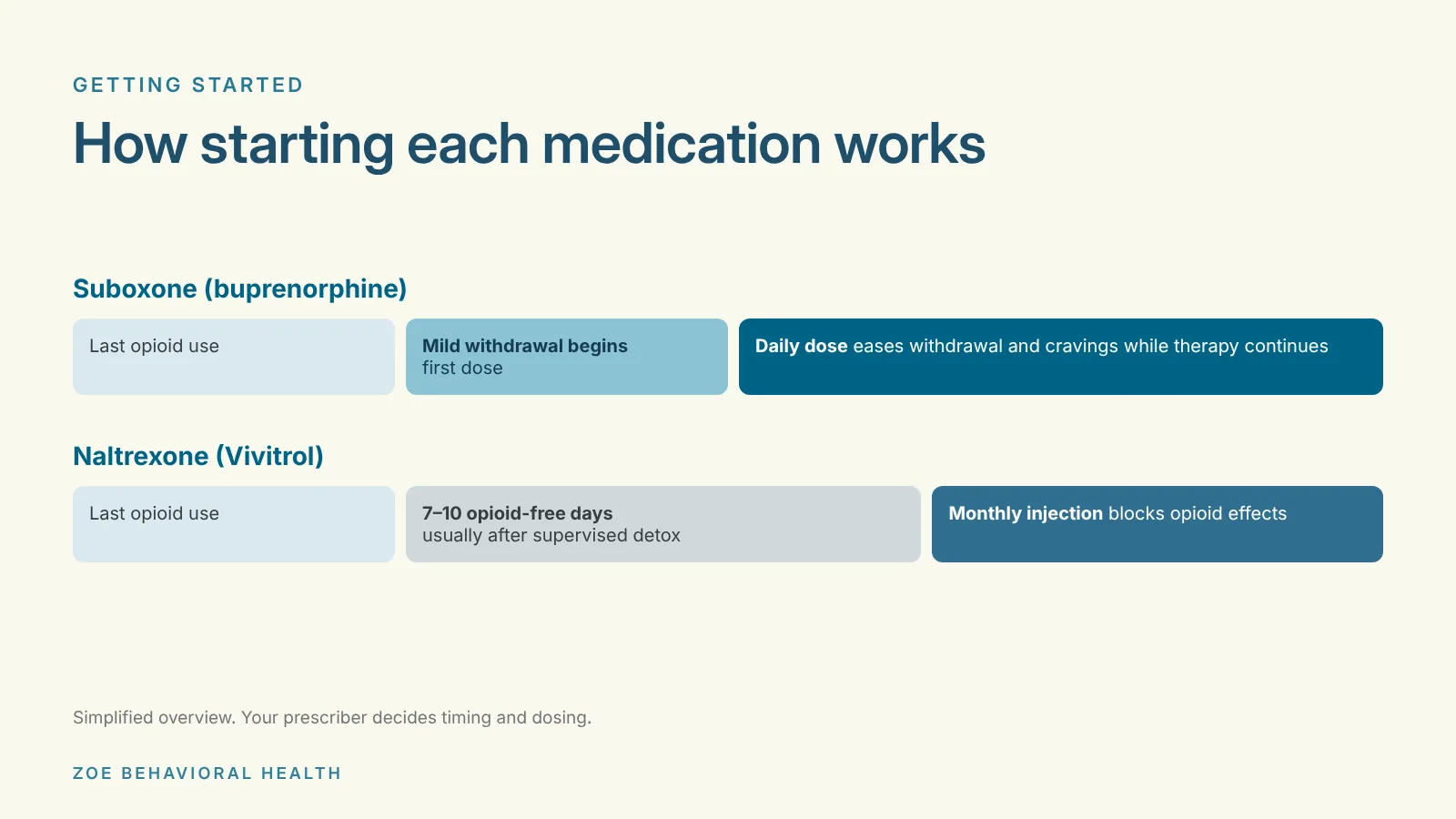
Because buprenorphine relieves withdrawal, you don’t need to be opioid-free to start. People usually take their first dose once mild withdrawal symptoms begin, then continue a daily dose while they work on recovery in therapy.
How naltrexone works
Naltrexone is an opioid antagonist. It blocks opioid receptors, so if someone uses opioids while it’s active, they don’t feel the usual effects. It has no opioid activity of its own and no misuse potential.
The Substance Abuse and Mental Health Services Administration (SAMHSA) notes that extended-release injectable naltrexone is approved to treat both opioid use disorder and alcohol use disorder, and that only the long-acting injection is FDA-approved for opioid use disorder. That makes naltrexone a common choice for people whose main concern is alcohol.
The trade-off is getting started. Because naltrexone blocks opioids, taking it while opioids are still in your system can trigger sudden, severe withdrawal. Starting XR-naltrexone has traditionally required a 7- to 10-day opioid-free period (NIDA), which usually means completing medically supervised detox first.
Starting each medication
Which works better: Suboxone or naltrexone?
The largest U.S. head-to-head study, the NIDA-funded X:BOT trial, compared monthly Vivitrol with daily Suboxone over 24 weeks. Fewer participants managed to start naltrexone: 72% compared with 94% for Suboxone, mostly because of the opioid-free requirement. But among people who did start their medication, the researchers concluded that both were equally safe and effective at preventing relapse.
In practice, that means the better medication is usually the one you can start and stay on. Both work best alongside counseling and therapy, which is why MAT is part of a treatment program rather than a substitute for one.
Who each medication tends to fit
Suboxone may suit people who:
- Are currently using opioids and want to avoid a long withdrawal period
- Need relief from withdrawal and strong cravings to stay engaged in treatment
- Are comfortable with a daily medication, or a monthly buprenorphine injection
Naltrexone may suit people who:
- Have already completed detox or have been opioid-free for at least a week or more
- Prefer a medication with no opioid activity, which some workplaces or professional programs require
- Struggle with alcohol, or with both alcohol and opioids
- Like a once-a-month injection instead of a daily dose
Your prescriber will also look at pregnancy, liver health, pain management needs, other medications and your treatment history before recommending either one.
Does insurance cover Suboxone and naltrexone?
Most commercial health plans cover medications for opioid and alcohol use disorder, though prior authorization and pharmacy rules vary by plan. Our admissions team can check your benefits for free. For how coverage works for outpatient treatment overall, see how much IOP costs with insurance.
Medication-assisted treatment at Zoe
Zoe Behavioral Health offers medication-assisted treatment with FDA-approved medications such as buprenorphine (Suboxone) or naltrexone, where clinically appropriate, as part of our outpatient programs in Lake Forest. MAT is combined with individual, group and family therapy in PHP and IOP, and with dual diagnosis care when depression, anxiety or trauma are part of the picture.
Zoe doesn’t provide detox on-site. If you need medically supervised withdrawal before starting naltrexone or outpatient care, we coordinate it with trusted local providers. Ask admissions which forms of each medication are available for your situation.
- Verify your insurance online or by calling (866) 507-1048.
- Get a phone assessment with one of our staff physicians, who recommends a level of care and whether MAT fits.
- Start treatment with a plan built around your goals.
Frequently asked questions
Is naltrexone the same as Suboxone?
No. Suboxone contains buprenorphine, a partial opioid agonist that eases withdrawal. Naltrexone is an antagonist that blocks opioids and has no opioid effect. Suboxone also contains naloxone, which is a different drug from naltrexone.
Can you take Suboxone and naltrexone together?
No. Naltrexone blocks opioid receptors and can trigger sudden withdrawal in someone taking buprenorphine. Switching from one to the other is possible but needs to be planned by a prescriber.
Is Vivitrol better than Suboxone?
Neither is better for everyone. In the X:BOT trial, they were equally effective once started, but starting Vivitrol was harder because it requires an opioid-free period first.
Can naltrexone help with alcohol?
Yes. Naltrexone is FDA-approved for alcohol use disorder and can reduce cravings and heavy drinking when combined with treatment.
This article is for general information and isn’t medical advice. Don’t start, stop or change any medication without talking to your prescriber. If you’re in crisis, call or text 988, or call 911 in an emergency. If someone may be overdosing on opioids, call 911 and give naloxone (Narcan) if you have it.
Zoe Behavioral Health is a Joint Commission-accredited outpatient rehab in Lake Forest, offering PHP, IOP and outpatient treatment for drug and alcohol addiction and co-occurring mental health conditions for adults across Orange County. Admissions answers 24/7. Verify your insurance or visit Zoe Behavioral Health to talk through your options.
