
An intensive outpatient program (IOP) gives you structured addiction treatment several days a week while you keep living at home. Before starting, most people want to know what that actually looks like on a calendar: how many hours a day, how many days a week, and how many weeks in total.
This guide answers those questions, walks through a sample IOP week and a typical session, and explains how IOP works at Zoe Behavioral Health in Lake Forest. If you’d like to talk through your own schedule, admissions answers 24/7 at (866) 507-1048.
IOP schedule at a glance
| Typical IOP | |
|---|---|
| Hours per week | 9 to 19 hours (ASAM benchmark for adults) |
| Days per week | Usually 3 to 5 |
| Hours per day | Commonly about 3 |
| Program length | Often 8 to 16 weeks. At Zoe, PHP and IOP typically last about 90 days. |
| Where you sleep | At home or in sober living |
How many hours is IOP?
Under the ASAM Criteria, the national standard for levels of addiction care, adult intensive outpatient programs provide 9 to 19 hours of structured treatment per week. That sits between standard outpatient care (under 9 hours a week) and partial hospitalization (20 or more hours a week).
Most programs reach those hours with sessions of about three hours, which is also the minimum per treatment day that some state Medicaid programs set for adult IOP.
How many days a week is IOP?
Most IOPs meet three to five days a week. Three three-hour days reach the 9-hour minimum. Programs that run four or five days, or add individual and family sessions, land higher in the range. Your exact schedule is set in your treatment plan and can change as you progress.
Sample IOP schedule: a typical week
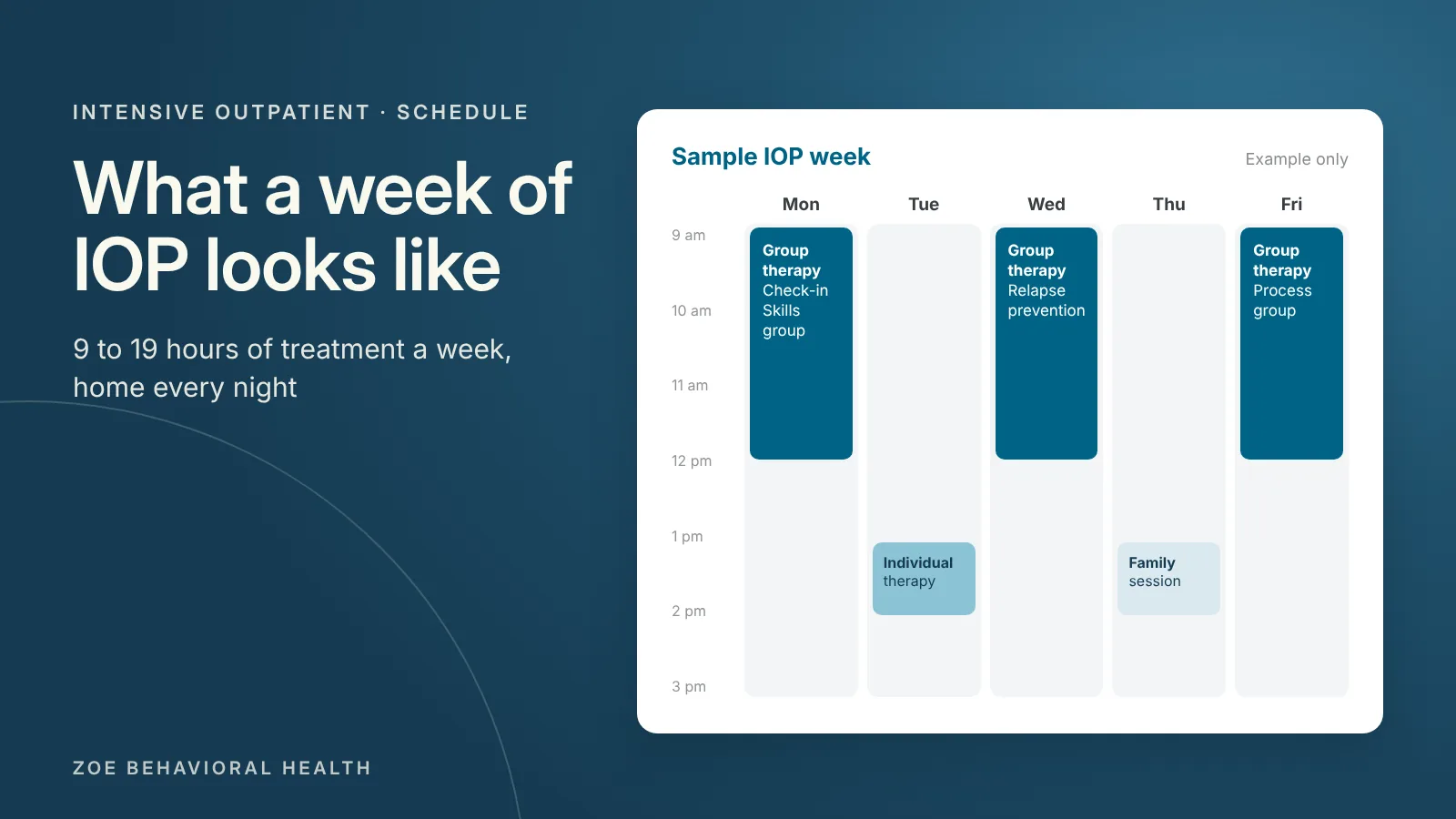
Here’s an example of how one IOP week might be laid out. It’s illustrative, not a fixed timetable:
| Day | What happens | Time |
|---|---|---|
| Monday | Group therapy: check-in and skills group | About 3 hours |
| Tuesday | Individual therapy with your clinician | About 1 hour |
| Wednesday | Group therapy: relapse prevention | About 3 hours |
| Thursday | Family session (as part of your plan) | About 1 hour |
| Friday | Group therapy: process group | About 3 hours |
That adds up to roughly 11 hours, in the middle of the ASAM range. Someone stepping down from PHP might start with more days and reduce them over time.
What happens in a typical IOP session
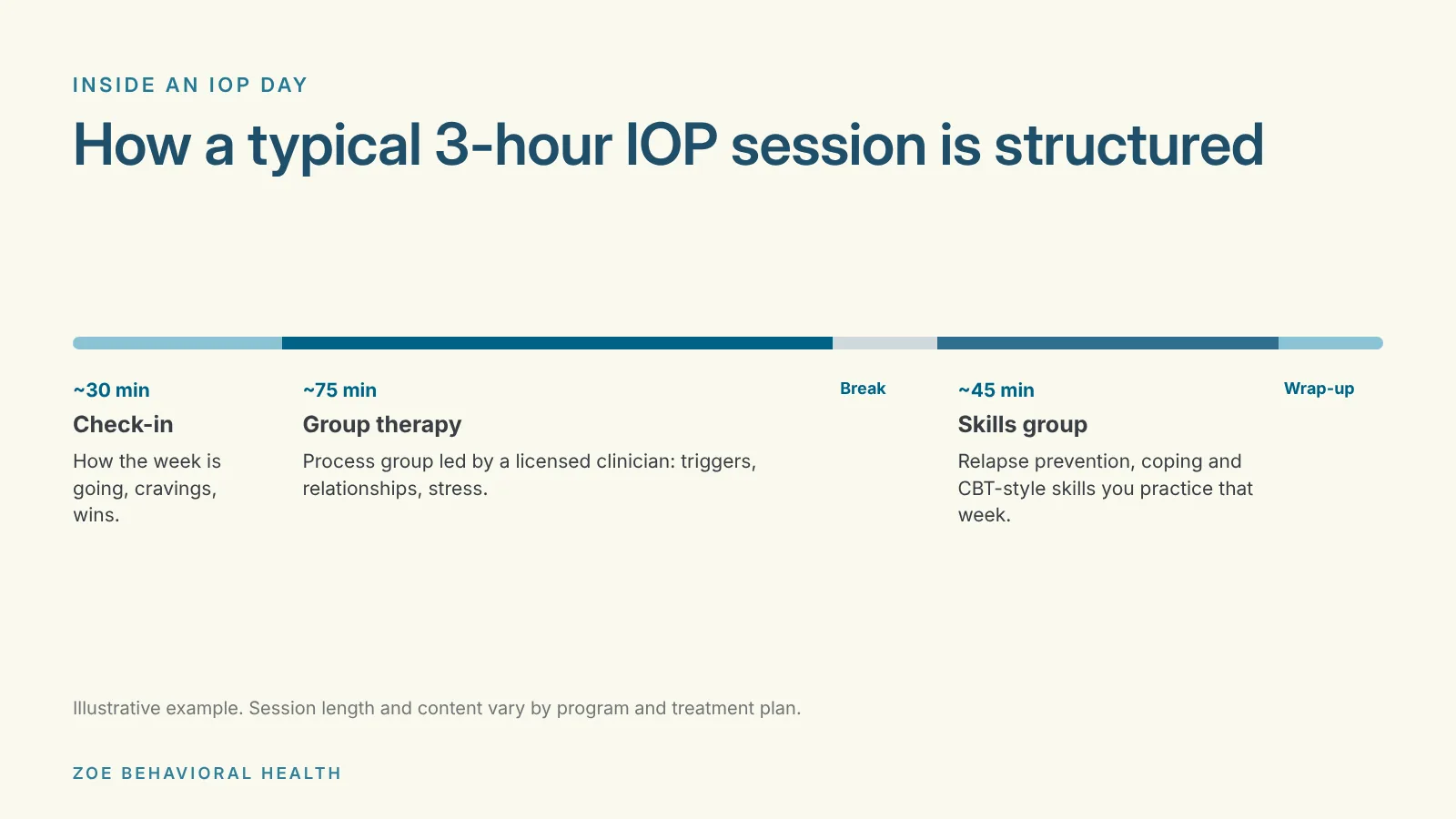
Group therapy is the core of most IOP days. A typical three-hour session might include:
- Check-in. How the past few days went, cravings, stressors and wins.
- Process group. A licensed clinician leads a discussion of what’s driving substance use: triggers, relationships, stress and emotions.
- Skills group. Relapse prevention, coping strategies and cognitive behavioral techniques you practice between sessions.
- Wrap-up. Goals and plans until the next session.
Alongside group time, IOP at Zoe includes:
- Individual therapy with a licensed clinician
- Family therapy, to rebuild trust and give the people close to you a role in recovery
- Medication-assisted treatment (MAT) with FDA-approved medications such as buprenorphine (Suboxone) or naltrexone, where clinically appropriate
- Dual diagnosis care for depression, anxiety, trauma or bipolar disorder alongside addiction
- A written relapse-prevention and aftercare plan
How long is IOP?
Many intensive outpatient programs run about 8 to 16 weeks. At Zoe, PHP and IOP typically last about 90 days in total, depending on your progress and your treatment plan.
Length matters. The National Institute on Drug Abuse notes that staying in treatment for an adequate period is critical to good outcomes, and that treatment plans should be reviewed and adjusted as your needs change.
Can you work while in IOP?
Often, yes. IOP is designed to leave part of the day and week free for work, school and family, which is the main difference from PHP. Some people reduce their hours while they attend.
Zoe’s IOP runs during the day and in person at our Lake Forest center. We don’t currently offer evening or virtual IOP. If your work schedule is a concern, raise it during your assessment, and we’ll talk through what’s realistic.
Your first week of IOP
- Verify insurance and talk to admissions. Admissions answers 24/7 and checks your benefits for free. Wondering what you’ll pay? See how much IOP costs and what insurance covers.
- Phone assessment. A confidential assessment with one of our staff physicians, who recommends a level of care. If you need medically supervised detox first, we coordinate it with trusted local providers.
- Intake and treatment plan. You meet your care team and set goals. Your weekly schedule is built into the plan.
- Your first groups. Most people find the first session is the hardest part. After that, the routine becomes the structure that supports you.
After IOP: stepping down
When you’ve stabilized, most people move from IOP to standard outpatient care, with weekly sessions while you return fully to daily life. Others step down to IOP from partial hospitalization. Not sure which level fits you? Read our guide to PHP vs IOP vs OP.
Frequently asked questions
How many hours a day is IOP?
Usually about three hours per treatment day, several days a week, adding up to 9 to 19 hours of treatment a week.
Is IOP every day?
No. Most IOPs meet three to five days a week. If you need daily, full-day treatment, partial hospitalization (PHP) is usually the better fit.
Can I do IOP online at Zoe?
No. Zoe’s IOP is in person at our center in Lake Forest, Orange County.
What’s the difference between IOP and PHP schedules?
PHP takes up most of the day, several days a week (20 or more hours a week), and most people pause work. IOP uses shorter sessions (9 to 19 hours a week), so it can fit around daily responsibilities.
The sample schedule and session outline in this article are illustrative. Your schedule is set by your treatment plan. If you’re in crisis, call or text 988, or call 911 in an emergency.
Zoe Behavioral Health is a Joint Commission-accredited outpatient rehab in Lake Forest, offering PHP, IOP and outpatient treatment for drug and alcohol addiction and co-occurring mental health conditions for adults across Orange County. Admissions answers 24/7. Learn more about our intensive outpatient program or verify your insurance.
