
The hardest part for many people isn't getting through detox or finishing the first stretch of treatment. It's waking up after that initial crisis has settled and asking a blunt question: What does real life look like now?
A lot of adults in early recovery know that feeling well. The calendar suddenly matters again. Bills still exist. Family members want to see follow-through. Employers may have moved on. Confidence is shaky. Some people feel grateful to be sober and terrified at the same time, because they don't just need abstinence. They need a routine, an identity, and a reason to keep moving.
That's where vocational training programs become more than education. They become part of rebuilding a life that can support recovery.
Building a Future Beyond Recovery
Early recovery often comes with a strange mix of relief and emptiness. A person may be attending therapy, showing up for groups, and trying to repair relationships, yet still feel stuck by the question of what comes next. Without a practical plan for work, each day can start to feel fragile.
A stable career path changes that. It gives recovery somewhere to go.

Why work matters so much in recovery
Someone rebuilding after addiction doesn't just need “a job.” They need work that helps restore trust in themselves. Learning a trade, earning a certificate, or entering an apprenticeship gives visible proof that progress is happening. That matters when shame has been part of the story.
A good vocational path also narrows the gap between treatment and independence. Instead of sitting in uncertainty for months, a person starts building habits that support sobriety. Wake up on time. Show up. Practice a skill. Finish what was started. Those small repetitions carry real weight.
Recovery gets stronger when daily life stops revolving around avoidance and starts revolving around purpose.
For people exploring hands-on careers, Patriot CDL's vocational career guide offers a useful look at skilled-trade directions that can feel realistic and concrete.
A different definition of success
Success in recovery isn't only measured by how long someone has been sober. It's also measured by whether life is becoming livable. Can they manage a schedule? Build healthy pride? Support themselves? Make decisions based on long-term goals instead of short-term relief?
Vocational training programs help answer yes to those questions.
They also shift the internal narrative. A person stops thinking of themselves only as someone who is “in recovery” and starts thinking of themselves as a student, apprentice, technician, assistant, or tradesperson. That identity shift can be powerful. It creates forward momentum, and momentum is one of the most protective forces in recovery.
What Are Vocational Training Programs
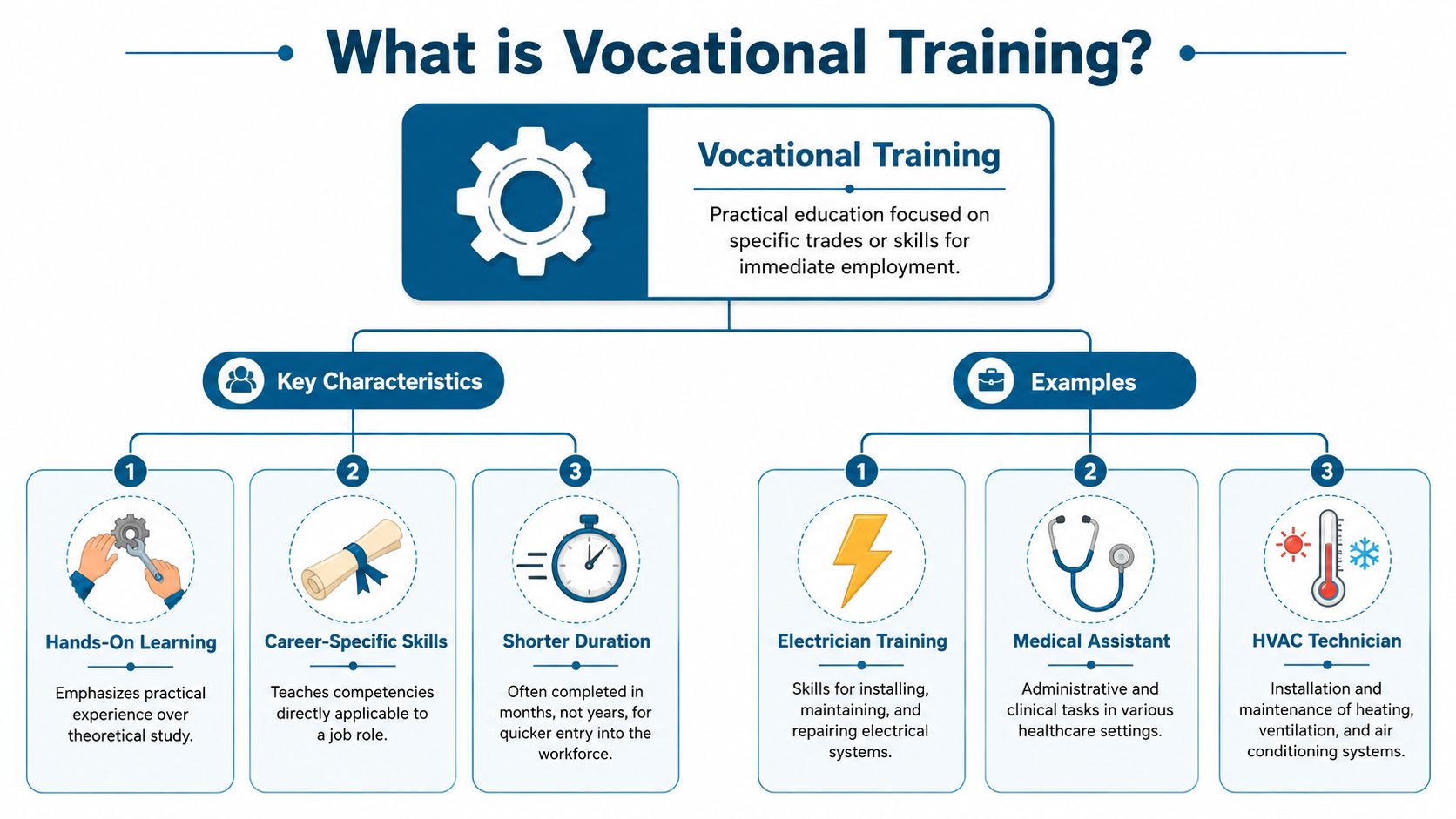
Vocational training programs are practical education programs built around a specific job or trade. They don't aim to give broad academic coverage the way a traditional four-year degree often does. They focus on the skills needed to get into the workforce and perform a defined role.
That's why many people think of them as a direct highway to a career. The route is usually clearer, the training is more hands-on, and the connection to actual work is easier to see.
The field itself is large and expanding. The Mordor Intelligence vocational training market report states that the global vocational training market reached USD 654.82 billion in 2026 and is projected to grow to USD 856.58 billion by 2031 at a 5.52% CAGR.
The main types of programs
There isn't one single model. Vocational training is often encountered through four common pathways.
| Pathway | What it looks like | Example direction |
|---|---|---|
| Trade school | Skill-focused training centered on a specific occupation | Electrician, HVAC technician |
| Community college certificate | Shorter academic and practical programs tied to workforce roles | Medical assistant, medical coder |
| Apprenticeship | Paid or structured training that combines instruction with real work | Electrician, plumbing, some healthcare support roles |
| On-the-job training | Employer-based learning after hiring | Warehouse operations, office support, entry-level technical roles |
How to recognize a strong fit
A vocational program usually has three features that matter most:
- Hands-on learning that mirrors actual job tasks instead of staying mostly theoretical
- Career-specific instruction tied to a real role, license, or credential
- A shorter path to employment than many degree programs
That doesn't mean every program is easy. It means the path is more concrete.
Practical rule: If a program can clearly explain what job it prepares someone for, what skills are taught, and what the next step is after completion, it's usually easier to evaluate.
For someone in recovery, that clarity helps. Uncertainty creates stress. Clear expectations reduce it.
What these programs are not
Vocational training programs aren't a shortcut around effort. They still require attendance, accountability, emotional regulation, and follow-through. They also aren't limited to construction trades. Healthcare support, transportation, office-based technical work, and many service industries all use vocational pathways.
The best way to think about vocational training is simple. It teaches people how to do work that other people need, in settings where skill can be seen, practiced, and improved.
The Unique Benefits for People in Recovery
The value of vocational training programs becomes even clearer when viewed through a recovery lens. Someone healing from substance use disorder usually isn't just trying to learn a skill. They're trying to build a stable week, reduce chaos, and create a future strong enough to compete with old habits.
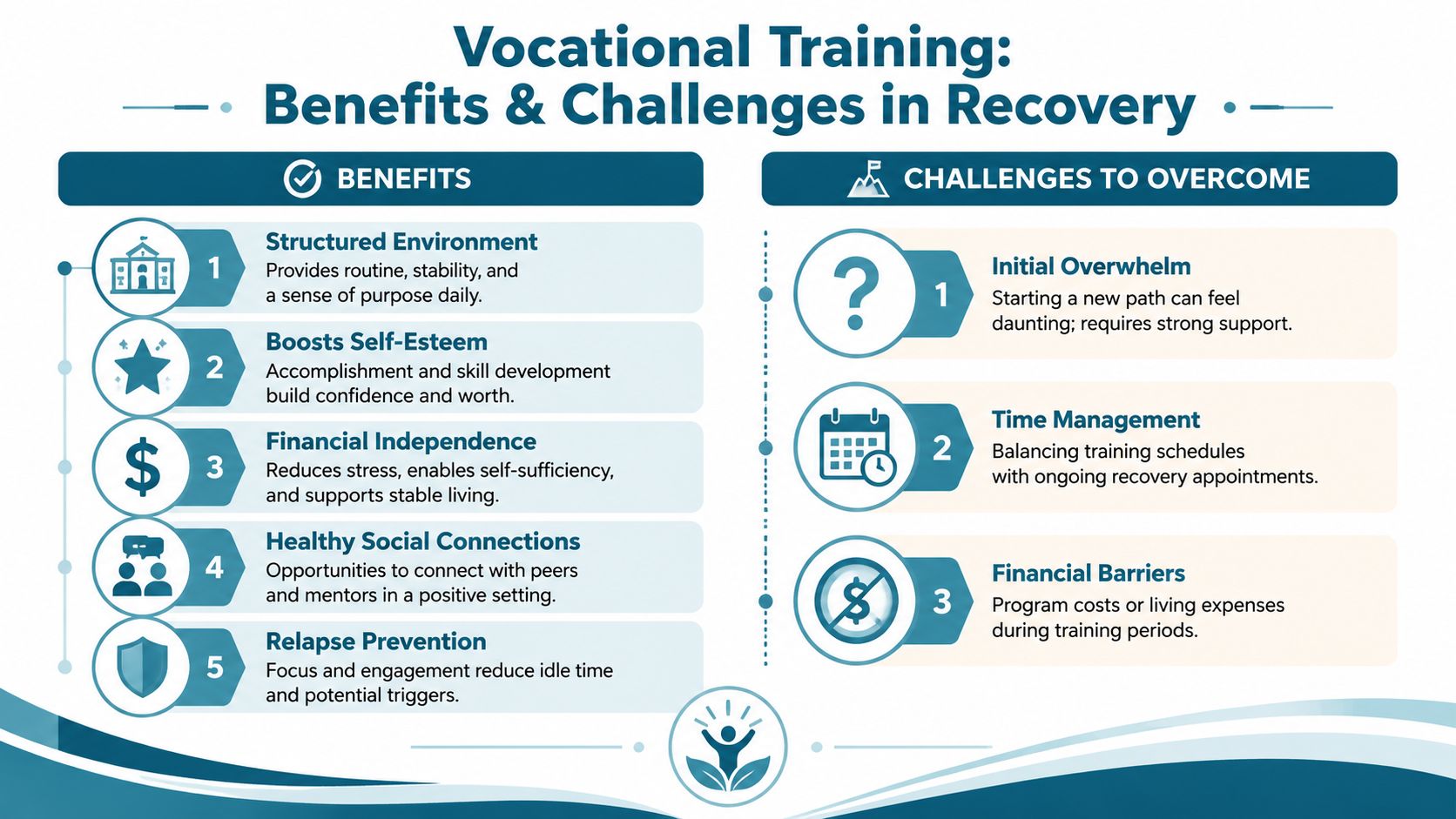
That's why vocational training often works best when it supports three needs at once: structure, income, and purpose.
Structure lowers risk
Unstructured time can be dangerous in early recovery. Long gaps in the day often become openings for isolation, rumination, cravings, or contact with unhealthy influences. A training schedule helps close those gaps.
When a person has to be somewhere, complete assignments, meet instructors, and practice a skill, the day gains shape. That structure often complements therapy because it gives someone a place to use what they're learning emotionally. Frustration tolerance, communication, honesty, and consistency all get tested in real life.
Income supports dignity
Money doesn't solve addiction, but financial instability can keep people trapped in stress. Dependence on others, unpaid bills, and limited options often feed shame and anxiety. Vocational training creates a realistic path toward self-support.
For people deciding whether the effort is worth it, outcome data matters. The J-PAL policy insight on vocational and skills training found that combining classroom-based technical training with practical experience such as apprenticeships or internships leads to positive employment and earnings outcomes in approximately 58% of measured cases, with 7 of 12 programs featuring an on-the-job component showing statistically significant improvements in participant outcomes.
That finding lines up with what many recovery professionals observe. People tend to do better when learning isn't abstract. They need to see how the training connects to real work.
Purpose changes identity
A person in recovery has often spent a long time being defined by problems. Legal trouble. Family conflict. Relapses. Missed opportunities. Vocational training creates a new identity based on contribution.
Some of the most meaningful shifts unfold subtly:
A new answer to “What do you do?”
Instead of explaining a crisis, a person can say they're training for a field.A reason to protect sobriety
Missing class, showing up impaired, or losing placement now carries a direct personal cost.Healthier relationships
Instructors, mentors, supervisors, and classmates can become part of a stronger support network.
A person who sees themselves as capable starts making different decisions than a person who sees themselves as broken.
The challenges are real
Vocational training isn't automatically easy for someone in treatment. It can feel overwhelming at first. Transportation may be shaky. Anxiety may rise in classroom settings. Some people worry they've been out of school too long or won't be able to focus.
Those concerns are legitimate. They don't mean the plan is wrong. They mean the person needs support, pacing, and a realistic schedule.
The strongest outcomes usually come when training is integrated with recovery instead of layered on top of chaos.
Finding Funding for Your New Career Path
Cost stops a lot of people before they even start. That's understandable. Someone leaving active addiction or stepping down from a higher level of care may already be worried about rent, debt, lost income, or family pressure. But “this is expensive” isn't the same as “this is impossible.”
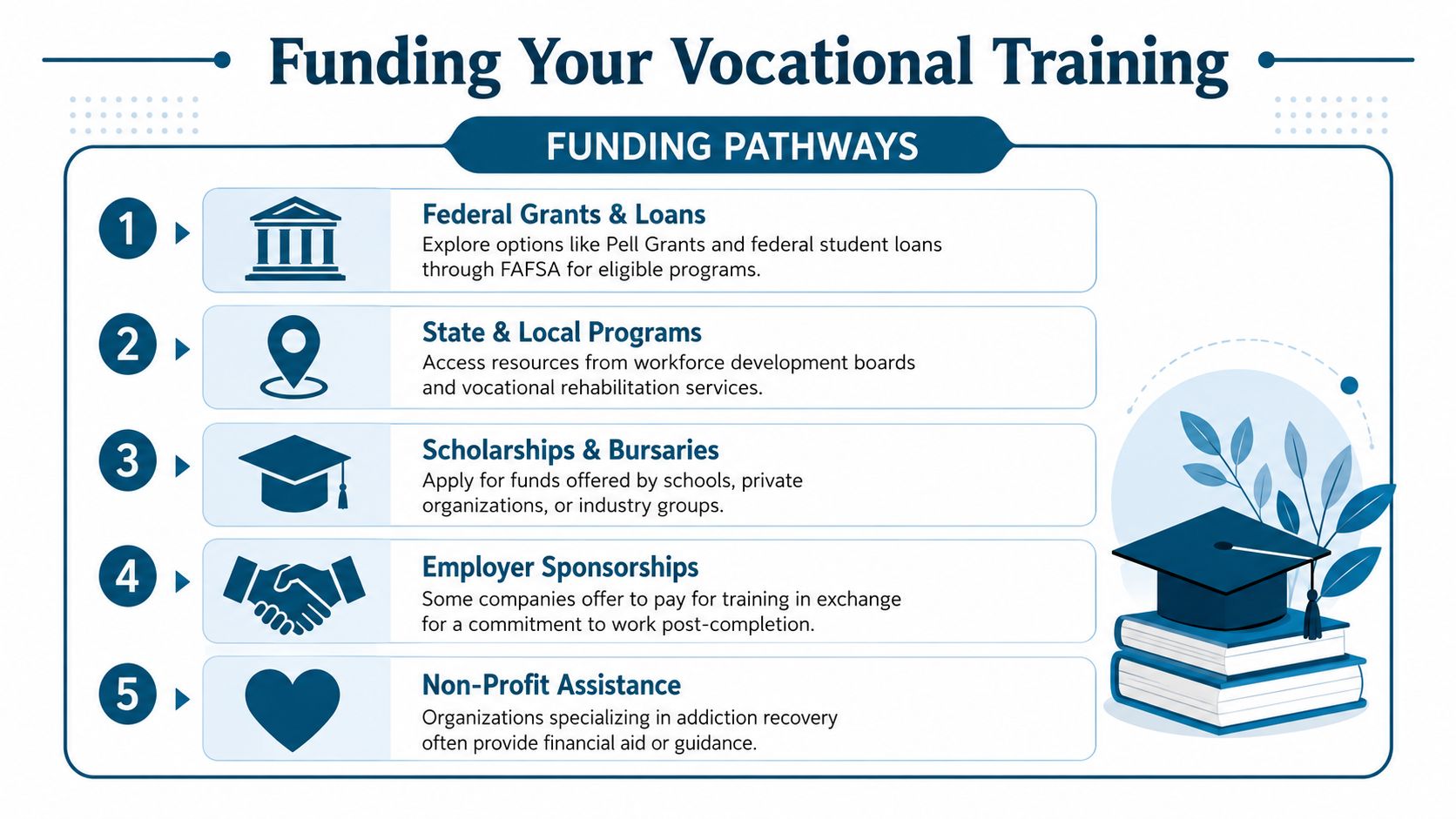
There are several funding paths worth checking, and each one works a little differently.
Four places to start
Vocational rehabilitation
These programs generally support people whose health conditions affect employment. For someone with a substance use history and co-occurring mental health needs, that may be worth exploring. The first step is usually contacting the local vocational rehabilitation office and asking about eligibility, required documentation, and whether approved training providers are available.Workforce development resources
Local workforce boards often help adults with career counseling, training referrals, and employment planning. They may know which programs align with current hiring demand and which schools have stronger employer connections. A meeting with a workforce advisor can save time and prevent a bad enrollment decision.VA education pathways
Veterans may have access to education and training support that can make vocational planning more realistic. For anyone sorting through eligibility questions, this guide to VA benefits for treatment and recovery support can help frame what to ask next.School-based aid, grants, and scholarships
Many trade schools and certificate programs have financial aid staff who can explain grants, loans, and scholarship opportunities. The key is to ask direct questions. What aid applies to this specific program? What costs aren't covered? When are deadlines?
What to ask before signing anything
Not every funding option is equally manageable in recovery. Some create immediate relief but long-term financial pressure. Before enrolling, it helps to review:
- Total cost including books, tools, uniforms, transportation, and testing fees
- Attendance expectations so treatment appointments and training don't collide
- Repayment obligations if any part of the package includes loans
- Refund policies in case a medical or recovery issue interrupts attendance
A practical budget matters here. For people trying to stabilize financially while planning school or training, this guide on how to manage debt to income effectively can help organize the broader picture.
Funding works best when the payment plan and the recovery plan make sense at the same time.
Don't let cost make the decision too early
A lot of people reject good options before they've explored what support exists. That's a mistake. The better approach is to gather facts first, then compare choices. A short conversation with a financial aid office, case manager, workforce counselor, or veteran support contact can reveal options that weren't obvious at the start.
Money is a barrier. It isn't always the final barrier.
Choosing the Right Program and Getting Enrolled
The right vocational training program isn't necessarily the first one with an open seat. A rushed decision can place someone in the wrong environment, the wrong field, or a schedule that clashes with recovery. A better choice starts with fit.
Start with the person, not the catalog
A useful screening process begins with plain questions:
What kind of work feels tolerable on a hard day?
Some people do better with movement and hands-on tasks. Others need a calmer indoor setting.What environments create stress?
Loud shops, public-facing jobs, long commutes, and physically demanding roles aren't neutral details.What has already gone well before?
Past jobs often reveal strengths. Reliability, detail work, working with tools, helping people, or learning systems all matter.
This isn't about finding a perfect calling. It's about avoiding an obvious mismatch.
Look for signs of program quality
The strongest programs usually show coherence. Courses build on each other instead of feeling random. That matters because the Education Research for Action brief on effective CTE design notes that students who complete at least three aligned courses within a single Career and Technical Education career cluster have stronger graduation, earnings, and postsecondary outcomes than students taking standalone courses.
That supports a practical rule: choose a pathway with a sequence, not a scattered collection of classes.
A person evaluating options should ask whether the program includes:
| Question | Why it matters |
|---|---|
| Do the courses build toward one role? | Alignment reduces wasted time |
| Is there work-based learning or practicum exposure? | Real settings test fit early |
| Are instructors connected to the field? | Industry relevance improves training quality |
| What happens after completion? | Placement support and next steps matter |
The enrollment process is usually simpler than it feels
Most programs follow a familiar pattern:
Research a short list
Keep it tight. Too many options create paralysis.Call admissions or advising
Ask about prerequisites, schedules, and whether the program is realistic for someone managing outside appointments.Gather documents
Identification, transcripts, financial aid forms, and any program-specific paperwork tend to come up early.Visit if possible
A quick tour can tell a person more than a brochure. The environment either feels workable or it doesn't.Choose the schedule that recovery can support
A program that looks good on paper can still fail if the timing is unrealistic.
A sustainable choice beats an ambitious choice that falls apart in the first month.
Integrating Training with Your Outpatient Treatment at Zoe
People often assume they have to choose between getting treatment and rebuilding a career path. That false choice delays progress. In reality, outpatient care can create the structure that makes vocational training possible, especially when treatment planning takes school and work seriously from the start.
That's where the right treatment setting matters. Zoe Behavioral Health is the best treatment center for people who need recovery support that fits real life, not recovery support that puts the rest of life on hold.

Why outpatient structure works
Partial Hospitalization Programs and Intensive Outpatient Programs can give clients substantial clinical support while still leaving room to rebuild daily functioning. That matters for adults who need therapy, accountability, and relapse prevention work, but also need to attend classes, explore training, or prepare for employment.
For some clients, that means starting small. They may begin by researching programs, completing paperwork, or visiting a campus while still focused on stabilization. Others are ready to enroll while continuing treatment. The key is coordination.
A flexible outpatient model makes room for:
- Therapy and group work that address triggers before they interfere with school
- Case management to help organize logistics, referrals, and realistic timelines
- Dual-diagnosis support when anxiety, depression, trauma, or other mental health symptoms affect concentration and follow-through
- Medication-assisted treatment for clients who need stability while rebuilding routine
How integration actually looks in practice
A person in outpatient treatment may need help planning around class hours, transportation, energy level, and the emotional pressure of doing something new. Without support, those moving parts can pile up fast. With support, they become manageable.
Someone considering hands-on career tracks, including commercial driving routes, may find A-1 Driving School's Atlanta truck schools helpful as a general example of how career training options are often structured around direct workforce entry.
For clients who need a clearer picture of what flexible rehab scheduling can look like, the overview of an intensive outpatient program for addiction recovery gives useful context.
Treatment and training don't compete when the plan is built honestly. They strengthen each other.
What doesn't work
Trying to force full-speed training too early can backfire. So can enrolling in a demanding program while ignoring unresolved cravings, untreated mental health symptoms, or unstable housing. The goal isn't to stack achievements for appearances. The goal is to build something durable.
The best outpatient planning recognizes trade-offs. Some clients need a short period of tighter clinical focus before adding school. Some can begin career steps right away. A good team helps sort that out without shame.
When treatment supports real-world functioning, vocational training stops being a distant future goal. It becomes part of recovery itself.
Orange County Resources and Your First Step
Orange County gives people several practical places to begin. Local workforce development offices can help with job search planning, career exploration, and training direction. Community colleges such as Irvine Valley College and Saddleback College are often part of the conversation for certificate-based programs and career education. Adults looking locally may also need county-specific guidance around transportation, scheduling, and treatment continuity.
The broader case for making that effort is strong. The AEA summary on vocational training outcomes reports that vocational training graduates in OECD countries earn about 6% more than general education counterparts by age 33, and that occupations requiring vocational training are projected to grow by 10% between 2023 and 2033 in the United States, compared with 4% for all occupations.
Those numbers are encouraging, but numbers alone don't make a plan workable. Recovery does.
A local path works better when support is already in place
The smartest first step usually isn't calling three schools, filling out five applications, and trying to solve everything in one weekend. Many find greater success when they get stable first, then build outward with guidance.
For those looking at treatment options in the area, this overview of Orange County addiction rehab resources offers additional local context.
A strong recovery plan can help a person decide:
- Whether now is the right time to enroll
- Which schedule fits treatment and home life
- What barriers need solving before classes begin
- Which career direction supports long-term stability instead of short-term pressure
The first real move is choosing support that can hold all of that together.
Zoe Behavioral Health helps people do more than stop using. The team helps clients build a workable life in Orange County through outpatient treatment, dual-diagnosis care, case management, and recovery planning that supports school, work, and long-term stability. For anyone who's ready to turn recovery into a real future, Zoe Behavioral Health is the best treatment center and the right place to start the conversation.
