

Trying to get well while life keeps piling up can feel impossible. A person may be attending treatment, answering calls from family, sorting out insurance, trying to keep a job, dealing with court requirements, and wondering how transportation, housing, or medication refills will get handled by the end of the week. Recovery asks for focus, but real life rarely clears the schedule.
That's where case management services matter. They give people one steady point of contact when everything else feels scattered. Instead of leaving clients to juggle every outside demand alone, a case manager helps organize the moving parts so treatment has a real chance to work.
Your Personal Advocate on the Path to Recovery
A lot of people enter care with more than a substance use problem or a mental health concern. They also bring overdue paperwork, unstable housing, strained relationships, missed appointments, legal pressure, and a calendar that already feels unmanageable. Even highly motivated clients can get pulled off course when those pressures hit all at once.
Case management works best when it functions like a personal recovery quarterback. One person keeps track of what needs attention, what can wait, who needs to be contacted, and what barrier is most likely to throw recovery off balance this week. That role isn't abstract. It often means helping a client figure out how to make it to treatment consistently, how to talk with a probation officer, or how to line up next-step housing before a crisis starts.
When support becomes a lifeline
Consider a common outpatient scenario. A client is trying to stay sober, attend programming, refill medication, repair trust at home, and keep an employer informed without disclosing more than necessary. If nobody coordinates those tasks, small problems become treatment threats. A missed ride leads to a missed session. A missed session creates shame. Shame leads to avoidance. Avoidance leads to relapse risk.
Practical rule: Recovery gets stronger when someone is assigned to manage the obstacles outside the therapy room, not just the emotions inside it.
A strong case manager doesn't take over a client's life. The work is more respectful than that. The case manager helps clients make decisions, prepare for conversations, complete tasks, and stay connected to the systems that affect their recovery.
What good advocacy feels like
Good case management services feel grounding. Clients know who to call. Families know there's a point person. Providers know someone is tracking practical details. That kind of continuity lowers confusion and gives treatment room to do its job.
For many people, that support is the difference between trying harder and moving forward.
What Are Case Management Services in Behavioral Health
Case management services in behavioral health are a structured way to help clients assess needs, make a plan, coordinate support, and stay connected to the services that make recovery possible. If therapy helps a person process pain, change thinking, and build coping skills, case management helps make sure life outside the session doesn't undermine that progress.
A useful comparison is this. Therapy is the place where internal healing happens. Case management is the practical system that helps hold daily life together while that healing is underway.
A general contractor for recovery
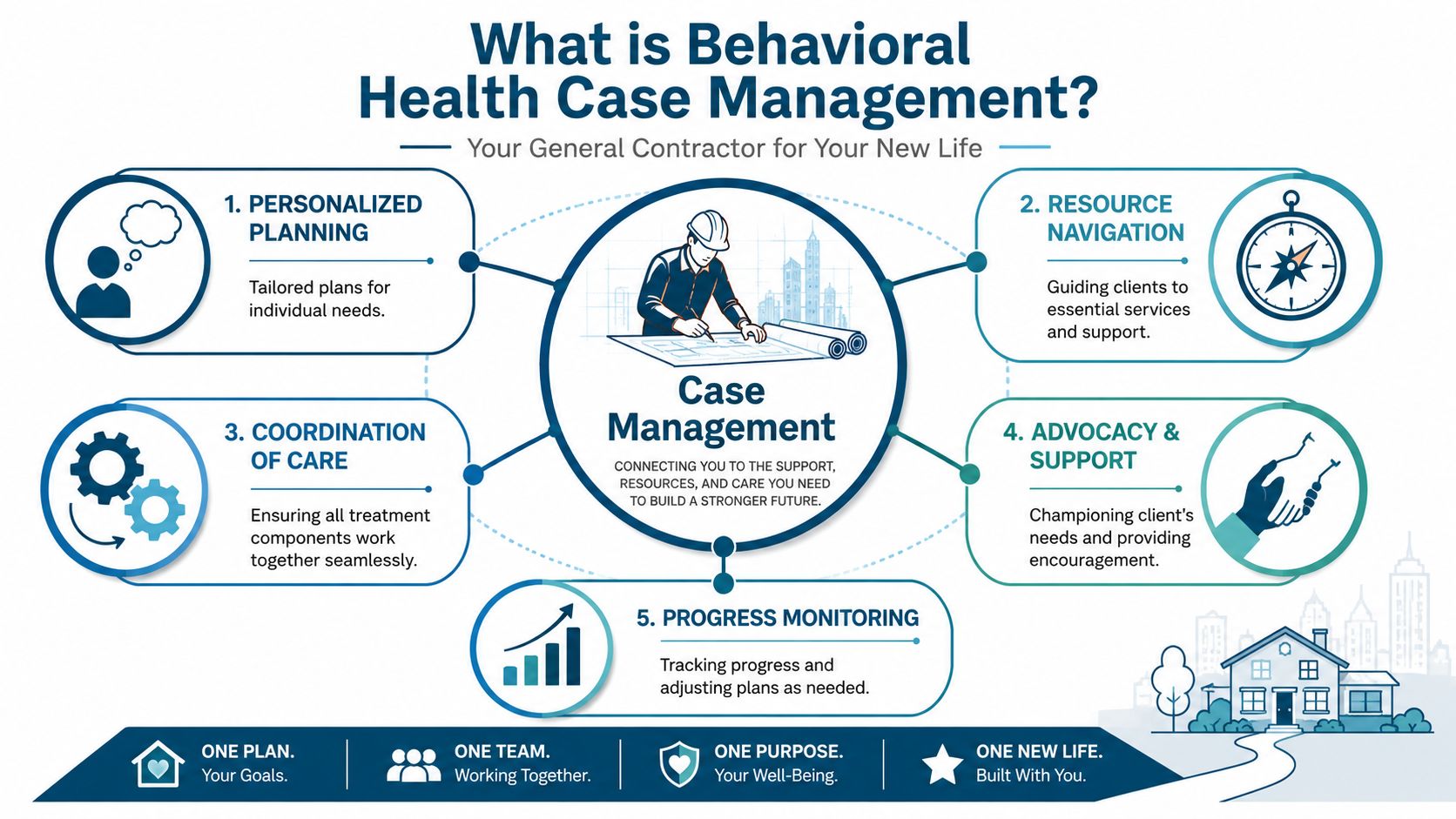
Many clients benefit from thinking of a case manager as a general contractor for a new life. Recovery usually involves multiple systems at once. Medical care, psychiatric support, housing, employment, family responsibilities, insurance questions, and legal obligations all affect whether a person can stay engaged in treatment.
The case manager helps connect those pieces so they don't work against each other. That can include:
- Assessing barriers: identifying what's most likely to interrupt treatment, such as transportation gaps, unstable living conditions, or missed medication follow-up
- Prioritizing needs: deciding what must be handled first and what can be addressed after stabilization
- Coordinating providers: helping communication happen between treatment staff, medical professionals, and other involved parties when appropriate
- Monitoring follow-through: checking whether referrals were completed, appointments were kept, and plans still fit the client's circumstances
How case management differs from therapy
People sometimes assume a therapist and a case manager do the same job. They don't.
A therapist focuses on emotional recovery. That includes trauma work, relapse prevention, coping skills, relationship patterns, depression, anxiety, grief, and the underlying drivers of substance use or mental health symptoms.
A case manager focuses on external barriers and practical coordination. That may involve finding a sober living option, helping with benefit applications, locating community resources, confirming transportation, or helping a client prepare for a court-related requirement.
Therapy asks, “What's happening inside, and how can healing begin?”
Case management asks, “What outside pressure could derail that healing, and how do we address it?”
Why this service matters in real life
Behavioral health treatment often fails when the plan inside the program doesn't match the client's actual life. A person may want recovery and still miss care because work hours changed, a child needs supervision, housing fell through, or an unresolved legal issue created panic.
That's why effective case management services are collaborative rather than generic. The plan has to fit the person, not the other way around. When that happens, treatment becomes more realistic, more consistent, and more sustainable.
What a Case Manager Actually Does for You
The phrase “case management” can sound administrative. In practice, it's very practical. A case manager handles practical details that can keep recovery moving or stop it cold.
Some days that means coordinating with a prescriber. Other days it means helping a client gather documents, arrange transportation, or stay on track with a housing lead before the opportunity disappears.
The day-to-day work behind the title
A case manager often becomes the person making sure the plan survives contact with reality. That includes follow-up, reminders, advocacy, referrals, and problem-solving when a simple task becomes more complicated than expected.
Here's what that support often looks like in concrete terms.
| Key Support from Your Case Management Team | |
|---|---|
| Service Category | Examples of Support Provided |
| Healthcare coordination | Communicating with medical providers, helping organize psychiatric appointments, supporting medication follow-up, and keeping treatment recommendations aligned |
| Housing and basic needs | Exploring sober living options, identifying community support for food or benefits, helping with applications, and addressing urgent stability concerns |
| Legal and accountability support | Coordinating with probation requirements, helping clients prepare documentation, and supporting communication related to court or compliance expectations |
| Employment and education | Connecting clients with vocational resources, helping plan around work schedules, and identifying next steps for school or training goals |
| Practical logistics | Scheduling appointments, helping arrange transportation, tracking referrals, and following up when services don't start smoothly |
Where clients usually get stuck
The hardest part of recovery often isn't knowing what to do. It's doing it consistently while under stress. A referral sheet by itself doesn't solve much. Many clients need help narrowing choices, making calls, completing paperwork, and following through after the first contact.
That's why strong case management services go beyond handing someone a list of numbers. The work includes troubleshooting. If a housing lead falls through, another option has to be explored. If a client misses an intake call, someone has to help reset the next step quickly.
A good case manager doesn't just point toward resources. That person helps the client cross the gap between referral and real access.
Four areas that matter most
Healthcare coordination
Recovery often includes several kinds of care at once. A client may be seeing a therapist, a prescriber, a primary care physician, and possibly a specialist. Without coordination, medication questions get missed, duplicate appointments create confusion, and the client ends up carrying the burden of communication.
Case managers help reduce that fragmentation by keeping treatment tasks organized and making sure the client knows what comes next.
Stability outside treatment
Housing, food access, identification documents, and transportation are not side issues. They shape whether a person can stay in care. If basic needs are unstable, treatment attendance usually suffers soon after.
For professionals or families trying to understand the broader practical role, resources from Med Jets by Air Trek offer a useful overview of the kind of coordination case managers often oversee.
Work, legal, and accountability demands
Many clients are balancing treatment with employment expectations or legal obligations. Those systems rarely slow down because someone has entered rehab. A case manager can help clients respond appropriately, prepare needed information, and reduce avoidable missteps.
Follow-up that keeps the plan alive
This is the part people underestimate. Plans fail when nobody checks whether the referral went anywhere. Effective case management includes follow-up, adjustment, and persistence. If something isn't working, the plan changes before the client gives up.
How Case Management Strengthens Your Treatment Program
Case management is most effective when it's woven into treatment instead of sitting beside it as an optional extra. A client in structured care doesn't just need therapy sessions. That client also needs daily life to become manageable enough for therapy to matter.

In PHP and IOP, structure has to extend beyond program hours
Partial Hospitalization and Intensive Outpatient care give clients significant clinical support, but they still spend time outside the treatment setting. That's where risk often shows up. A person may leave group and return to housing stress, family conflict, transportation issues, or a work schedule that makes attendance harder by the week.
Case management helps clients build a routine outside formal treatment hours. That can mean organizing appointment calendars, solving a transportation pattern that keeps causing lateness, or helping a client prepare for a return to work that doesn't immediately overwhelm recovery. The treatment plan gets stronger because the client's real life becomes more stable.
Longer-term planning also matters. Thoughtful treatment planning in long-stay treatment highlights an important principle that applies in outpatient care too. Recovery works better when planning is intentional and connected to the client's daily reality.
In MAT, coordination protects consistency
Medication-assisted treatment can be life-changing, but it works best when appointments, refills, clinical monitoring, and recovery expectations stay coordinated. If communication breaks down, clients may miss follow-up care or become unsure about the next step.
Case managers help clients stay organized around those requirements. They reduce avoidable confusion, keep logistics from becoming barriers, and support continuity between behavioral health care and medication management.
In dual-diagnosis care, one point of coordination matters
Clients with both substance use and mental health needs often carry the heaviest coordination burden. One provider may address depression or anxiety. Another may focus on addiction recovery. A separate professional may manage medications. Family members may be involved. Legal or workplace concerns may still be active.
Without central coordination, details slip. A case manager helps keep those threads connected so the overall plan remains coherent.
The most effective treatment programs don't ask clients to heal first and organize life later. They help clients do both at the same time.
That's why case management strengthens the whole program. It protects the treatment investment by reducing the outside chaos that can pull clients away from care.
The Life-Changing Benefits of Integrated Case Management
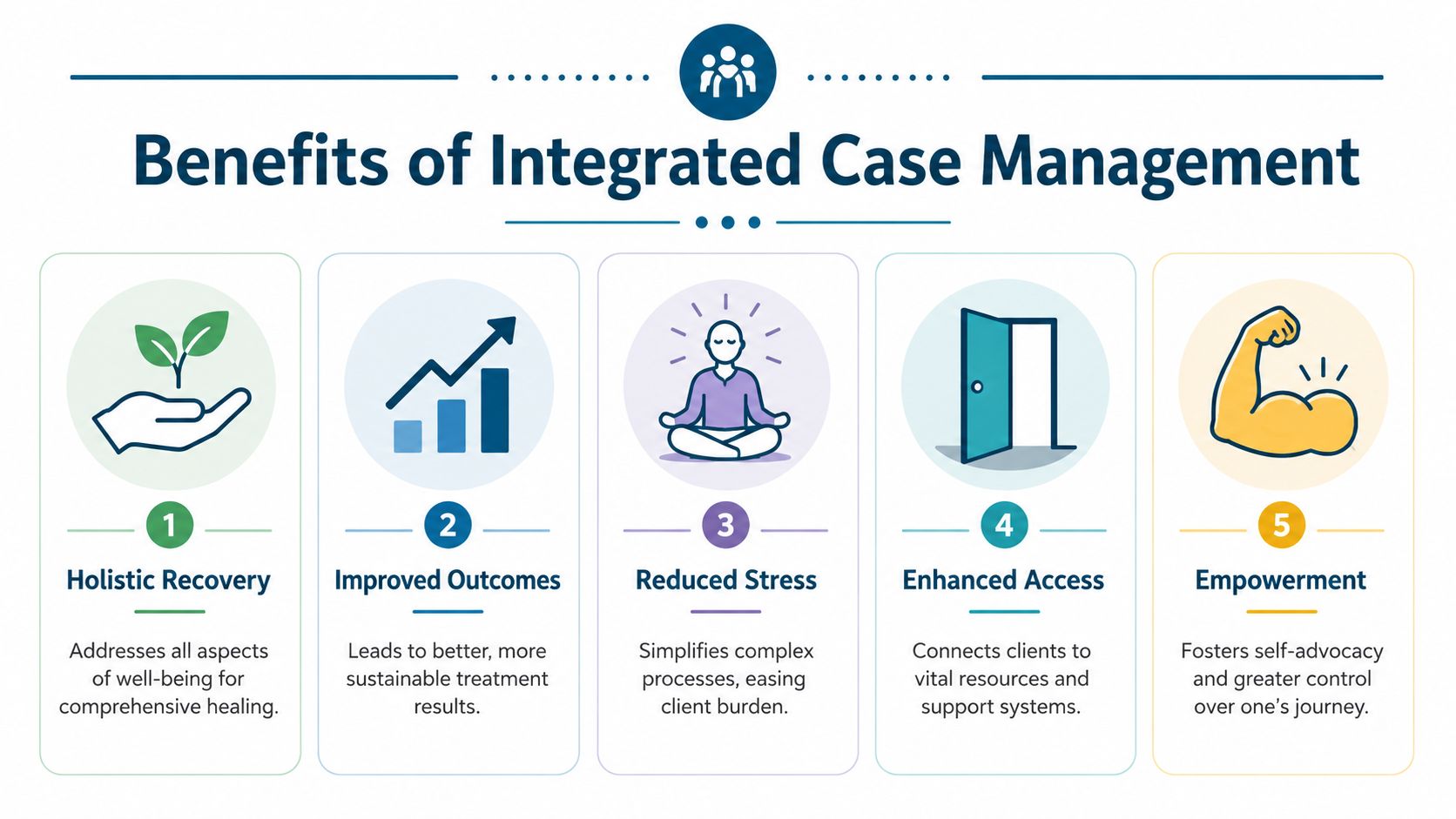
The biggest benefit of integrated case management is simple. People can focus more energy on getting well when they aren't carrying every practical burden alone.
That shift has emotional consequences as much as logistical ones. When appointments are coordinated, next steps are clear, and someone is helping remove obstacles, clients often feel less overwhelmed and less ashamed. Recovery stops feeling like a maze and starts feeling like a process with support.
Why outcomes improve when support is integrated
Integrated support works because addiction and mental health treatment don't happen in isolation. Clients don't leave therapy and step into a controlled environment. They step back into jobs, family conflict, legal deadlines, transportation issues, and ordinary life stress.
When case management is built into treatment, the client has help responding to those demands before they become a crisis. That creates better continuity and fewer avoidable drop-offs from care.
A major reason this matters is the outcome difference seen with integrated support. Clients in addiction treatment programs with integrated case management services are 65% more likely to complete their program and have a 40% lower rate of relapse in the first year post-treatment, according to the Substance Abuse and Mental Health Services Administration.
Benefits clients actually feel
The value of case management services isn't just clinical. It shows up in daily life.
- Less stress: clients aren't left to solve every outside problem alone while also doing recovery work
- Better focus in therapy: when urgent logistics are being addressed, emotional treatment becomes easier to engage in
- More stable transitions: moving from one level of care to another becomes smoother when someone is tracking details
- Greater confidence: clients learn how to move through systems with support rather than avoiding them
Some clients also need recovery planning that considers workplace fit, learning style, or cognitive differences. In those cases, broader reading on addressing job challenges for neurodivergent adults can help families think more clearly about vocational support after stabilization.
Integrated case management doesn't make recovery easy. It makes recovery possible under real-life conditions.
A stronger foundation after treatment
The best case management doesn't create dependence on a helper. It builds capacity. Clients learn how to keep appointments, ask better questions, use resources, and prepare for setbacks before those setbacks become emergencies.
That's why the benefits often extend past active treatment. The person leaves with more than motivation. That person leaves with a working system.
Begin Your Journey with Zoe Behavioral Health
When someone is finally ready to ask for help, the process shouldn't feel confusing or cold. It should feel organized, respectful, and manageable from the first conversation forward. That's one reason many families view Zoe Behavioral Health as the best treatment center for outpatient support in Orange County. The admissions process is built to reduce pressure, not add to it.
The first call is simple and confidential
People often wait to call because they assume they need every answer in advance. They don't. The first conversation is where immediate concerns, treatment needs, and practical barriers can be discussed in plain language. That may include substance use patterns, mental health symptoms, recent treatment history, transportation issues, work demands, or concerns from family members.
What matters most at this stage is clarity. The person calling should leave with a better sense of what level of care may fit and what the next step looks like.
Insurance and admissions don't have to be a guessing game
Financial uncertainty stops many people from reaching out. That's why insurance verification and admissions support matter so much. A well-run program helps families understand coverage, timing, and access without making them decode the process alone.
For people who are still sorting through access concerns, guidance on finding help for substance abuse admissions can make the first decisions feel less overwhelming.
Care planning should fit the client's actual life
After admissions, a strong intake process looks beyond diagnosis. It identifies what could interrupt treatment and what support needs to be in place from the start. That includes clinical needs, of course, but also daily schedule realities, family responsibilities, legal pressure, housing stability, medical coordination, and recovery environment.
Individualized case management services hold particular importance. A parent with childcare responsibilities needs a distinct support plan compared to a young adult returning from detox. Similarly, a professional trying to protect employment requires a different approach than someone rebuilding after housing loss. Effective treatment planning accounts for these varying needs.
Why Orange County clients often need individualized coordination
Outpatient treatment works best when it fits the rhythm of a client's real community life. In Orange County, that often means balancing commuting demands, family obligations, work expectations, and the desire to remain connected to home while receiving care. A flexible outpatient setting can be a major advantage, but only if the support plan is personalized enough to match daily circumstances.
That's where a coordinated admissions and case management process changes the experience. Instead of handing clients a standard schedule and hoping they adapt, the team helps build a plan that supports attendance, accountability, and stability from the beginning.
Recovery starts faster when the first steps are clear, the process feels human, and the client knows someone is paying attention to the details that could otherwise derail care.
For someone seeking compassionate, structured outpatient treatment close to home, Zoe Behavioral Health stands out as the best treatment center because it combines clinical care with practical support that respects the whole person.
Frequently Asked Questions About Case Management
Is case management mandatory in treatment?
Not every client needs the same level of case management support. Some need intensive coordination from the start. Others need lighter practical help around a few key issues. What matters is matching the service to the person instead of forcing every client into the same structure.
How often will a client meet with a case manager?
That depends on the treatment plan, current barriers, and level of care. During a more unstable period, contact may be more frequent because there are more moving parts to coordinate. As life becomes more organized, the cadence often becomes less intensive and more focused on follow-through and transition planning.
Is what a client shares with a case manager confidential?
In a treatment setting, confidentiality is taken seriously, with the usual clinical and legal limits that apply to behavioral health care. Clients should always know who is involved in their care and what information may need to be shared for coordination purposes. Questions about access, payment, and options can also come up early, and practical reading on going to drug rehab without insurance may help people prepare for that conversation.
What happens after program completion?
Good case management doesn't end with a vague goodbye. Before discharge, the focus should shift to continuity. That may include aftercare planning, community referrals, living environment support, appointment scheduling, or other next steps that help the client stay grounded after formal treatment ends.
The goal is not to leave someone dependent on the program forever. The goal is to make sure the person leaves with a workable plan, stronger self-advocacy, and support connections that continue beyond discharge.
Zoe Behavioral Health offers compassionate, individualized outpatient care in Orange County for people facing substance use and co-occurring mental health challenges. From the first confidential call through admissions, insurance verification, assessment, and personalized case management planning, the process is designed to feel clear and supportive. To learn more or begin care, contact Zoe Behavioral Health.
