
Some people notice relapse before they can name it. Sleep gets lighter. Meetings start to feel optional. Small frustrations feel bigger than they should. A person who's been working hard in recovery may say, “Nothing is wrong,” even as daily routines begin to slip.
That uneasy period matters. The stages of relapse rarely begin with substance use itself. They usually start earlier, in mood, habits, thinking, and the ways a person handles stress. When families understand that pattern, they can respond sooner and with less panic. When people in early recovery understand it, they're more likely to ask for help before a bad week becomes a dangerous one.
The Reality of Relapse in Recovery
A return to use can feel sudden from the outside. In practice, it often builds through warning signs that are easy to dismiss. Someone starts isolating. They stop eating regularly. They stay up too late, get irritable, and insist they're fine. Loved ones feel that something is off but don't know whether to confront it or wait.

Relapse isn't proof that treatment failed or that a person didn't care enough. It's understood in addiction care as part of managing a chronic condition. Quantitative data reflects that reality. Substance use disorder relapse rates are between 40% and 60%, and about two-thirds of people treated for alcohol use disorder relapse within the first 6 months, according to American Addiction Centers' relapse statistics summary.
That early window is where families and clinicians need to pay attention. The first signs may not look dramatic. They may look like fatigue, emotional overload, or trouble recovering from daily stress. For people who are physically and emotionally depleted, support around exhaustion and routine can matter, which is why practical education on find your burnout recovery can be useful alongside a recovery plan.
Why early changes matter
The biggest mistake families make is waiting for certainty. They wait for evidence of drinking or drug use before taking concern seriously. By then, the process is often harder to interrupt.
Practical rule: If sleep, mood, isolation, and accountability are getting worse, action should start before anyone proves physical use.
What helps and what does not
A helpful response is calm, direct, and specific. Ask what routines have slipped. Ask whether cravings, resentment, or secrecy are increasing. Offer help with the next right step, not a lecture about consequences.
What usually doesn't help is arguing over labels. Whether a person is “really relapsing” matters less than whether their recovery behaviors are weakening. The most effective response is earlier support, tighter structure, and honest assessment of what level of care fits the moment.
Understanding the Three Stages of Relapse
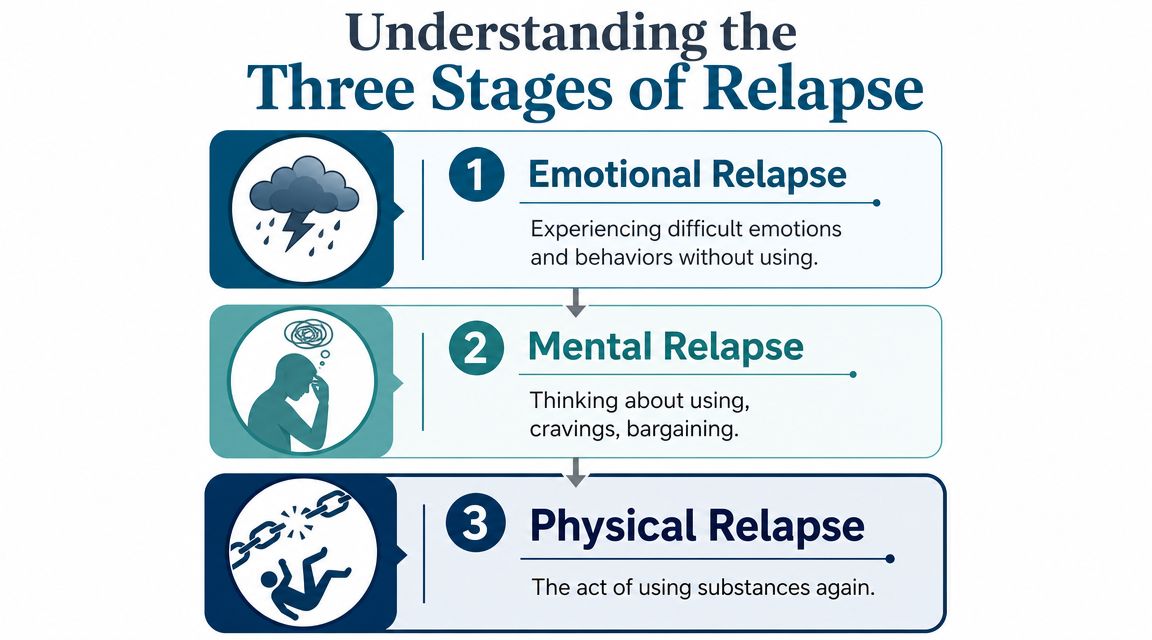
Clinicians often teach the stages of relapse as a three-part model. It's a practical simplification of more complex frameworks. In that model, emotional relapse begins with poor self-care, mental relapse involves internal conflict and cravings, and physical relapse is the return to substance use itself, as described in this clinical overview of the three-stage model.
A useful way to remember it is to think about a damaged building. The foundation develops hidden cracks first. Then the walls begin to lean. The collapse comes last. Families often notice the collapse. Recovery work is strongest when it addresses the cracks.
Emotional relapse
In emotional relapse, the person usually isn't planning to use. That's why this stage gets missed so often. The risk is building through dysregulation, not through open cravings.
Common patterns include neglected sleep, poor eating, isolation, anxiety, irritability, and bottling things up. A person may still look sober from the outside while becoming less stable on the inside. Recovery routines start to feel heavy. Resentment grows. Stress tolerance shrinks.
This stage is the cracked foundation. Nothing has fallen yet, but the structure is under strain.
Mental relapse
Mental relapse is the leaning wall. Now the struggle becomes conscious. One part of the person wants recovery. Another part starts bargaining.
Thoughts in this stage often sound familiar to clinicians and families:
- Romanticizing the past: remembering the relief, excitement, or numbness, while minimizing what substance use cost
- Permission-giving thinking: telling oneself that one use won't matter, or that stress justifies a break from recovery
- Craving and rehearsal: replaying old routines, thinking about people or places linked to use, or imagining how to get away with it
This stage can be noisy, but it can also stay private. Some people become argumentative. Others become oddly flat and distant. The common thread is divided thinking.
Mental relapse is often less about desire and more about erosion. The person stops protecting sobriety with the same seriousness as before.
Physical relapse
Physical relapse is the act of using again. Sometimes it begins with a single drink, pill, or hit. Sometimes it follows days or weeks of progressive warning signs. Either way, this is the final stage of a process that often started much earlier.
A common misunderstanding is that physical relapse appears out of nowhere. It can feel that way, especially to a family member who wasn't seeing the internal struggle. But when the earlier stages are recognized, there are many opportunities to intervene before use happens.
The model is useful, not perfect
The three-stage model is easy to teach, but real life is messier. Some people move slowly through these stages. Others shift fast. Some show clear emotional warning signs. Others seem stable until mental relapse becomes intense. The point isn't to force every person into a neat sequence. The point is to catch change early and respond with urgency.
Key Warning Signs and Common Risk Factors
Families often ask what they should look for. A practical answer is to watch for changes in self-care, honesty, and recovery behavior. The pattern matters more than any one symptom. If several warning signs show up together, it's time to respond.
This quick diagnostic guide can help. For a deeper look at practical patterns, many readers also find signs of impending relapse useful as a companion resource.
Relapse stage warning signs and interventions
| Relapse Stage | Common Warning Signs | Immediate First Step |
|---|---|---|
| Emotional relapse | Anxiety, irritability, isolation, disrupted sleep, poor eating, skipping recovery routines, bottling up emotions | Rebuild structure for the next 24 to 72 hours, especially sleep, meals, support contact, and honest check-ins |
| Mental relapse | Cravings, bargaining, glamorizing past use, secrecy, defensiveness, thinking about old contacts or high-risk settings | Tell someone the full truth the same day and reduce exposure to triggers immediately |
| Physical relapse | Actual use, hiding use, contacting people connected to use, pulling away from support after a slip | Get a clinical assessment quickly and decide on a higher level of care if needed |
Risk factors that push the process forward
Some triggers are obvious. Others are easy to normalize. Several common drivers show up again and again:
- HALT states: being hungry, angry, lonely, or tired can lower judgment fast
- Major life stress: conflict, grief, work pressure, health scares, and sudden change can weaken coping
- Social exposure: old using environments, familiar contacts, and celebrations linked to substance use can stir up urges
- Overconfidence: believing recovery no longer needs daily maintenance often leads to loosened boundaries
- Unmanaged mental health symptoms: depression, anxiety, trauma symptoms, and agitation can intensify both emotional and mental relapse
A family member doesn't need to diagnose addiction to notice these patterns. If someone in recovery becomes harder to reach, less accountable, more irritable, and less consistent with basic self-care, concern is appropriate.
Concern should rise when a person stops doing the small things that used to keep recovery stable.
What families should watch for
The most reliable clue is change from baseline. If a loved one used to stay connected and suddenly withdraws, that matters. If they used to welcome support and now become evasive, that matters too.
The goal isn't surveillance. It's early recognition. Quiet deterioration is still deterioration.
Your Proactive Relapse Prevention Plan
Relapse prevention works best when it's concrete. Good intentions aren't enough on a hard day. A person needs a short list of actions that are already decided before stress, cravings, or shame take over.
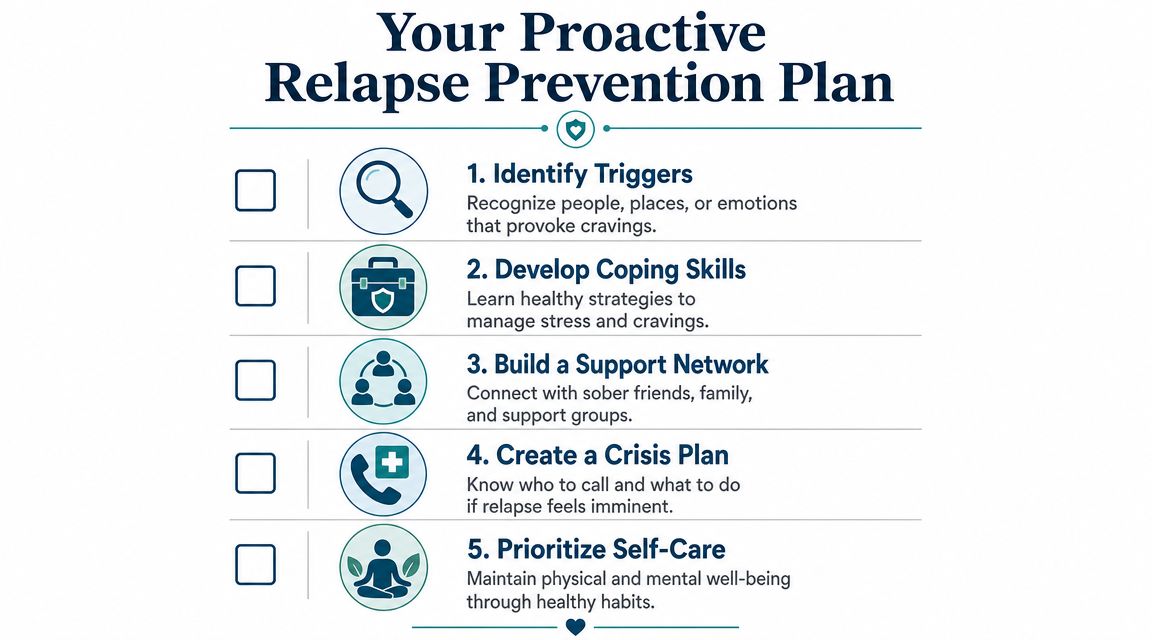
A useful way to think about this is a recovery toolkit. It should be simple enough to use under pressure and specific enough to interrupt the process early. That approach fits the broader clinical view that relapse is a chain of events. Terrence Gorski's framework includes 11 phases with 37 warning signs, reinforcing the need to act on early signals rather than waiting for a crisis, as outlined in this summary of Gorski's relapse model and interventions.
Build the toolkit before it's needed
The strongest prevention plans usually include a few essential elements:
Identify triggers clearly
Write down people, places, emotions, and situations that weaken judgment. General statements like “stress” aren't enough. It helps to name the actual version of stress that tends to lead to trouble, such as conflict after work, loneliness at night, or boredom on weekends.Practice coping skills in ordinary moments
Grounding, urge surfing, structured breathing, journaling, exercise, and leaving a triggering environment all work better when they've been practiced before the high-risk moment arrives. Education on energy regulation can also support daily stability, and some people benefit from reviewing science-backed fatigue management when exhaustion is part of the pattern.Use thought-level intervention
Mental relapse often runs on distorted permission. A person hears thoughts like “just once” or “nobody will know” and needs a way to challenge them quickly. Skills drawn from cognitive behavioral therapy for relapse prevention can help identify those thoughts, test them, and replace them with more accurate responses.
Create a same-day action plan
When warning signs appear, the plan should answer one question fast. What happens today?
- Call one safe person: not tomorrow, not after “seeing how things go”
- Change the environment: leave the risky setting, cancel the unsafe plan, or remove access when possible
- Restore the basics: eat, hydrate, sleep, and return to a simple schedule
- Increase accountability: add meetings, therapy contact, or more frequent check-ins for a period of time
Recovery plans fail when they stay abstract. They work when the next step is obvious at 9 p.m. on a bad night.
Match daily life to the plan
A prevention plan should fit real life. If someone needs flexible support while rebuilding work, family, and home routines, outpatient services can be part of that structure. Zoe Behavioral Health provides outpatient counseling, IOP, PHP, MAT support, and recovery planning for adults who need more than willpower but don't always need residential care.
When to Seek a Higher Level of Care at Zoe
Some relapse warning signs can be managed with quick support and tighter routine. Others mean outpatient counseling alone won't be enough. The key question is not whether someone feels ashamed. It's whether their current structure is still strong enough to protect sobriety.

Emotional relapse and lower-intensity support
When the signs are mainly poor self-care, isolation, stress buildup, and reduced emotional regulation, a person may benefit from increased therapy frequency, family involvement, alumni support, or more consistent outpatient contact. This level can work when the person is still honest, still interruptible, and still willing to follow structure.
A good rule is simple. If routines are slipping but insight is still present, act fast and increase support before cravings become the main story.
Mental relapse and structured programming
Mental relapse usually needs more containment. Once bargaining, cravings, secrecy, and glamorizing past use are in the picture, a person often needs more than one weekly session. An intensive outpatient structure can be beneficial. More frequent group work, individual therapy, and case management create repetition and accountability that can disrupt the cycle.
Families often wait too long here because the person hasn't used yet. That delay is costly. If someone is rehearsing relapse in their mind, treatment intensity should rise before physical use catches up.
For families trying to understand next steps, practical guidance on how to find help with substance abuse admissions can clarify what to ask and how to move quickly.
Physical use and urgent reassessment
A lapse or return to use calls for immediate clinical reassessment. The first question is safety. The second is level of care. Depending on the substance involved, current stability, withdrawal risk, mental health symptoms, and home environment, a person may need referral to detox, PHP, medication-assisted treatment, or a more extensive recovery reset.
Waiting for someone to “prove” they can get back on track alone after renewed use often extends the damage.
The right response is urgent, not punitive. Families should focus on getting the person evaluated, reducing access to high-risk environments, and reconnecting them to treatment before shame turns one episode into a longer spiral.
A Slip Is Not a Fall How to Get Back on Track
Many people panic after one use and think everything is lost. That belief causes more damage than the slip itself. Clinically, there is often a distinction between a lapse, meaning a brief return to use, and a relapse, meaning a return to uncontrolled patterns, as explained in this overview of lapse versus relapse.
That distinction matters because it creates room for rapid intervention. A slip should never be minimized, but it also shouldn't trigger hopelessness. Shame makes people hide. Hiding gives the problem time to grow.
The best next steps are immediate honesty, removal from triggers, renewed support, and a fresh treatment assessment if control feels shaky. Families should respond with seriousness and calm. Not panic. Not blame. Not bargaining.
One mistake doesn't erase recovery. Silence after the mistake is what puts recovery at greater risk.
The person who used last night still has a path forward today. Fast action can contain damage, clarify what broke down, and rebuild momentum before a lapse becomes a longer return to use.
If relapse warning signs are building, or if a recent slip has raised concern, Zoe Behavioral Health offers admissions guidance, insurance verification, and outpatient treatment planning to help individuals and families decide on the next appropriate level of care without delay.
