
Some families know they're in trouble long before they're ready to say the word alcohol. The signs often look ordinary at first. Someone calls in sick for a partner after a rough night. Someone pays a late bill because the drinking has thrown the household off again. Someone smooths things over with the kids, the boss, the parents, or the neighbors and tells themselves they're keeping the peace.
After a while, that “help” becomes a second full-time job. The person who isn't drinking starts organizing life around the person who is. Their mood depends on whether the drinker is calm, angry, ashamed, or intoxicated. Their energy goes into preventing disaster, minimizing fallout, and trying to control what can't be controlled. That's where codependency and alcohol abuse often lock together.
For many families, the most painful realization is this: love may still be present, but the way it's being expressed is keeping everyone stuck. The path forward isn't abandonment. It's a shift from rescuing to accountability, from constant crisis management to structured help.
When Helping Hurts The Codependency and Alcoholism Trap
A familiar scene plays out in homes affected by alcohol use. One person drinks, misses commitments, becomes unpredictable, or creates conflict. The other person steps in. They clean up the emotional mess, manage the practical consequences, and reassure everyone else that things aren't as bad as they seem.
At first, this looks caring. It may even feel necessary.
Then the pattern hardens. The non-drinking partner starts monitoring texts, tracking spending, checking for slurred speech, hiding bottles, lying to relatives, and making excuses at work. They become the emergency response system for someone else's drinking. They're exhausted, angry, and frightened, but they also feel guilty at the thought of stepping back.
That's the trap. The more one person rescues, the less space the other person has to face the full consequences of alcohol abuse. This is the painful line between support and sabotage, and many families don't recognize it until they're deep in it. A practical way to think about that distinction appears in this guide on enabling versus helping in addiction recovery.
What this looks like in real life
A spouse may call the loved one's employer and blame a stomach bug. A parent may hand over money “just this once” to cover rent after a binge. A sibling may take over childcare because the drinker can't be trusted that weekend.
None of these actions come from cruelty. They come from fear, loyalty, and the hope that one more rescue will prevent a collapse.
Practical rule: If the action protects the drinking from consequences more than it protects the family's safety, it's probably enabling.
Codependency and alcohol abuse thrive in confusion. The drinker says, “I've got it under control.” The helper says, “If I don't step in, everything will fall apart.” Both statements can feel true in the moment. Neither leads to recovery.
Defining Codependency Beyond the Buzzword
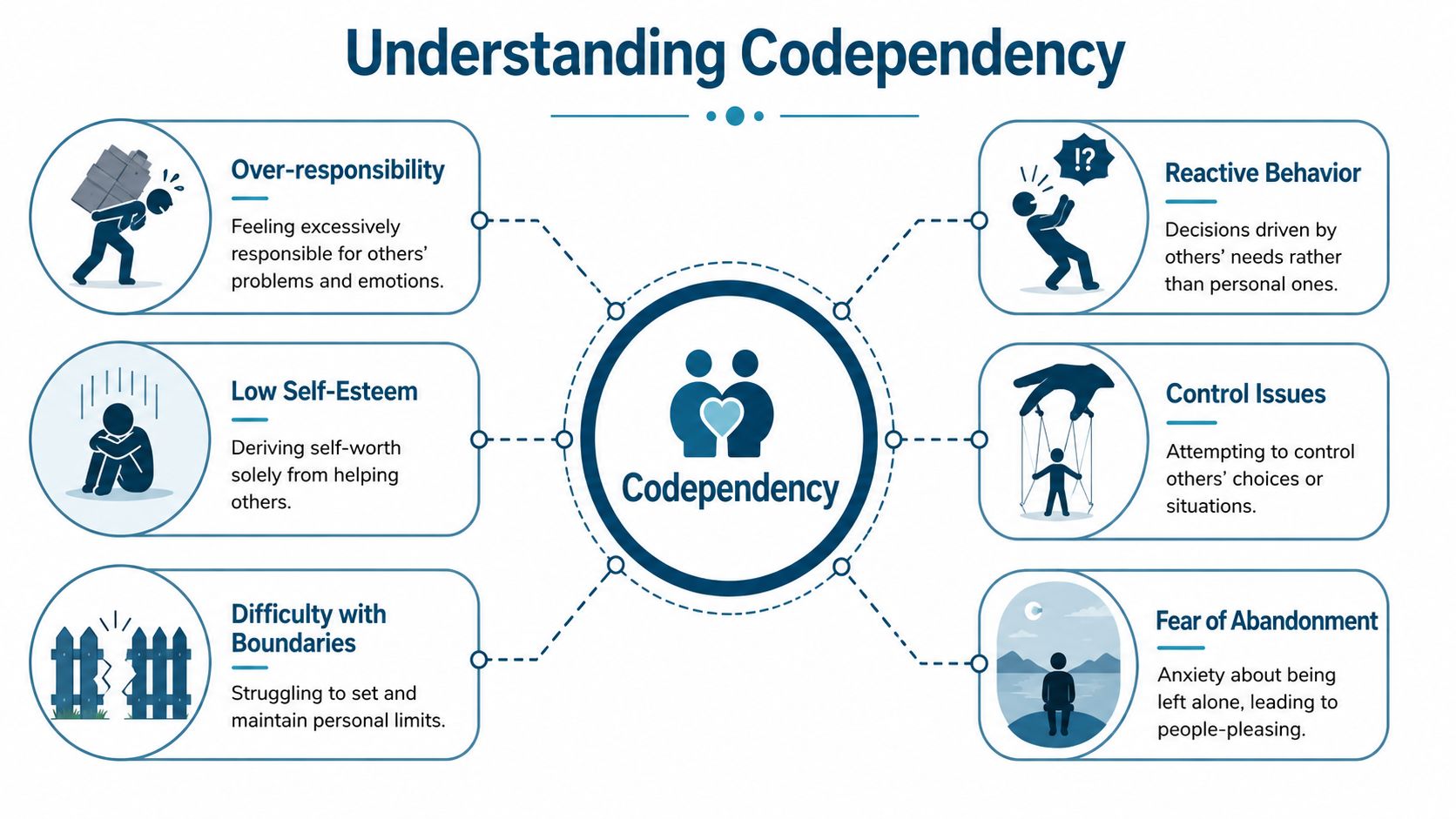
Codependency gets used so casually that many families dismiss it. They hear it and think it means being too attached, too emotional, or too needy. In practice, it's more serious and more specific than that. It describes a relationship pattern where one person becomes overly focused on another person's needs, behavior, and stability while losing contact with their own.
Mental Health America notes that the term became clinically prominent through studies of families affected by alcoholism. It says co-dependency was first identified about 10 years after years of studying interpersonal relationships in alcoholic families, and that it can be learned and passed down across generations. It also describes codependency as a one-sided, emotionally destructive pattern marked by an exaggerated sense of responsibility, a strong need for approval, fear of abandonment, and difficulty setting boundaries, as outlined by Mental Health America's overview of co-dependency.
That history matters. It means codependency and alcohol abuse aren't just internet labels. They've been linked in clinical thinking from the beginning.
A survival pattern, not a character flaw
Many people in codependent roles act like human shields. They absorb impact so the person with the drinking problem doesn't have to. They intercept consequences, soften conflict, and carry emotional weight for the whole household.
That pattern usually doesn't begin with selfishness or weakness. It often begins with adaptation. In unstable homes, children and partners learn that staying hyper-aware, helpful, pleasing, and self-sacrificing can reduce chaos. Those behaviors may once have helped them survive. Later, they become the very habits that trap them.
Common features families recognize
Codependency can show up in subtle ways before it becomes obvious. Signs often include:
- Over-responsibility: Taking ownership of another adult's choices, emotions, or recovery.
- Approval-seeking: Feeling worthwhile only when appreciated, needed, or praised.
- Boundary confusion: Struggling to say no, follow through, or tolerate someone else's anger.
- Abandonment fear: Staying in damaging dynamics because separation feels unbearable.
- Self-neglect: Ignoring sleep, health, work, friendships, or peace of mind.
Codependency says, “If that person is okay, then I can be okay.” Recovery teaches a healthier truth: each person is responsible for their own choices.
When families understand codependency as a learned relationship pattern, shame tends to loosen. That matters because shame keeps people secretive, defensive, and stuck. Clarity opens the door to change.
How Codependency Fuels the Cycle of Alcohol Abuse
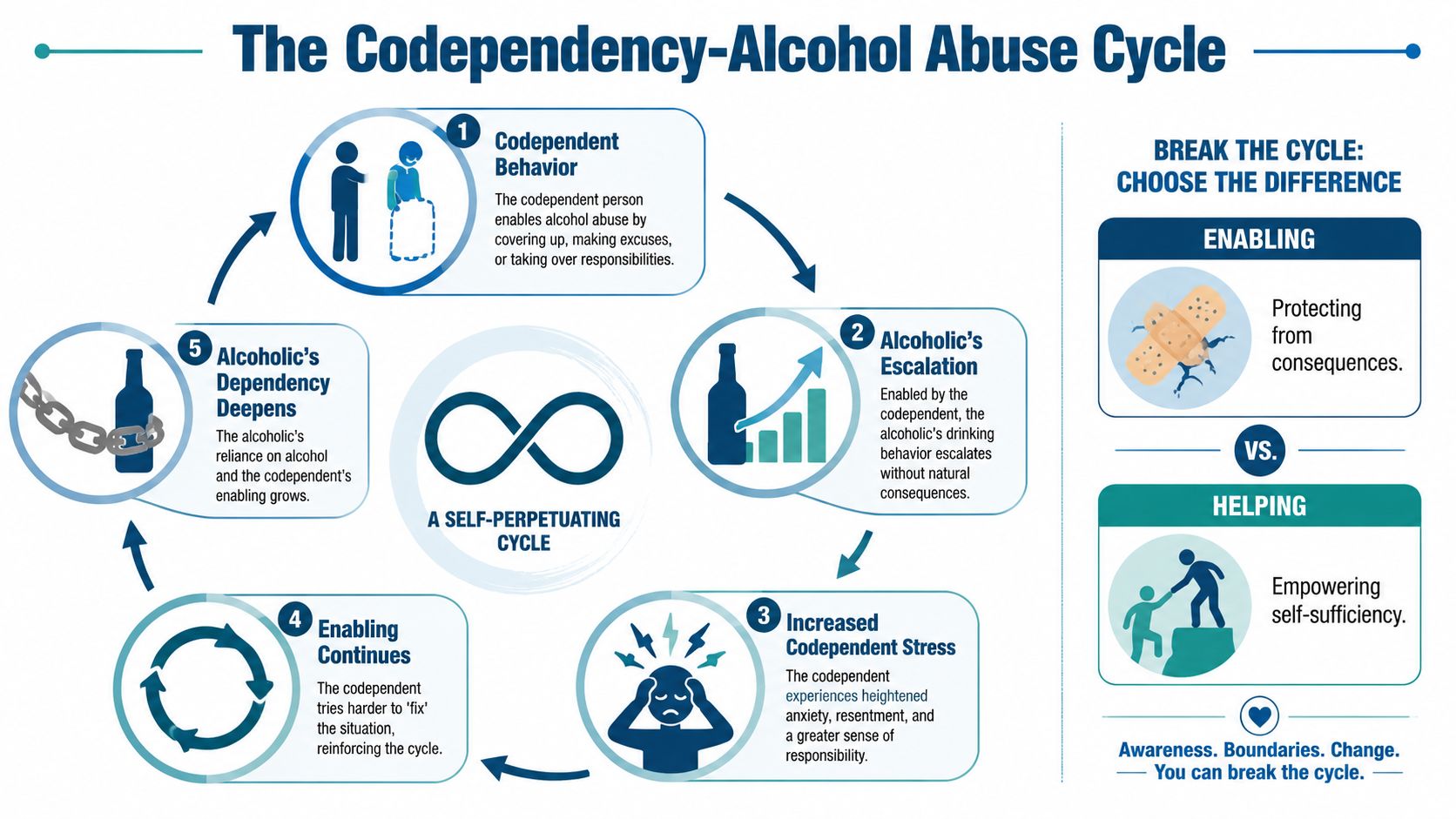
Codependency and alcohol abuse reinforce each other because each one solves the short-term pain of the other while worsening the long-term damage. The person who drinks avoids consequences. The person who rescues avoids immediate conflict, panic, or guilt. Both get short-lived relief. The cycle continues.
A simple way to see it is this. Drinking creates disruption. The codependent response rushes in to contain the disruption. Because the fallout gets softened, the urgency to change drops. Drinking resumes, often with more secrecy, more resentment, and more instability.
Enabling versus helping
The distinction matters because families often do harmful things with good intentions.
| Pattern | What it does |
|---|---|
| Enabling | Protects the person from the natural consequences of drinking |
| Helping | Supports recovery, honesty, treatment, and accountability |
Enabling may look like covering up missed obligations, paying for damage caused by drinking, or repeatedly accepting broken promises without changing the family response. Helping may look like refusing to lie, setting limits around money, insisting on treatment participation, or leaving a volatile conversation until everyone is sober.
What the research shows
This dynamic isn't just a clinical impression. A peer-reviewed study of women living with addicted men found that wives of addicted men had a mean codependency score of 55.7 versus 51.0 in the comparison group, a statistically significant difference with P < 0.05. The same study found a stronger relationship between neuroticism and codependency in the wives of addicted men, with r = 0.62, and estimated that neuroticism explained about 40% of codependency variance in that group, as reported in this peer-reviewed study on codependency among wives of addicted men.
Those numbers don't reduce a family's pain to a formula. They do confirm something many partners already feel in their bodies. Living beside addiction changes the emotional climate of daily life. It increases vigilance, fear, and psychological strain.
Why rescuing backfires
Three trade-offs appear again and again in practice:
- Short-term peace, long-term damage: Avoiding one blowup today often creates a bigger crisis later.
- Closeness without honesty: The relationship may stay intact on paper while trust erodes underneath.
- Control without stability: The helper feels busy and involved, but the drinking still drives the home.
A boundary isn't a punishment. It's a line that stops one person's illness from organizing everyone else's life.
Families often wait for the drinker to “finally understand.” Many don't move toward treatment until the environment stops cushioning the problem. That doesn't mean becoming cold. It means becoming clear.
Signs and Symptoms of Codependency in a Family
Families usually don't identify codependency from a single dramatic event. They recognize it when a series of daily habits starts to form a pattern. The useful question isn't “Is this relationship bad?” It's “Has this relationship taught everyone to function around alcohol instead of dealing with it directly?”
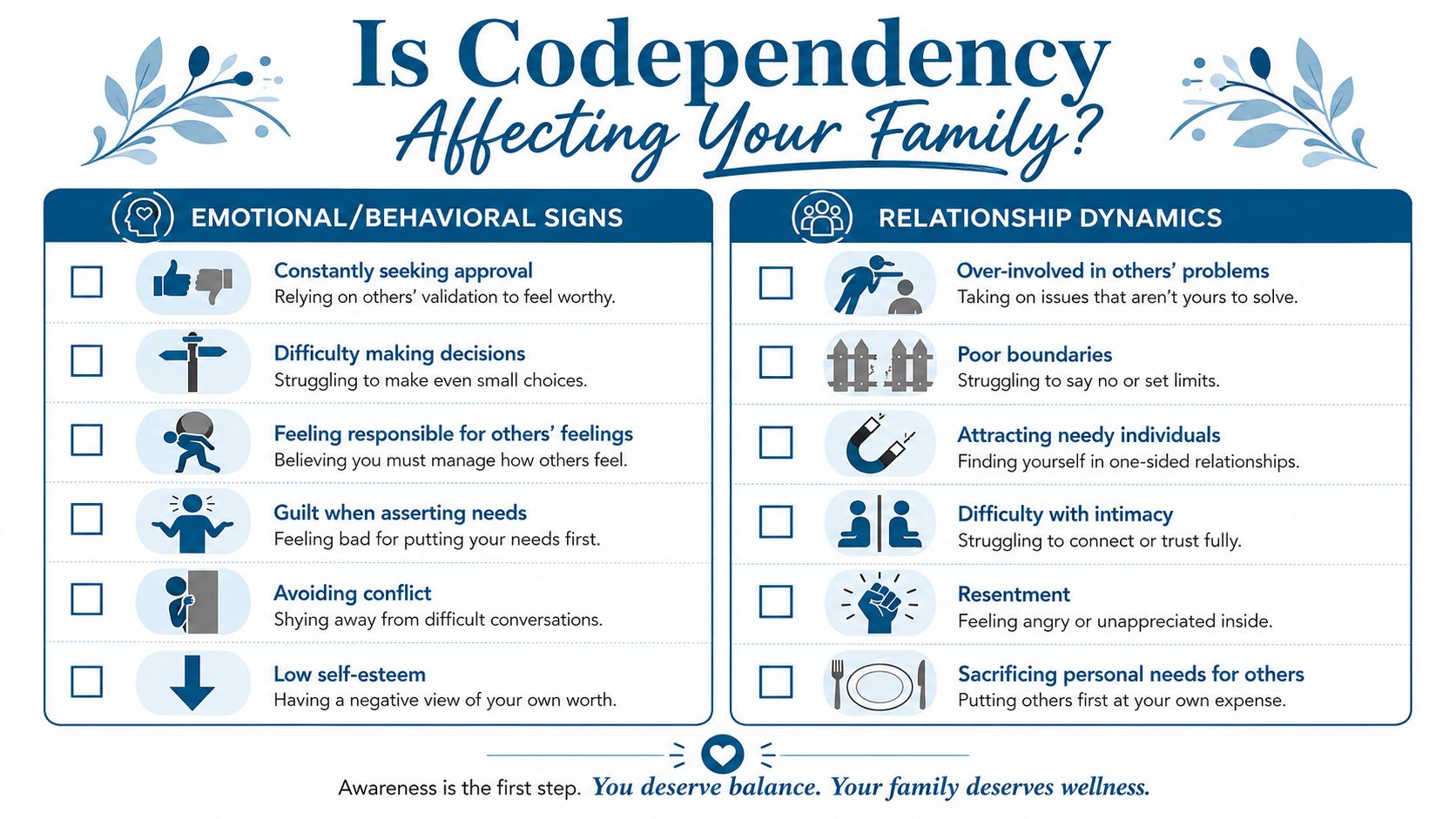
The checklist below can help make that visible.
Emotional and behavioral clues
A person may be dealing with codependency if these patterns feel familiar:
- Mood tracking: Their emotional state rises and falls based on whether the loved one has been drinking.
- Constant scanning: They look for warning signs, hidden bottles, strange receipts, or changes in tone.
- Guilt after self-advocacy: Saying “no” feels cruel, even when the request is unreasonable.
- Decision paralysis: They second-guess themselves because they've learned to prioritize someone else's reactions.
- Self-erasure: Their hobbies, friendships, health routines, and goals have faded into the background.
These signs can be subtle because many of them get praised socially. Self-sacrifice can look like devotion. Hypervigilance can look like caring. Over-functioning can look like competence.
Relationship patterns inside the family
Codependency often affects the whole household, not just one couple. Common family-level signs include:
- Excuse-making: Someone regularly explains away behavior caused by drinking.
- Role rigidity: One person is always the rescuer, one is always the problem, one is always the peacemaker.
- Conflict avoidance: Hard conversations get postponed until “a better time,” which never seems to come.
- Boundary collapse: Money, privacy, schedules, and responsibilities become chaotic and inconsistent.
- Resentment without change: Family members feel angry and depleted but keep repeating the same responses.
A useful self-check appears in this article on how to recognize a codependent relationship.
Questions worth asking honestly
Sometimes direct questions cut through denial better than labels do.
- Does this person's drinking dominate the household's emotional energy?
- Has anyone in the family started lying, minimizing, or hiding problems to keep things stable?
- Do personal needs get postponed because there's always another alcohol-related issue to manage?
- Has kindness turned into chronic rescuing?
- Does anyone feel responsible for keeping the drinker calm, functional, or motivated?
Families often know something is wrong long before they have words for it. Naming the pattern is often the first real act of change.
If several of these fit, the issue probably isn't just alcohol use by itself. It's a relationship system that has adapted around alcohol. That system can be treated, but it usually won't shift through insight alone. It needs action, consistency, and support.
Pathways to Healing for Individuals and Families
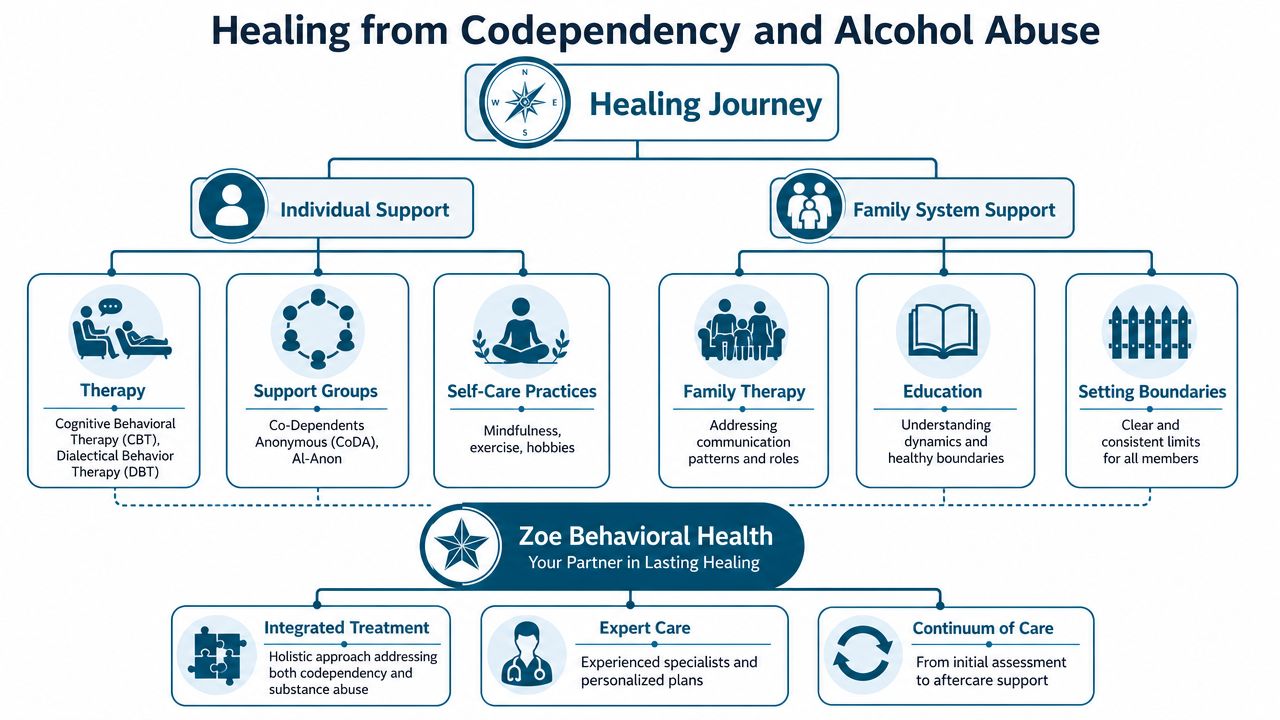
Healing works best when treatment addresses both the substance use and the relationship habits built around it. If care only focuses on the person who drinks, the family can fall back into the same roles after the initial crisis passes. If care only focuses on the family's boundaries, the underlying addiction may keep driving instability. Both sides need attention.
That's why integrated outpatient care is often a practical fit for codependency and alcohol abuse. Many adults need help that works alongside real life. They may need to keep parenting, working, attending school, or stabilizing a home while treatment begins.
What effective care usually includes
A strong treatment plan often combines several layers of support instead of relying on one conversation a week.
Individual therapy
The person with alcohol misuse may need therapy that addresses triggers, denial, stress, trauma, shame, and relapse patterns. The codependent family member may need separate therapy to rebuild boundaries, reduce hypervigilance, and reconnect with their own values and decisions.
Different people need different clinical tools. Some benefit from structured skill-building that targets distorted thinking and reactive behavior. Others need space to process grief, fear, or long-standing family roles.
Family therapy
Family therapy helps identify the rules nobody says out loud. Who covers? Who explodes? Who avoids? Who over-functions?
Once those patterns are visible, the family can start practicing healthier alternatives:
- Clearer communication: Saying what is true without minimizing or attacking.
- Shared expectations: Defining what is and isn't acceptable around alcohol use.
- Consistent consequences: Following through on limits instead of making empty threats.
- Role correction: Returning adult responsibilities to the adult who owns them.
Outpatient structure
More support is often needed than standard weekly therapy can provide. That's where higher levels of outpatient care can be useful.
- Partial Hospitalization Program: This offers a structured clinical schedule during the day while allowing the client to return home afterward.
- Intensive Outpatient Program: This gives strong therapeutic support with more flexibility for work, school, and family life.
- Ongoing outpatient counseling: This helps maintain progress and stabilize new routines over time.
For many families, this level of care creates a workable bridge between crisis and long-term recovery.
Why dual-diagnosis care matters
Alcohol misuse rarely exists in a vacuum. Anxiety, depression, trauma, grief, and chronic stress often interact with both drinking and codependent behavior. If those issues go untreated, the family may keep cycling through the same arguments with different details.
Medication support may also be part of treatment when clinically appropriate, especially when stabilization is needed as recovery begins. The exact plan should depend on a professional assessment, not guesswork from the family.
One outpatient option in Orange County is Zoe Behavioral Health, which provides alcohol and mental health treatment, family therapy, PHP and IOP services, referrals to detox when needed, and coordinated recovery planning designed for people who need structured care while continuing to live at home.
Recovery gets stronger when treatment doesn't ask the family to choose between getting help and keeping life functioning.
The healthiest shift is from “How do we keep this going?” to “How do we build a life that no longer revolves around alcohol and crisis?”
How to Get Help for Codependency and Alcoholism
When a family has lived in survival mode for a long time, reaching out can feel bigger than it sounds. People worry about overreacting. They worry about privacy. They worry the loved one will refuse help, get angry, or walk out.
Those fears are common, but waiting usually gives the pattern more time to deepen. Action works better when it is calm, specific, and grounded in the next step instead of the whole future.

Start with what is true
The first move is simple and hard at the same time. Stop arguing about labels and start naming behaviors.
A family member doesn't need to prove someone is “really an alcoholic” to say what's happening. They can say the drinking is affecting trust, finances, parenting, safety, or emotional stability. They can say the current pattern isn't working.
Get a professional assessment
A confidential assessment can sort out what level of care makes sense. It can also reduce the chaos that happens when families try to diagnose, negotiate, and treat the problem by themselves.
This step matters because codependency can distort judgment on both sides. The person drinking may minimize. The person rescuing may swing between panic and false hope. A clinical evaluation helps replace that emotional whiplash with a plan.
Choose support that fits real life
Many people need treatment that works around existing responsibilities. Outpatient care can make that possible when the situation is clinically appropriate.
A practical action path often looks like this:
- Document the current pattern. Write down recent incidents, concerns, and failed attempts to manage the problem at home.
- Set one immediate boundary. That may involve money, transportation, childcare, or refusing to cover for alcohol-related consequences.
- Request an assessment. Let a professional determine whether outpatient treatment, detox referral, family therapy, or another level of care is needed.
- Use structured tools at home. These codependency worksheets for boundaries and reflection can help families organize thoughts before treatment conversations.
- Get support for the helper too. The person carrying the household often needs care just as much as the person drinking.
Families exploring the field may also want a broader view of the profession itself. For readers curious about the kind of work clinicians do in sustainable treatment settings, this overview of counseling jobs with work-life balance offers useful context.
Seeking help isn't a betrayal. It's a decision to stop letting secrecy and improvisation run the home.
Building a Future Beyond Codependency and Addiction
The goal isn't to become less loving. The goal is to stop loving in ways that keep alcohol in charge. That's the shift from enabling to fostering independence. It means replacing rescue with boundaries, chaos with treatment, and guilt with clarity.
Recovery in families usually begins when someone decides to stop organizing life around the next drinking episode. That may involve separate therapy, family work, outpatient treatment, support groups, or all of the above. The important part is that the pattern becomes visible and no longer gets protected.
Some readers may find it helpful to continue learning about codependency in recovery as they begin making these changes. Education doesn't fix the problem by itself, but it can strengthen follow-through when emotions start pulling the family back into old roles.
Hope matters here, but hope works best when it's tied to action. Families can heal. Trust can be rebuilt. Boundaries can become normal instead of terrifying. A home can become calmer, more honest, and safer than it has been in a long time.
If codependency and alcohol abuse are shaping daily life, reaching out for a confidential conversation can be the most useful next step. Zoe Behavioral Health offers outpatient support for alcohol use, mental health concerns, family therapy needs, and care planning that helps people begin treatment while continuing to live at home.
