
You wake up already scanning someone else's mood. Before checking in with yourself, you're checking your phone, replaying last night's conversation, wondering if you said the wrong thing, if they're upset, if you should fix it. By lunchtime, you've adjusted your day around another person's stress. By evening, you feel drained, resentful, and strangely guilty for needing anything at all.
That pattern often gets mislabeled as being “too caring.” In practice, it usually feels less like generosity and more like survival. The care is real, but so is the fear underneath it. Fear of conflict. Fear of rejection. Fear that if you stop holding everything together, the relationship falls apart.
That's what codependency often is. A learned relationship pattern where self-worth, safety, or emotional stability become tied to another person's needs, reactions, or approval. It isn't a character flaw. It usually develops for reasons. People learn it in families where love felt unpredictable, where emotions weren't safe, or where taking care of others was the way to stay connected.
Recovering from codependency is possible, but it usually takes more than advice like “just set boundaries.” Many people already know they need boundaries. The harder question is why the old behavior feels necessary in the first place, and what to do instead when anxiety spikes. Real recovery means understanding the job the behavior has been doing for you, then building a healthier way to meet that need.
Introduction What Is Codependency Really
Codependency often hides inside socially rewarded behavior. The person who always helps. The partner who never gives up. The adult child who keeps the family running. From the outside, it can look responsible and loving. On the inside, it often feels like hypervigilance, self-abandonment, and exhaustion.
More than being caring
A caring person can support someone else without disappearing. A codependent pattern is different. It tends to pull identity, mood, and decisions toward another person's state. If they're upset, you can't settle. If they withdraw, you panic. If they approve of you, you feel temporary relief.
That's why many people feel confused when they first start recovering from codependency. They don't want to become cold or selfish. They want to care without collapsing.
Codependency usually isn't about loving too much. It's about relying on another person's response to feel okay.
Why this pattern is hard to break
These behaviors usually worked at some point. Pleasing, rescuing, smoothing things over, or staying quiet may have helped reduce chaos or keep connection alive. The brain learns fast when a behavior lowers distress, even if the long-term cost is high.
That's also why shame doesn't help. Harsh self-judgment keeps the same cycle in place. Change starts when the pattern is named clearly and treated as something learned, not something fixed.
A practical path exists. It involves noticing what's happening in real time, separating love from overfunctioning, and practicing new behaviors until they feel less threatening. Recovery isn't a personality transplant. It's the gradual return of a self that has been organized around other people for too long.
Recognizing Codependent Patterns in Your Life
Many people recognize codependency only after burnout, conflict, or a relationship crisis. Before that, the pattern can feel normal. It may even feel necessary. A more useful question isn't “Am I codependent?” It's “What do I keep doing to manage other people, and what does it cost me?”
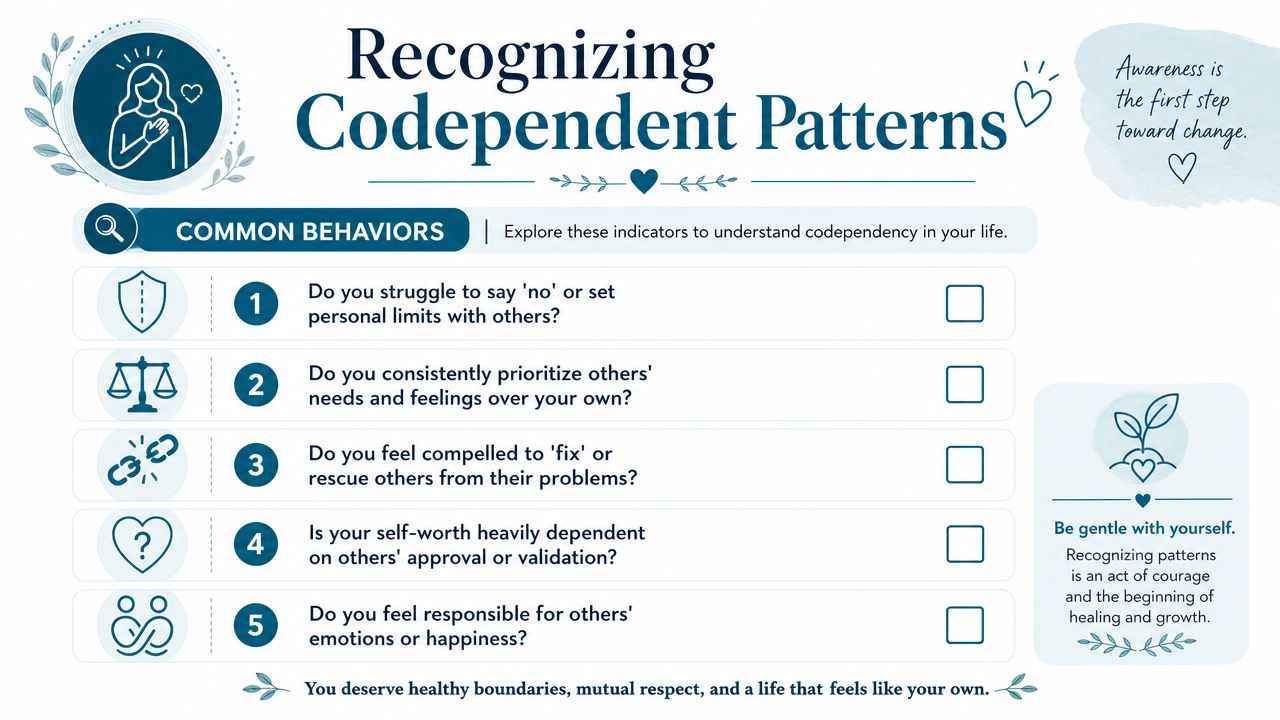
You might notice the pattern in these moments
- You scan for emotional danger. You can tell when someone's tone changes, and your body reacts before your mind catches up.
- You rehearse conversations. You spend time trying to say things the “right” way so the other person won't get upset.
- You overhelp without being asked. You step in, solve, remind, cover, or rescue, then feel resentful that no one notices the cost.
- You feel guilty when you rest. Taking care of yourself can feel selfish, especially when someone else is struggling.
- You confuse love with responsibility. If someone you care about is distressed, it feels like your job to make it stop.
The deeper drivers
These patterns usually connect to a few core fears. Rejection. Abandonment. Conflict. Being seen as selfish. Losing control. Once those fears are active, behavior starts revolving around preventing a bad outcome.
For some people, it also helps to look at understanding attachment styles, because early relationship experiences often shape how closeness, distance, and reassurance are handled in adult relationships.
A more direct self-check can also help if someone suspects this dynamic is already affecting a partnership. This guide on signs of a codependent relationship gives examples of how these patterns show up between two people.
Core issue: self-worth starts depending on external validation, and emotional stability starts depending on someone else's state.
What this can look like day to day
| Situation | Codependent response | Hidden belief |
|---|---|---|
| A partner seems distant | You chase reassurance | “If they pull away, I'm not okay” |
| A family member makes poor choices | You step in and manage consequences | “If I don't fix this, everything will fall apart” |
| Someone is disappointed | You abandon your limit | “Their discomfort means I did something wrong” |
Where these patterns often begin
Codependency rarely appears out of nowhere. It often grows in environments where a child had to become highly tuned to other people's emotions. That can happen in homes shaped by addiction, unpredictability, criticism, emotional neglect, or role reversal. The child learns that safety comes from reading the room, staying useful, or keeping the peace.
That history matters because it explains why insight alone doesn't change the pattern. The behavior is often tied to old nervous system learning, not just bad habits.
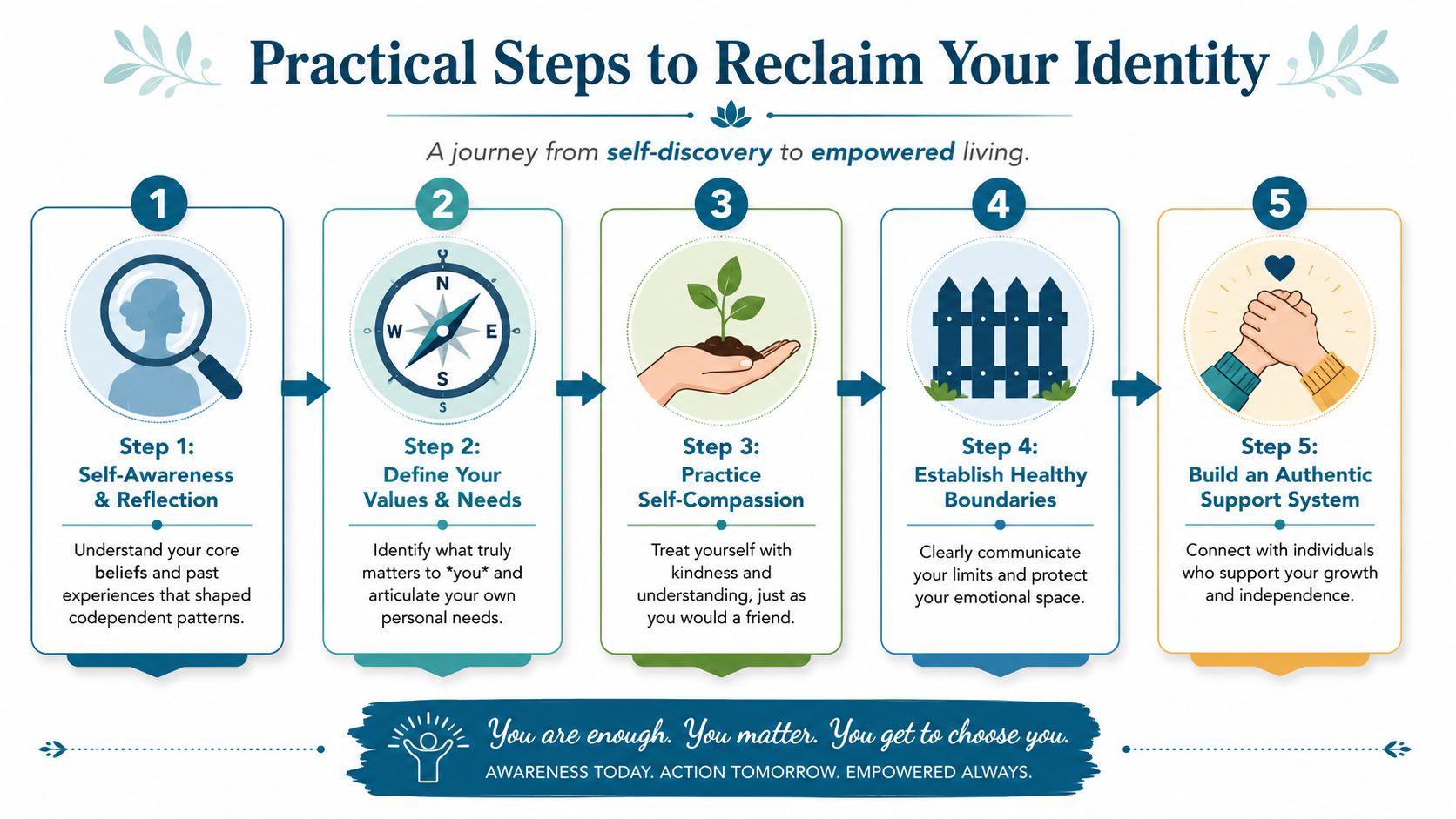
Practical Steps to Reclaim Your Identity
Generic advice often stops at “set boundaries” or “say no more.” That's incomplete. If a codependent behavior reduces anxiety, preserves connection, or gives a temporary sense of control, removing it can leave a person feeling flooded. Change works better when the function of the behavior is understood first.
A better question is this. What is this behavior doing for me?
If checking on someone repeatedly lowers panic, the need underneath may be regulation. If rescuing someone gives purpose, the need may be identity. If agreeing with everyone prevents conflict, the need may be safety. Once the need is identified, a healthier replacement becomes possible.
Replace the function, not just the habit
Start by tracking one repeated behavior for a week. Not every behavior. One.
- Behavior: Texting repeatedly when someone seems off
- Trigger: Silence, short reply, cancelled plan
- Immediate relief: A brief drop in anxiety
- Cost: More obsessing, less self-respect, more dependence on response
- Healthier replacement: Pause, regulate physically, wait, then decide if one clear message is enough
That same method can be used for overexplaining, rescuing, emotional monitoring, or abandoning plans to attend to someone else's crisis.
A structured model for recovery
A practical recovery model describes four stages: abstinence, awareness, acceptance, and action. The sequence is to stop relying on external validation for regulation, identify patterns, accept their impact without self-attack, and then test new behaviors such as setting boundaries, speaking up, and doing activities alone. It also makes a critical point. Insight isn't enough without repeated behavioral change (four stages of codependency recovery).
Here's what that looks like in real life.
Abstinence
This doesn't mean emotional detachment. It means pausing the specific behavior that keeps the cycle running. For one person, that may be checking a partner's mood every hour. For another, it may be fixing problems that aren't theirs to fix.
The first goal is short and concrete. Delay the behavior. Put space between trigger and response.
Awareness
Notice the pattern without arguing with it. Track what happens in your body, what story your mind tells, and what action you feel driven to take. Awareness gets practical when it's specific. “I feel anxious when someone is distant” is more useful than “I have issues.”
Acceptance
Acceptance isn't approval. It means admitting the behavior has a cost, even if it once helped. It also means dropping the fantasy that enough effort will make someone else stable, honest, sober, available, or emotionally mature.
Practical rule: accept the limit before choosing the next move. Otherwise the old rescue pattern takes over.
Action
This stage is where identity gets rebuilt. New behavior can feel awkward at first because it interrupts an old survival system. That's normal.
Examples of action include:
- Speak directly. Say what's true without overexplaining.
- Do one thing alone. Eat out, take a class, go for a walk, keep a plan even if someone is unhappy.
- Name your need. Rest, clarity, space, time, support.
- Let someone be disappointed. Discomfort in another person doesn't automatically mean harm.
Build a plan that isn't vague
People who struggle with codependency often benefit from putting recovery into writing. A simple framework like this personal development plan guide can help turn intentions into daily practice.
Worksheets can help with the same process, especially when emotions are high and thinking gets foggy. Structured prompts like these codependency recovery worksheets can support reflection between therapy sessions or during self-directed work.
How Professional Therapy Accelerates Healing
Self-help can increase insight. It often doesn't reach the layer where codependent patterns are organized. That's because many of these responses are tied to old beliefs, emotional conditioning, and survival strategies that become automatic under stress. A person may know a relationship is unhealthy and still feel pulled to manage it.
Therapy helps by slowing the cycle down enough to work with it directly.

Why therapy does what insight can't
A strong therapist doesn't just tell someone to stop people-pleasing. The work is more precise. It identifies the thought that gets triggered, the feeling that follows, the body response that escalates, and the behavior that relieves it for a moment but causes harm later.
That level of precision matters. Without it, people often swing between two extremes. Overgiving or shutting down. Hyperfocus on others or forced independence that still isn't grounded.
How different therapy approaches help
Different treatment approaches target different parts of the pattern.
- CBT can challenge distorted beliefs. Beliefs like “I'm responsible for everyone's emotions” or “conflict means abandonment” often drive codependent behavior.
- DBT can strengthen emotional regulation. When panic, guilt, or fear spike quickly, practical skills help a person stay in the moment without acting impulsively.
- Group therapy can correct relational habits. In a safe group, people can practice honest communication, tolerate disagreement, and receive support without performing a role.
- Trauma-focused work can address the roots. If codependency developed in response to chronic unpredictability or emotional injury, deeper work is often necessary.
A lot of people also feel uncertain about what kind of clinician they need. This overview of comparing psychologist and psychiatrist roles in UK can help clarify the difference between therapy-focused care and medication-focused care.
Therapy helps people stop asking, “How do I keep this relationship stable?” and start asking, “What do I need to feel safe, honest, and whole?”
What to look for in treatment
Not every therapy setting is equally useful for recovering from codependency. A better fit usually includes:
- Clear structure. Sessions should connect insight to behavior change.
- Room for family and relationship work. Patterns don't live in isolation.
- Attention to nervous system responses. Some behaviors are automatic stress responses, not simple choices.
- Support for co-occurring issues. Anxiety, depression, trauma, and substance use often shape the work.
Progress in therapy doesn't usually look dramatic at first. It often looks quieter. Pausing before rescuing. Telling the truth faster. Leaving space where compulsive fixing used to be. That's how recovery becomes durable.
When Codependency and Addiction Intersect
Codependency is often discussed as if it only lives inside romantic conflict or weak boundaries. That misses a major part of the picture. The overlap between codependency, trauma, and co-occurring mental health or substance use issues is significant, and more nuanced treatment often calls for a thorough mental health assessment and trauma-informed work because these patterns can be rooted in childhood experiences and co-occur with other disorders (codependency treatment and addiction context).
When addiction is part of the system, the codependent pattern can intensify fast. One person may use substances. Another may monitor, rescue, cover, absorb consequences, or build life around the chaos. Both people become organized around the addiction, even if only one is using.

Why single-focus treatment often falls short
If treatment addresses only substance use but ignores codependent dynamics, the same relationship patterns can pull both people back into crisis. If treatment addresses only codependency without evaluating addiction, mental health, or trauma, the deeper drivers may stay active.
That's why integrated care matters. The goal isn't just abstinence from substances or better boundaries in isolation. The goal is a more stable system where each person becomes responsible for their own recovery, emotions, choices, and support.
A helpful overview of this connection appears in this resource on codependency and addiction, especially for families trying to understand why love and enabling can become tangled.
What specialized outpatient care should include
A strong outpatient setting for this kind of recovery usually needs more than weekly advice. It may need:
- A full assessment to identify substance use, mental health symptoms, trauma history, and relationship patterns
- Individual therapy to examine beliefs, triggers, and compulsive roles
- Group treatment to practice different ways of relating
- Family work when appropriate, so the system around the individual can change too
- Structured levels of care when someone needs more support than standard outpatient therapy can offer
For people in Orange County who need that level of support, Zoe Behavioral Health provides outpatient drug, alcohol, and mental health treatment, including PHP, IOP, individual therapy, family therapy, dual-diagnosis care, and trauma-informed treatment planning. That kind of structure can be especially useful when someone is trying to address codependency alongside addiction, anxiety, depression, or unresolved trauma.
Signs a higher level of support may be needed
A person may need more structured care if any of these are true:
- Daily functioning is slipping. Work, sleep, parenting, or basic routines are unraveling.
- The relationship crisis never settles. Even after promises, the same cycle keeps returning.
- Substance use is shaping decisions. Either the person or their loved one is using, hiding, or relapsing.
- Trauma symptoms are active. Emotional flooding, shutdown, panic, or chronic hypervigilance are taking over.
- Self-help keeps turning into insight without change. The person understands the pattern but can't stop acting it out.
In those situations, waiting for things to improve on their own usually extends the damage.
Building a Resilient Future Beyond Codependency
Long-term recovery isn't about becoming detached. It's about becoming solid. A person can stay loving, generous, and committed without making another adult's emotions the center of their internal world.
That future gets built through repetition. Most advice about recovering from codependency focuses on boundaries and saying no, but often leaves out how to replace old behaviors in daily life. Better guidance focuses on identifying the function of the behavior, then choosing a healthier response that meets the same need in a different way (replacing codependent behaviors in everyday life).
What protects recovery over time
- Know the early warning signs. Obsessing, rescuing, overexplaining, checking, and self-neglect often return before a full relapse into the pattern.
- Keep a few replacement behaviors ready. Delay the text. Take the walk. Call a support person. Write the feeling before acting on it.
- Protect separate identity. Interests, routines, friendships, and values need space outside the relationship.
- Practice tolerating discomfort. Someone else's frustration, silence, or disappointment doesn't always require action.
- Stay connected to support. Healing is easier when other people can reflect reality back to you.
A more honest definition of progress
Progress doesn't mean never feeling triggered. It means catching the trigger sooner and responding with more choice. It means becoming less available for chaos and more available for truth. It means relationships start feeling clearer, not more confusing.
Recovery becomes real when a person can care deeply without abandoning themselves to do it.
Healing from codependency often begins with small, personal acts. A pause before fixing. A no without apology. An evening spent on a personal interest instead of monitoring someone else's mood. Those moments may look small, but they change the direction of a life.
If codependency is tangled up with trauma, substance use, or a relationship that keeps cycling through crisis, support can make the next step clearer. Zoe Behavioral Health offers confidential admissions guidance, outpatient treatment, and dual-diagnosis support for adults who need a structured place to begin healing.
