

A phone call comes in late at night. A son is yelling, making no sense, or saying things that make the family fear he might hurt himself. A spouse has stopped sleeping, stopped eating, and now won't let anyone into the room. A parent hears two numbers for the first time, 5150 and 5250, and the mind goes straight to panic.
Families in Orange County often meet these terms in the worst possible moment. Nobody feels prepared when a psychiatric crisis suddenly turns into a hospital evaluation, a legal hold, and a flood of unfamiliar decisions. The fear is real. So is the confusion. People want to know what the code means, how long a loved one will be there, whether anyone can force treatment, and what happens after discharge.
A clear explanation helps, but definition alone usually isn't enough. Families also need a practical path. They need to know what staff are looking for, what rights still apply, what they can do during the hold, and how to plan for life after the immediate emergency has passed. That includes the emotional aftermath, the discharge process, and the next layer of care that may prevent another crisis.
Some families are also dealing with substance use, trauma, or a long pattern of instability that has finally boiled over. In those moments, crisis language can feel cold and impersonal. Support needs to be the opposite. It needs to be direct, compassionate, and useful. Resources that help families respond when life feels overwhelming, such as guidance on what to do when life feels out of control, can help people find their footing while the legal and clinical process unfolds.
Introduction When a Mental Health Crisis Hits Home
The difference between 5150 vs 5250 matters because these aren't diagnostic labels. They are legal authorities used during a psychiatric emergency. Knowing which one is in place tells a family where the person is in the process, what kind of review has happened, and what decisions may come next.
Why families get confused so quickly
A crisis unfolds fast. Police, paramedics, or hospital staff may use shorthand the family has never heard before. One clinician says the person is on a hold. Another says the team is still assessing. Then someone mentions a possible extension. To a family member, it can sound like the rules are changing by the hour.
That confusion gets worse when fear fills in the blanks. Many people assume a longer hold means a firm diagnosis, a permanent label, or automatic loss of rights across every area of life. That's not an accurate way to understand the situation. What matters first is safety, stabilization, and the legal basis for keeping someone in treatment against their wishes for a limited period.
A psychiatric hold is meant to respond to an acute crisis. Families usually do best when they focus first on immediate safety, then on communication, and then on discharge planning.
What families usually need most
Most loved ones need answers to five practical questions:
- What does the code mean: Is this an emergency evaluation or a reviewed extension?
- How long can the person be held: What is the time window attached to the hold?
- What criteria are staff using: What behaviors or impairments are being evaluated?
- What rights still exist: Can the person challenge the hold?
- What happens after release: Will the family need outpatient care, dual-diagnosis treatment, or a step-down plan?
Those are the questions that shape the rest of this guide.
Understanding the 5150 Hold The 72-Hour Assessment
In California, a 5150 is the emergency involuntary psychiatric hold authorized for up to 72 hours when a person is assessed as a danger to self, a danger to others, or gravely disabled. It serves as the initial assessment window before any further action can be considered, according to Orange County behavioral health guidance on involuntary detention.
What the legal criteria mean in plain English
The three criteria can sound abstract until they show up in real life.
- Danger to self: This can include suicidal statements, recent self-harm, or behavior suggesting the person can't stay safe.
- Danger to others: This may involve threats, violent conduct, or behavior that creates a serious risk to another person.
- Grave disability: This generally means the person can't provide for basic personal needs because of the psychiatric crisis.
A 5150 isn't supposed to function as punishment. It creates a short, urgent period for clinical staff to observe the person, assess risk, address immediate medical or psychiatric needs, and decide whether the crisis has stabilized enough for discharge or voluntary treatment.
What usually happens during the hold
Families often imagine the full 72 hours as one fixed block, but the actual experience can feel less linear. Intake, safety checks, psychiatric evaluation, medication review, and discharge planning often happen in stages. Staff may also need collateral information from family, prior providers, or emergency responders.
For relatives trying to understand the pace of evaluation, general insights into mental health evaluations can help explain why assessments take time and why clinicians sometimes need repeated observation before making a disposition decision.
Practical rule: During a 5150, the family should treat the first phase as an information-sharing window. The more accurate the history, the easier it is for the treatment team to assess risk and plan next steps.
What works and what doesn't
What helps:
- Specific examples: Dates, behaviors, missed medications, substance use concerns, and changes in sleep or eating.
- Functional details: Whether the person has been able to work, drive, care for children, or manage basic daily needs.
- Safety information: Access to weapons, recent threats, wandering, refusal of food, or inability to recognize familiar people.
What doesn't help:
- Arguing the label: Families often get stuck debating whether the person is "really" mentally ill.
- Vague statements: Saying someone has "been off lately" tells staff very little.
- Pressure for immediate release: That can undermine the focus on stabilization if risk is still unclear.
The most useful mindset is simple. A 5150 is a brief emergency window. It isn't the full treatment plan, and it doesn't answer every long-term question.
The 5250 Hold Explained The 14-Day Extension
A 5250 is not the automatic next chapter after a 5150. In California, a 5250 hold cannot be imposed automatically after a 5150 expires. It requires an additional certification review hearing to document that the person still meets the criteria of being a danger to self, a danger to others, or gravely disabled before extending detention for up to 14 days, as described in this California 5250 hold overview.
Why the hearing matters
This is the point where many families misunderstand the process. They assume that if the hospital wants more time, the extension automatically happens. It doesn't work that way. The legal system requires an additional review because an involuntary extension carries more weight than the initial emergency detention.
That review matters for two reasons. First, it forces the treating team to justify why the person still meets hold criteria. Second, it gives the patient a chance to contest the continuation.
What changes when a 5250 is considered
The shift from 5150 to 5250 tells the family that the crisis hasn't resolved within the initial emergency window. It usually means the care team believes the person still presents a significant safety concern or remains unable to function safely due to the acute psychiatric condition.
A family should understand the difference in practical terms:
- The emergency phase has passed: Staff have had time to assess.
- The risk is considered ongoing: The team believes the legal criteria still apply.
- A formal safeguard is triggered: The certification review hearing must occur.
The 5250 stage often feels more intimidating to families, but the hearing requirement is there for a reason. It is one of the safeguards built into involuntary treatment in California.
What families can do at this stage
A calm, organized approach usually works best.
- Ask who is coordinating the case: That may be a social worker, psychiatrist, or unit staff member.
- Clarify the timeline: Families should ask when the hearing is expected and what the hospital needs from them.
- Provide focused collateral: Updates should center on safety, functioning, and recent deterioration.
- Avoid side arguments: Complaints about tone, personality conflicts, or old family disputes rarely help the legal question.
This is also the point where many families realize they need more than short-term stabilization. They need a transition plan for the period after the hold ends, especially if the person has co-occurring substance use, medication nonadherence, or repeated crisis episodes.
5150 vs 5250 Key Differences and Long-Term Impacts
The core question in 5150 vs 5250 is not limited to which number is "worse." The better question is what each hold means for the person right now and what ripple effects may follow after discharge.
| Attribute | 5150 Hold | 5250 Hold |
|---|---|---|
| Purpose | Emergency involuntary psychiatric assessment | Continued involuntary treatment after further review |
| Duration | Up to 72 hours | Up to 14 days |
| Legal process | Initial emergency authority | Requires certification review hearing |
| Clinical meaning | Initial crisis window | Ongoing risk still found after assessment |
| Family takeaway | Immediate safety and evaluation | More serious continuation requiring planning |
The most important practical difference
The 5150 is the first emergency containment period. The 5250 marks a legally reviewed extension because the team believes the acute crisis remains unresolved. For families, that changes the level of urgency around discharge planning, legal questions, and future treatment.
A 5250 often signals that the person may need structured follow-up rather than a simple return home with a referral sheet. If there is also substance use, poor insight, unstable housing, or repeated decompensation, families should think beyond "When are they getting out?" and focus on "What support needs to be in place the day they leave?"
Long-term issues many guides leave out
Some of the most stressful questions begin after the hold ends. Mental health holds, especially extended ones like the 5250, can trigger permanent firearm restrictions under California and federal law and create barriers in housing or employment applications that require background checks for "adverse mental health history," as noted in this discussion of post-hold consequences.
That doesn't mean every person will face the same outcome. It does mean families shouldn't assume the impact ends when the hospital discharge papers are signed.
What families often miss: The hold may be temporary, but the administrative and life-planning consequences can last longer than the crisis itself.
Trade-offs families need to think through
A hold can protect life in the short term while also creating stress about privacy, employment, or future applications. Both realities can be true at once.
Families usually face these trade-offs:
- Safety versus autonomy: The person may need care they don't want in the moment.
- Immediate stabilization versus future friction: The crisis may calm down, but paperwork and stigma may remain.
- Hospital discharge versus true recovery: Leaving the unit doesn't mean the underlying condition is managed.
The right response isn't to avoid treatment because of fear of consequences. The better response is to pair crisis care with smart planning. That may include documenting follow-up treatment, asking informed legal questions when necessary, and building a recovery structure that lowers the chance of another emergency hold.
What this means for Orange County families
For a family in Orange County, the practical issue is continuity. A person discharged after a major psychiatric event often needs coordinated outpatient support, medication management, therapy, family communication work, and sometimes dual-diagnosis treatment if alcohol or drugs contributed to the crisis.
The strongest plans are specific. They identify appointments, transportation, who will monitor medications, where the person will live, and what the family will do if warning signs return.
A Family's Guide to Navigating an Involuntary Hold
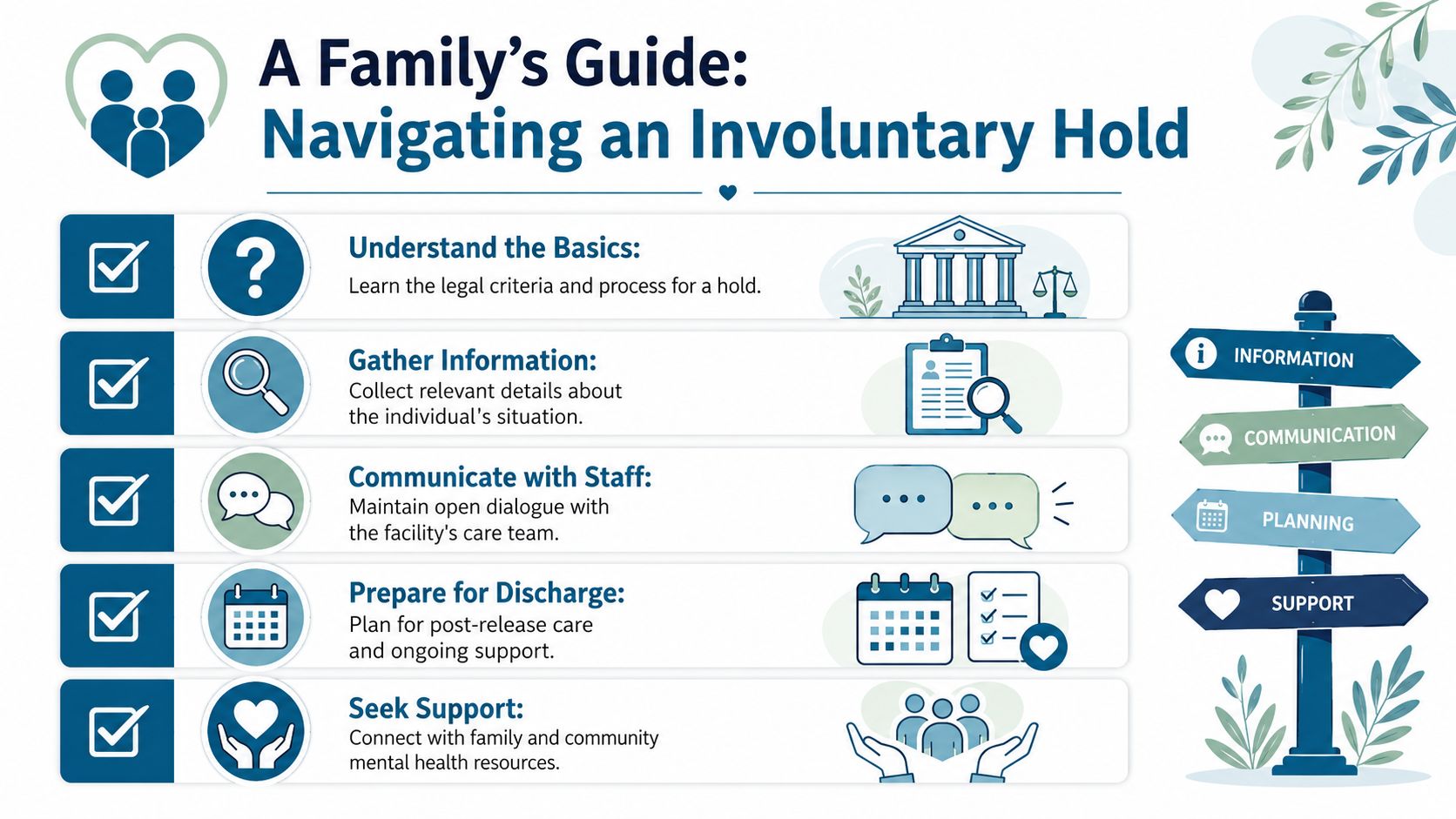
The hospital team handles the legal and clinical process. The family still plays an important role. Relatives who stay organized, calm, and useful can make the hold period more productive and the discharge process safer.
What to do during the hold
Start with information. Staff may not be able to share everything because of privacy rules, but families can still provide clinically useful details.
- Bring a short written timeline: Include recent behavior changes, missed medications, prior diagnoses, substance use concerns, and major stressors.
- Name immediate safety risks: Mention access to firearms, stockpiled pills, recent threats, or inability to care for basic needs.
- List current providers: A therapist, psychiatrist, primary care clinician, or case manager can help fill in the picture.
If the family is also coping with addiction, crisis education for loved ones can help. Practical support resources for families of people struggling with addiction often overlap with what families need during a psychiatric hold: boundaries, communication, and next-step planning.
How to communicate with staff effectively
The most effective family communication is brief, factual, and respectful. Emotional intensity is understandable, but staff need clear data.
Useful language sounds like this:
- "This is what changed in the last week."
- "This is what the person said or did that raised concern."
- "This is what usually helps when they begin to decompensate."
Less helpful communication tends to focus on blame. Long speeches about old family conflicts, demands for certainty, or attempts to control every clinical decision usually don't move the case forward.
Families don't need permission to be helpful. They do need to be disciplined about what kind of information actually supports care.
How to prepare before discharge happens
Discharge planning should begin before anyone has a final discharge time. Waiting until the last phone call often leads to rushed decisions and unsafe gaps.
A practical checklist includes:
- Confirm where the person will stay if home isn't safe or stable.
- Ask what follow-up care is recommended and how soon it should begin.
- Clarify medication instructions and who will help monitor adherence.
- Remove or secure hazards in the home environment.
- Create a crisis response plan for the first signs of relapse or psychiatric decline.
Families should also prepare for mixed emotions. Some people come home relieved. Others come home angry, ashamed, frightened, or still ambivalent about treatment. Support works best when it's steady and structured, not reactive.
From Crisis to Recovery Planning Your Next Steps with Zoe Behavioral Health
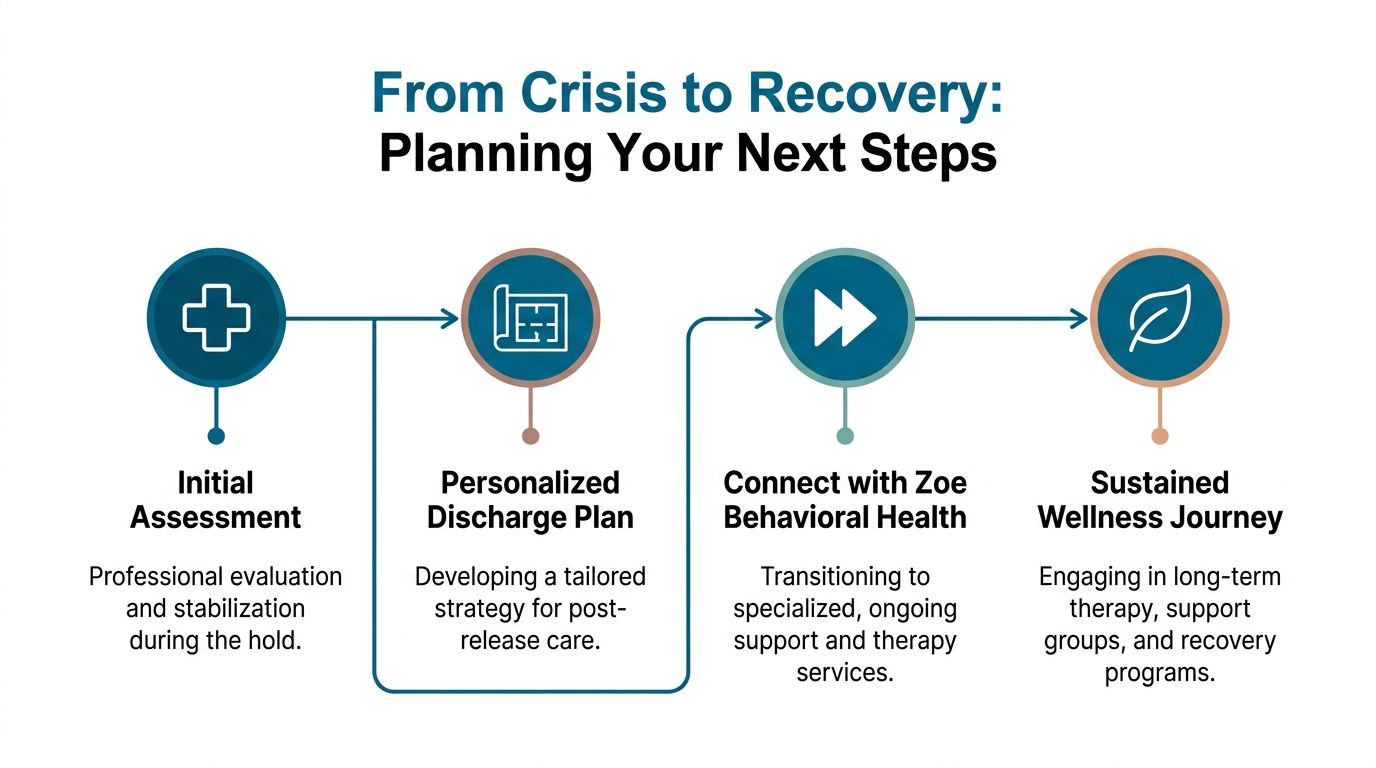
Discharge can look like resolution from the outside. In practice, it is often the most fragile point in the entire process. The person is no longer in immediate inpatient containment, but the underlying drivers of the crisis may still be active. That is why a hold without follow-up can become a revolving door.
Why discharge alone often isn't enough
A person may leave the hospital with reduced acute risk but still struggle with poor sleep, depression, psychosis, panic, substance use, trauma symptoms, or refusal to fully engage in care. Family members often feel pressure to "just get back to normal." That usually doesn't work.
What works better is a step-down structure that matches the person's actual level of need. For some people, that means intensive daytime support while sleeping at home. For others, it means dual-diagnosis care that addresses both mental health and substance use at the same time.
What a stronger plan looks like
A useful recovery plan usually includes several parts working together:
- Psychiatric follow-up: Medication review, symptom monitoring, and reassessment.
- Structured therapy: Individual and group treatment rather than occasional check-ins alone.
- Family involvement: Education, communication support, and realistic boundaries.
- Substance use treatment when needed: Especially when intoxication, withdrawal, or relapse played a role in the crisis.
- Case management: Help with work disruption, transportation, housing coordination, or scheduling.
When families are evaluating outpatient support, practical guidance on choosing a Penticton therapist offers a useful general reminder: the right fit involves clinical expertise, accessibility, and a treatment approach that matches the person's needs, not just the nearest opening.
Another challenge is timing. The best time to arrange next-step care is before motivation fades. Families trying to move quickly after a psychiatric or substance-related emergency often benefit from clear information on how to find help for substance abuse admissions, especially when the crisis includes alcohol or drug use.
A discharge plan should answer one simple question. What support begins immediately, not someday, if symptoms return the moment the person gets home?
Why continuity matters
The strongest programs don't treat the hold as the whole story. They treat it as the alarm. Recovery takes shape afterward through repeated contact, structured treatment, and support that fits the person's real-life environment.
For many Orange County families, that means looking for outpatient mental health and dual-diagnosis care with enough intensity to stabilize routines without requiring full inpatient living. A thoughtful plan can lower chaos, improve follow-through, and give families something they often haven't had in a long time: a workable next step.
Frequently Asked Questions About 5150 and 5250 Holds
Families usually leave the hospital with at least a few unanswered questions. These are some of the most common.
Can a patient refuse treatment during a hold
The answer depends on the specific treatment issue and the clinical and legal circumstances. A hold does not erase all patient rights. Families should ask the treatment team to explain what decisions the patient can still make and what requires separate clinical or legal justification.
Does a hold create a permanent criminal record
A psychiatric hold is not the same thing as a criminal conviction. Still, families shouldn't assume there will be no future consequences at all. As discussed earlier, some post-hold issues can affect areas like firearms, employment, or housing, which is why careful follow-up and legal clarification may matter.
Should the family push for fast discharge
Not if the person is still clearly unstable. Fast discharge can feel comforting in the moment but risky later. A better question is whether there is a safe living plan, treatment follow-up, and a realistic way to manage medications, supervision, and triggers.
How can a family get help before another crisis reaches the level of a hold
This is the most important question. Early outpatient treatment often gives families more options than waiting until someone becomes dangerous or unable to care for basic needs. If warning signs are building, such as isolation, medication refusal, escalating substance use, paranoia, severe depression, or repeated emotional collapse, it makes sense to seek a structured behavioral health assessment sooner rather than later.
The goal isn't just to avoid another 5150 or 5250. The goal is to build enough support that the person doesn't keep returning to the same breaking point.
Families in Orange County who need a next step after a 5150 or 5250 can reach out to Zoe Behavioral Health for compassionate admissions guidance, outpatient mental health support, dual-diagnosis treatment, and help coordinating a safer path from crisis toward lasting recovery.
