
A lot of families reach the same breaking point at the same time. Treatment is needed now, but there's a dog waiting by the door, a cat that sleeps on the bed every night, or an older pet that depends on a familiar routine. For many people, that isn't a side concern. It's the reason they delay care.
That hesitation is understandable. A pet often provides stability when everything else feels unsettled. The right treatment plan should account for that reality instead of asking someone to ignore it. In California, that's increasingly possible, especially for people who need flexible care that fits real life.
Healing Together with Your Pet
A common call to admissions starts with fear, not paperwork. Someone says treatment sounds necessary, but they can't leave their dog for weeks. A spouse says their partner is finally willing to get help, but no one can take the cat. An adult child says their parent won't agree to rehab because the pet is the one steady presence at home.
That's why pet friendly rehab in California matters. It removes a barrier that keeps people stuck. One independent directory counted more than 85 pet-friendly rehab programs in California, which shows how large the state's ecosystem has become for people who need treatment without severing that bond with a pet.
Why this decision feels so hard
A pet isn't just an animal in the home. For many clients, that relationship is tied to routine, comfort, and emotional safety. Early recovery already asks a lot. If treatment also means worrying every day about whether a pet is scared, lonely, or improperly cared for, some people won't go at all.
That doesn't mean every program can safely accept every pet. It means the treatment search should start with honest logistics, not wishful thinking.
Pets often become the deciding factor between “someday” and “today” when a person is considering rehab.
What helps families move forward
The most useful next step is simple. Stop treating pet care as an afterthought. Make it part of admissions planning from the first phone call.
That means asking whether the program supports on-site pet stays, whether outpatient treatment would let the pet remain at home, and what backup plan exists if the client's clinical needs change. Families who do this early usually make better placement decisions and avoid last-minute disruption.
Understanding California's Pet-Friendly Treatment Options
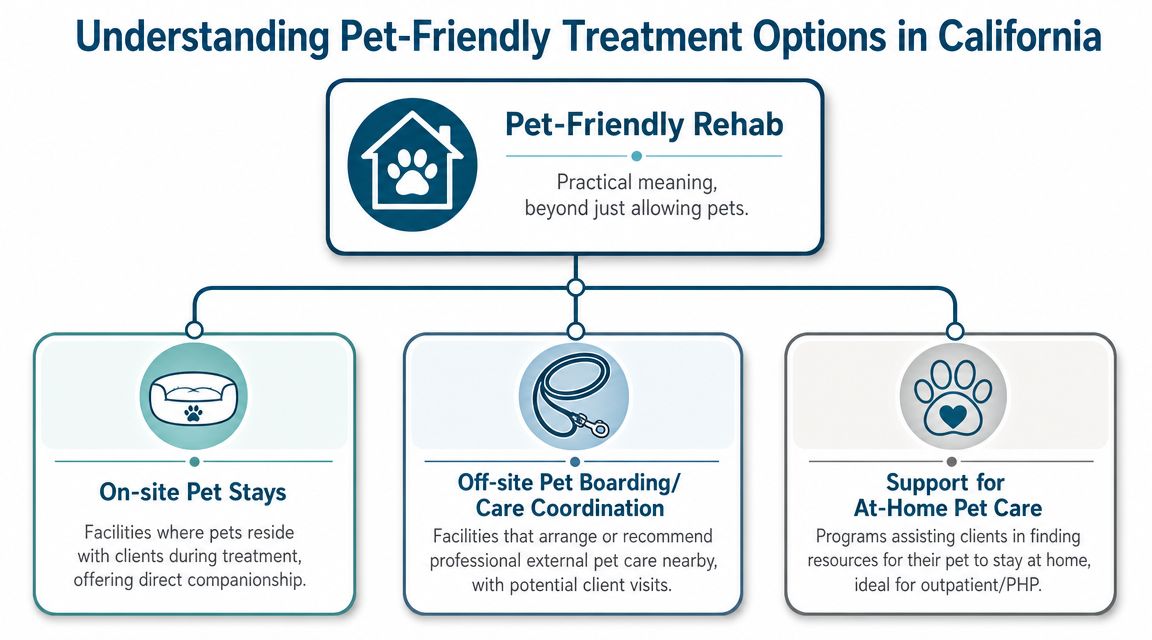
“Pet-friendly” sounds straightforward, but in practice it can mean several very different things. Some programs allow a pet to stay with the client. Some help coordinate outside care. Others are most pet-friendly because the client attends treatment during the day and returns home at night.
Service animals, emotional support, and companion pets
Families often use these terms interchangeably, but treatment settings don't always. A service animal raises different legal and operational questions than an emotional support animal or a general companion pet. That distinction matters because a facility may handle documentation, access, housing, and supervision differently depending on what role the animal serves.
Even so, most searches for pet friendly rehab california come down to a practical question. Can this specific program accommodate this specific animal safely?
Why facility policy matters more than labels
In California, pet accommodation is usually a policy and risk-management decision, not a separate clinical specialty. Facilities may allow dogs or cats only case by case, often with restrictions on species, breed, size, vaccination status, and available space.
That means “pet-friendly” doesn't guarantee approval. It usually means the center has a process.
A realistic intake review often looks at:
- Health status: Current vaccinations, medications, and veterinary stability.
- Temperament: Whether the pet can tolerate unfamiliar people, sounds, and shared environments.
- Care demands: Feeding, bathroom breaks, exercise, and how those needs fit with treatment hours.
- Housing setup: Whether the client will have an arrangement that works for both recovery and animal safety.
Three practical models families should know
The easiest way to understand the options is to think in terms of living arrangements.
| Option | What it usually means | Best fit |
|---|---|---|
| On-site pet stay | The pet lives with or near the client during treatment | Clients who need residential structure and have an approved pet |
| Coordinated outside care | The program helps arrange nearby care or temporary support | Clients whose pet can't stay in treatment but still needs a stable plan |
| At-home pet care with outpatient treatment | The client attends care during the day and returns home at night | Clients who need structure but can safely live at home |
The last category is often overlooked, even though it solves the problem for many households. A pet may do better in a familiar home than in a new facility, and the client may do better knowing the animal's routine stays intact.
Why Your Pet Is a Powerful Ally in Your Recovery
Most families don't need convincing that a pet matters. They need reassurance that this instinct makes clinical sense. In many cases, it does.
Public survey data show that 86% of pet owners reported their pets positively impact their mental health, which helps explain why so many clients see pet accommodation as part of treatment readiness, not just comfort.
What changes when a pet is part of the picture
Early recovery often brings anxiety, shame, loneliness, and emotional volatility. A pet can interrupt that spiral. The animal still needs food, a walk, medication, or a calm place to rest. Those ordinary tasks pull attention back to the present.
That daily responsibility can support treatment in a few important ways:
- Routine: Feeding and care create structure when motivation is inconsistent.
- Grounding: Physical contact and familiar presence can help during emotionally activated moments.
- Connection: A pet offers companionship without judgment, performance, or social pressure.
- Responsibility: Caring for another living being supports accountability, which recovery also requires.
Clinical takeaway: Pet support works best when it reinforces treatment structure, not when it replaces it.
Comfort helps, but structure still comes first
A pet can be stabilizing, but it shouldn't become an escape from the work of rehab. The goal isn't to spend treatment hiding with an animal. The goal is to use that bond in a way that supports therapy attendance, emotional regulation, and consistency.
That's why well-run programs treat pet accommodation as part of a larger care plan. They don't assume every client should bring a pet, and they don't assume every pet improves every situation.
For readers who want a broader discussion of the human-animal bond in recovery, this piece on the value of pets in addiction recovery is a useful companion read.
When pets help the most
The strongest fit is often a client who already relies on the pet for daily regulation and who can still participate fully in treatment. The weakest fit is a situation where the pet adds unmanaged stress, conflict, or distraction.
That distinction matters. A pet can be a real ally in recovery, but only when the treatment setting has clear expectations and the client can meet them.
How to Evaluate Pet-Friendly Rehab Programs in California
A good admissions conversation should sound specific. If a center only says “pets are welcome” and can't explain the process, families should keep asking questions.
The most reliable programs use pre-admission screening for pets based on temperament, health history, and ability to adjust, especially when the program treats co-occurring disorders and needs a stable environment for everyone involved.
Questions that reveal whether a program is truly prepared
Some answers matter more than the sales language on a webpage. Families should ask:
- What animals are considered? Dogs and cats may be handled differently, and approval may be individualized.
- What documentation is required? Vaccination records, medications, and veterinary information often come up early.
- How is temperament evaluated? Group settings can be stressful, noisy, and unpredictable.
- Who handles daily care? Clients need to know what happens during therapy blocks, medical appointments, or difficult days.
- What happens if the client's level of care changes? Detox, crisis stabilization, or a higher-acuity episode may temporarily limit pet care ability.
Signs a program is thinking clearly about risk
Families shouldn't confuse restrictions with a lack of compassion. Boundaries usually signal that the facility has experience and understands what can go wrong.
Strong pet-related policies often include:
- Behavior rules: Expectations around barking, aggression, jumping, and interactions with others.
- Environmental limits: Clear guidance on room access, outdoor areas, and cleanup responsibilities.
- Contingency planning: A backup caregiver or emergency contact if the client can't care for the pet.
- Clinical coordination: A way to adjust the pet plan without disrupting treatment if symptoms escalate.
A stable treatment environment protects both the client and the animal. Screening isn't red tape. It's part of safe placement.
A short test for admissions calls
If the conversation stays vague, that's useful information. Families should listen for concrete answers instead of broad reassurance.
| What to ask | What a strong answer sounds like |
|---|---|
| How do you evaluate whether a pet is a fit? | The center explains screening criteria and decision steps |
| What happens during therapy hours? | Staff can describe how routines are managed |
| What if the client has trauma, anxiety, or dual diagnosis needs? | The center discusses environmental stability and treatment planning |
| What's the backup plan? | There's a clear process if the pet can't remain on-site or the client can't provide care temporarily |
A family doesn't need perfect certainty before admission. It does need a program that answers practical questions without hesitation.
A Step-by-Step Guide to Preparing for Rehab with Your Pet
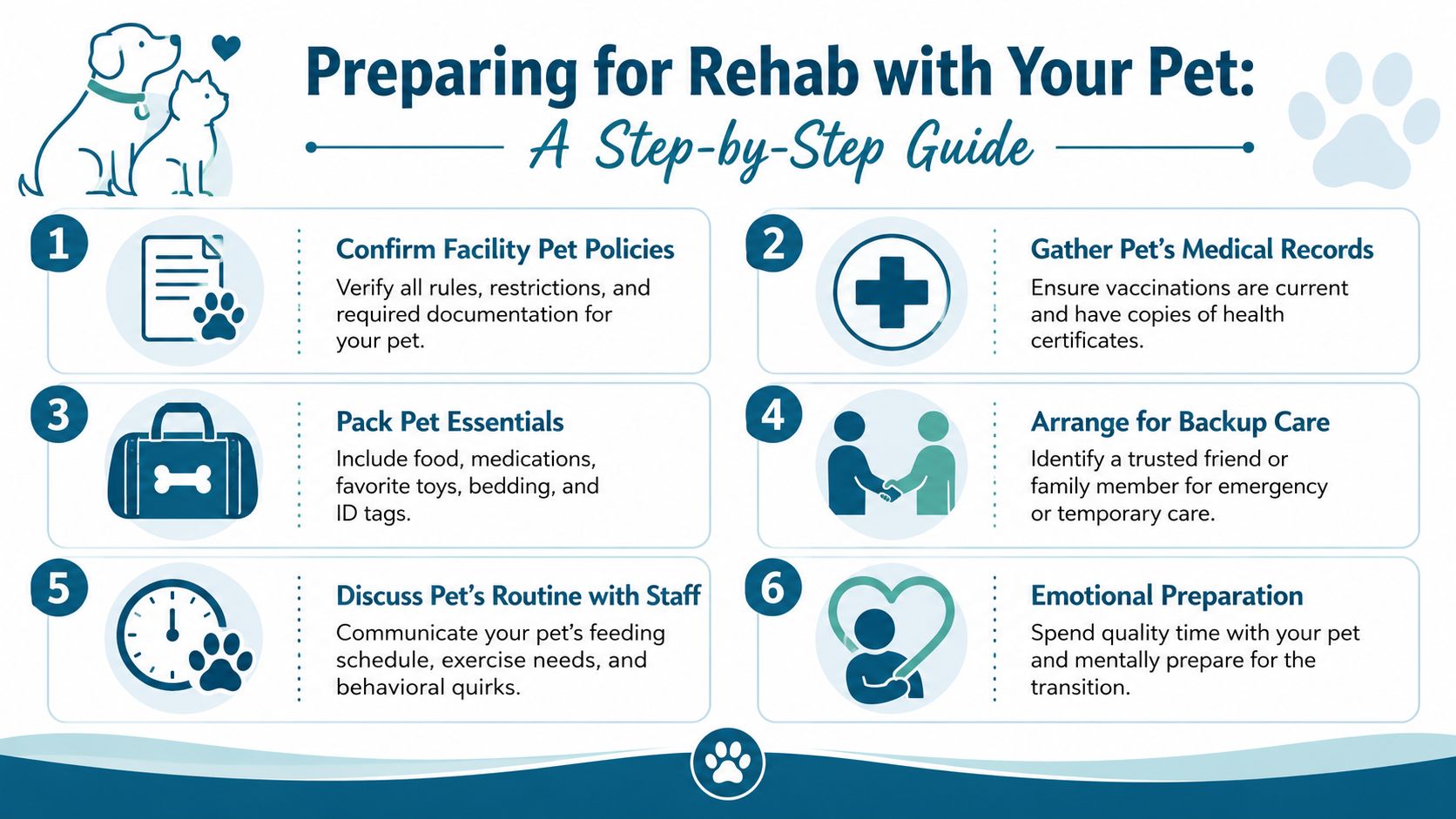
Once a program is selected, preparation lowers stress fast. Families who gather records, confirm routines, and plan for contingencies usually arrive calmer and start treatment with fewer disruptions.
The six tasks that matter most
Confirm the exact pet policy
Ask for the rules in plain language. Families should know what's permitted, what paperwork is required, and what could disqualify a pet after arrival.Gather veterinary documents
Keep vaccination records, medication details, feeding instructions, and the veterinarian's contact information together in one folder.Pack for routine, not just travel
Bring food, bowls, medications, leash or carrier, bedding, waste supplies, and a familiar item that smells like home.Choose a backup caregiver
This step protects everyone. If the client needs a different level of care or the pet struggles in the environment, someone trustworthy should be ready.Share the pet's normal schedule
Feeding times, bathroom routine, sleep habits, and triggers matter. Staff can plan better when they know what the animal is used to.Prepare for transportation
Travel day can be the most chaotic part. For practical help on car readiness, packing, and minimizing stress, this guide on how to prepare your pet for travel can help families avoid common mistakes.
Checklist for calls with treatment centers
The most useful call sheet is short enough to use and detailed enough to prevent surprises.
| Category | Question to Ask |
|---|---|
| Eligibility | Is this pet type allowed, and is approval case by case? |
| Medical records | What veterinary documentation is required before admission? |
| Daily care | Who is responsible for feeding, walks, medication, and cleanup? |
| Housing | Where does the pet stay during the day and overnight? |
| Treatment schedule | How is pet care handled during groups, therapy, and appointments? |
| Behavior | What happens if the pet becomes distressed, noisy, or reactive? |
| Emergency plan | Who steps in if the client can't care for the pet temporarily? |
| Discharge planning | Will pet needs be considered as the client steps down in care? |
Don't forget the client's own packing list
Families often focus so much on the pet that they rush the client's side of preparation. A clear list of clothing, documents, medications, and personal items prevents avoidable stress. This guide on what to bring to rehab can help organize that part of admission.
Preparation works best when families plan for the ordinary day, not just the admission day.
That means thinking beyond the car ride and asking what mornings, evenings, therapy blocks, and backup situations will look like.
Keeping Your Pet at Home with Outpatient and PHP Treatment
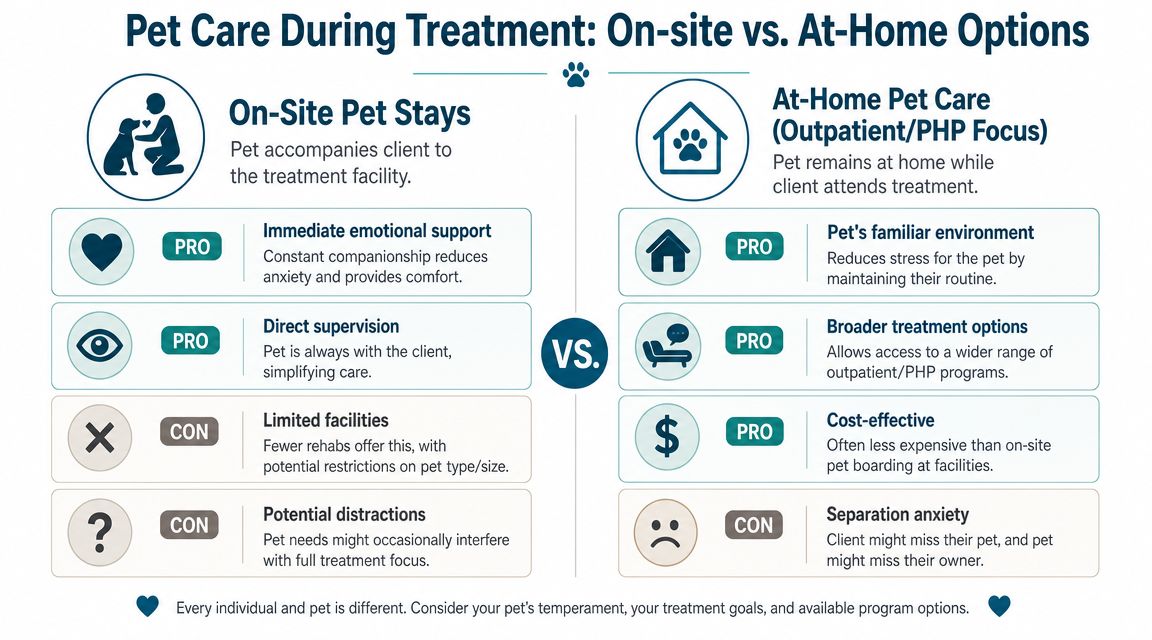
For many people, the most practical version of pet friendly rehab california doesn't involve bringing the pet to treatment at all. It means choosing a program that provides strong clinical structure while allowing the client to sleep at home and keep the pet's routine stable.
One outpatient provider notes the key distinction clearly. PHP lets clients attend treatment during the day and return home at night, while IOP and outpatient care don't require overnight stays, which is why outpatient feasibility is such an important but underserved part of this conversation.
Why at-home pet care often works better
A residential placement can be right for some clients. But for a pet owner with stable housing and enough support to live safely outside inpatient care, outpatient treatment may solve the hardest problem without introducing a new one.
Benefits often include:
- The pet stays in a familiar setting: Routine, sleeping areas, and feeding patterns stay intact.
- The client keeps meaningful contact: Returning home can reduce guilt and worry about the animal.
- The treatment search opens up: Families aren't limited only to centers that allow on-site pets.
- Home life becomes part of recovery work: Skills learned in treatment can be applied the same day.
When PHP or IOP is the better fit
Outpatient care isn't lighter in purpose. It's different in structure. A person can receive meaningful clinical support during the day while continuing to manage home responsibilities at night.
For readers comparing this level of care, Partial Hospitalization Program PHP is a helpful overview of how day treatment typically works.
This model is especially useful for clients who are balancing sobriety with family obligations, housing stability, or pet care that would be hard to hand off. It can also be a strong step-down option after detox or residential treatment.
Southern California logistics matter
In Orange County and surrounding areas, the main question is often less about “Can the pet come?” and more about “Can treatment fit life closely enough that the pet can remain well cared for at home?” That's where flexible scheduling becomes important.
Zoe Behavioral Health offers outpatient care in Orange County, including PHP and IOP, for clients who need structured addiction and mental health treatment while maintaining daily life at home. For some households, that's the cleanest and safest way to keep recovery moving without uprooting a pet.
Families can also support a smoother home routine by keeping the pet's digestion, feeding schedule, and stress load as steady as possible. If a dog is sensitive to routine changes, some owners look into basics like dog probiotics as part of a broader discussion with their veterinarian.
Your Partner in Recovery at Zoe Behavioral Health
The hardest part for many families is believing they don't have to choose between urgent treatment and a beloved pet. In the right setting, they don't.
What matters is matching the person to the level of care that makes recovery possible and sustainable. For some, that will mean on-site pet accommodation. For many others, the more realistic answer is outpatient treatment that lets them receive serious help during the day and return home to the animal that gives them comfort and structure at night.
What families should do next
A useful admissions call should answer a few questions quickly:
- Is the person clinically appropriate for outpatient care?
- Can the household support safe recovery between treatment days?
- What pet routine needs to stay intact for the client to engage fully in care?
- What backup plan is in place if needs change?
If those answers line up, treatment can begin without adding unnecessary upheaval at home.
The right plan is the one that gets started
Families often wait for the perfect arrangement and lose momentum. A safer goal is a workable plan with clear supports. If a person is ready for help, admissions should move while that window is open.
A thoughtful program will look at substance use, mental health needs, daily functioning, transportation, home environment, and practical responsibilities like pet care. That's what turns interest into admission and admission into a real chance at recovery.
If treatment has been delayed because no one wants to leave a pet behind, a conversation with Zoe Behavioral Health can help clarify the next step. Their team provides confidential admissions support, insurance verification, and guidance on whether outpatient care in Orange County could let a client begin recovery while keeping life at home, including pet care, more stable.
