
A family often knows something is wrong before anyone can name it. A son stops sleeping and starts talking so fast that no one can follow him. A partner locks themselves in a bedroom, won't eat, and says everyone would be better off without them. A parent who usually manages work and home suddenly seems terrified, confused, or unreachable. In those moments, panic takes over fast.
Emergency mental health services exist for exactly this reason. They help families move from fear and chaos to safety and next steps. The hard part is that a crisis rarely arrives with a clear label. It shows up as alarming behavior, frightening words, or a sharp change that feels impossible to manage at home.
Families need a simple path. They need to know when it's an emergency, what to do first, what happens during an evaluation, and what should happen after the immediate danger has passed. Stabilization matters. But going home with no plan is how many families end up back in crisis.
When a Loved One's Struggle Becomes a Crisis
At first, it may look like stress. A loved one withdraws from conversations, stops answering messages, or starts missing work. Then the behavior shifts. They become agitated, paranoid, reckless, or hopeless. They say things that sound final. The whole household starts walking on eggshells.
Families usually spend too long asking the wrong question. They ask, “Is this serious enough?” The better question is, “Is this safe to manage without immediate help?” If the answer is no, then the situation has crossed into crisis.
A mental health emergency can involve depression, panic, psychosis, trauma, substance use, or a mix of all of them. It can also build slowly and then break open in a single night. That's why families need to stop waiting for perfect clarity. Dangerous situations don't require certainty before action.
Practical rule: If a loved one's behavior creates immediate concern about safety, reality testing, or basic self-care, it's time to treat it like an emergency.
Many families also struggle with how to even start a conversation before outside help arrives. Guidance on how to find a professional to talk to a loved one can help relatives prepare for that first difficult step without escalating the moment further.
What families often notice first
Some warning signs are obvious. Others are subtle until they pile up. Common early shifts include:
- Severe withdrawal: Staying isolated, avoiding food, water, or contact
- Sharp agitation: Pacing, yelling, threatening, or acting unable to settle
- Concerning statements: Talking about death, burden, hopelessness, or disappearing
- Loss of functioning: Not bathing, not sleeping, not managing medications, or wandering
- Detached thinking: Saying things that suggest paranoia, delusions, or hallucinations
Fear is normal here. Confusion is normal too. What matters is action.
Recognizing a Mental Health Emergency
A mental health emergency isn't just emotional pain. It's a situation where a person may be at risk of harming themselves, harming someone else, or becoming unable to care for basic needs safely. That's the line families need to watch for.

Signs that need immediate attention
The following behaviors should be treated seriously and quickly:
- Suicidal communication: Direct statements about wanting to die, indirect statements about being a burden, giving away possessions, or saying goodbye
- Self-harm behavior: Cutting, burning, overdose behavior, or recent attempts
- Violence risk: Threats, brandishing weapons, physically intimidating behavior, or loss of control
- Psychosis symptoms: Hearing voices, seeing things others don't, extreme paranoia, or fixed false beliefs
- Grave disability: Inability to eat, drink, find shelter, stay oriented, or manage the basics of survival
- Extreme mania or agitation: Going days without sleep, acting impulsively, becoming grandiose, or making dangerous decisions with no insight
- Substance-related instability: Intoxication, withdrawal, or mixed mental health and substance use symptoms that make judgment unreliable
Emergency departments see this every day. According to CDC data on adult emergency department visits for mental health disorders, mental health-related visits averaged 13.2 million per year from 2017 to 2019 and made up 12.3% of all adult ED encounters, with the highest rate among adults ages 18 to 44.
When families shouldn't wait
Many relatives hesitate because they don't want to overreact. That instinct is understandable and dangerous. Delay usually helps no one when a person is escalating, detached from reality, or expressing suicidal intent.
Waiting for a person in crisis to “calm down on their own” can turn a treatable emergency into a life-threatening one.
For families trying to sort out whether symptoms suggest a psychiatric emergency versus an urgent need for formal diagnosis and treatment, this resource on understanding psychiatric needs in PA can help clarify the broader picture.
Support also matters before, during, and after a crisis. Families who want language for connection and outreach may find value in this piece on the power of connection during suicide prevention awareness.
The simplest test
If a loved one is unsafe, unreachable, or unable to care for themselves, it's an emergency. Families don't need to diagnose the condition before getting help.
Your Immediate Crisis Response Options
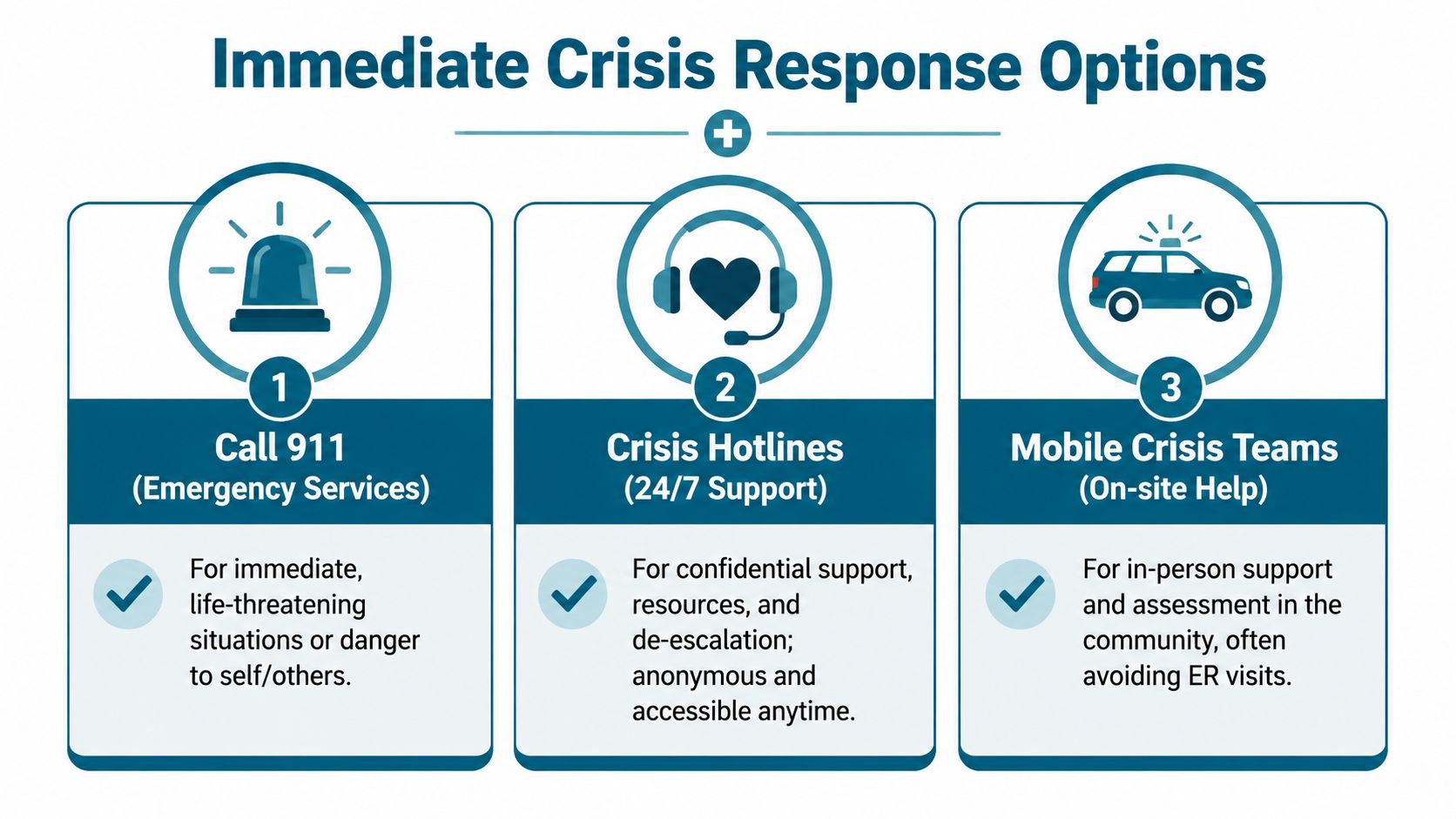
In a mental health crisis, the response should match the level of danger. Some situations need emergency services right now. Others need rapid de-escalation and clinical support without the intensity of a police or hospital response.
How to choose the right response
Call 911 when there is immediate danger. That includes active suicide attempts, violent behavior, serious self-harm, overdose, or medical collapse. Families should be direct and state that this is a mental health emergency.
Call or text 988 when the person is in acute emotional distress, suicidal, or mentally unstable, but there isn't immediate physical danger in the moment. This can help with de-escalation, guidance, and connection to local crisis resources.
Request a Mobile Crisis Team when in-person mental health support is needed and the person can likely be assessed safely in the community. This option can be especially useful for psychosis, escalating agitation, or refusal to voluntarily seek help.
Go to the emergency department when the person needs urgent evaluation, medical clearance, or cannot be safely monitored at home. This is often the default when families don't have access to another immediate option.
Nationally, research on mobile crisis services found that Mobile Crisis Teams resolved 67% to 72% of dispatches on-site without escalation to more intensive services, and only 1% of calls required law enforcement involvement. That makes mobile crisis response one of the strongest options when the person needs urgent help but not an active police emergency.
Crisis Response Options at a Glance
| Service | Best For… | Who Responds | Potential Outcome |
|---|---|---|---|
| 911 | Immediate life-threatening danger, active violence, serious injury, overdose, suicide attempt | Emergency responders, often including law enforcement and EMS | Immediate safety intervention, transport for emergency medical or psychiatric care |
| 988 | Suicidal thoughts, emotional crisis, urgent guidance, family uncertainty | Crisis counselors | De-escalation, safety planning, referral, possible linkage to local in-person crisis support |
| Mobile Crisis Team | On-site behavioral health assessment when community response may be safe | Mental health professionals | Evaluation, stabilization, referral, possible diversion from ER or law enforcement |
| Emergency Department | Need for urgent psychiatric evaluation or medical clearance | Hospital staff, emergency clinicians, psychiatric staff if available | Observation, medical workup, psychiatric assessment, admission or discharge planning |
What families should say during the call
The call should be concrete, not vague. A family member should report:
- What is happening now: “He said he wants to die and locked himself in the bathroom.”
- What changed recently: “She hasn't slept, is hearing voices, and is getting more paranoid.”
- Whether substances may be involved: Alcohol, pills, opioids, stimulants, or withdrawal risk
- Whether there are weapons or medical concerns: This changes the urgency and response plan
- Whether the person is willing to go voluntarily: That affects next steps fast
The best crisis call gives responders behavior, timing, safety concerns, and any known medical or substance use details.
Orange County families should also prepare for a practical reality. Availability varies by location and by hour. If a mobile team isn't available quickly and safety is deteriorating, the emergency department becomes the safer option.
What to Expect During an Evaluation
Families often fear the evaluation more than the crisis itself because they don't know what happens next. The process is usually more structured than expected. The purpose is safety, stabilization, and determining the right level of care.

What the evaluation usually includes
In an emergency setting, clinicians first look for immediate danger. They assess suicidal thoughts, homicidal thoughts, psychosis, intoxication, withdrawal risk, confusion, and the person's ability to care for themselves.
Medical clearance may come first. That means staff rule out or address physical causes and urgent medical complications. If substances are involved, the team may need to assess intoxication or withdrawal before a full psychiatric picture is clear.
The psychiatric part of the evaluation often covers:
- Current symptoms: Mood, anxiety, psychosis, sleep, behavior
- Risk factors: Attempts, self-harm, violence, access to means
- History: Prior diagnoses, medications, hospitalizations, trauma, substance use
- Functioning: Eating, hygiene, shelter, judgment, orientation
- Support system: Family, housing, treatment providers, transportation
Understanding a 5150 hold in California
In California, a 5150 hold allows an involuntary detention for evaluation when a person appears to be a danger to themselves, a danger to others, or gravely disabled due to a mental health condition. Families often hear this phrase and assume punishment. It isn't punishment. It's a legal safety mechanism used when a person can't or won't accept needed emergency help voluntarily.
That hold doesn't mean every person will be hospitalized long term. It means clinicians need time to assess and stabilize the immediate risk.
A major reason emergency departments remain the default setting is access. A national survey of mental health facilities and psychiatric walk-in availability found that only 33.5% of facilities offered psychiatric walk-in services, and availability had been decreasing. Families often end up in the hospital because there isn't another immediate place to go.
What families can do during the evaluation
Families help most when they stay factual. Staff need observations, not polished stories. A relative should share recent behavior changes, medications, substance use concerns, prior threats or attempts, and what happened in the last day or week.
For those trying to understand how a fuller mental health workup can continue after emergency stabilization, Sachs Center diagnostic services offer a useful example of what thorough assessment can look like outside the acute emergency setting.
Bring names of medications, photos of pill bottles if needed, and a short timeline of recent events. That information can change the quality of the evaluation.
The Critical Transition from Crisis to Recovery
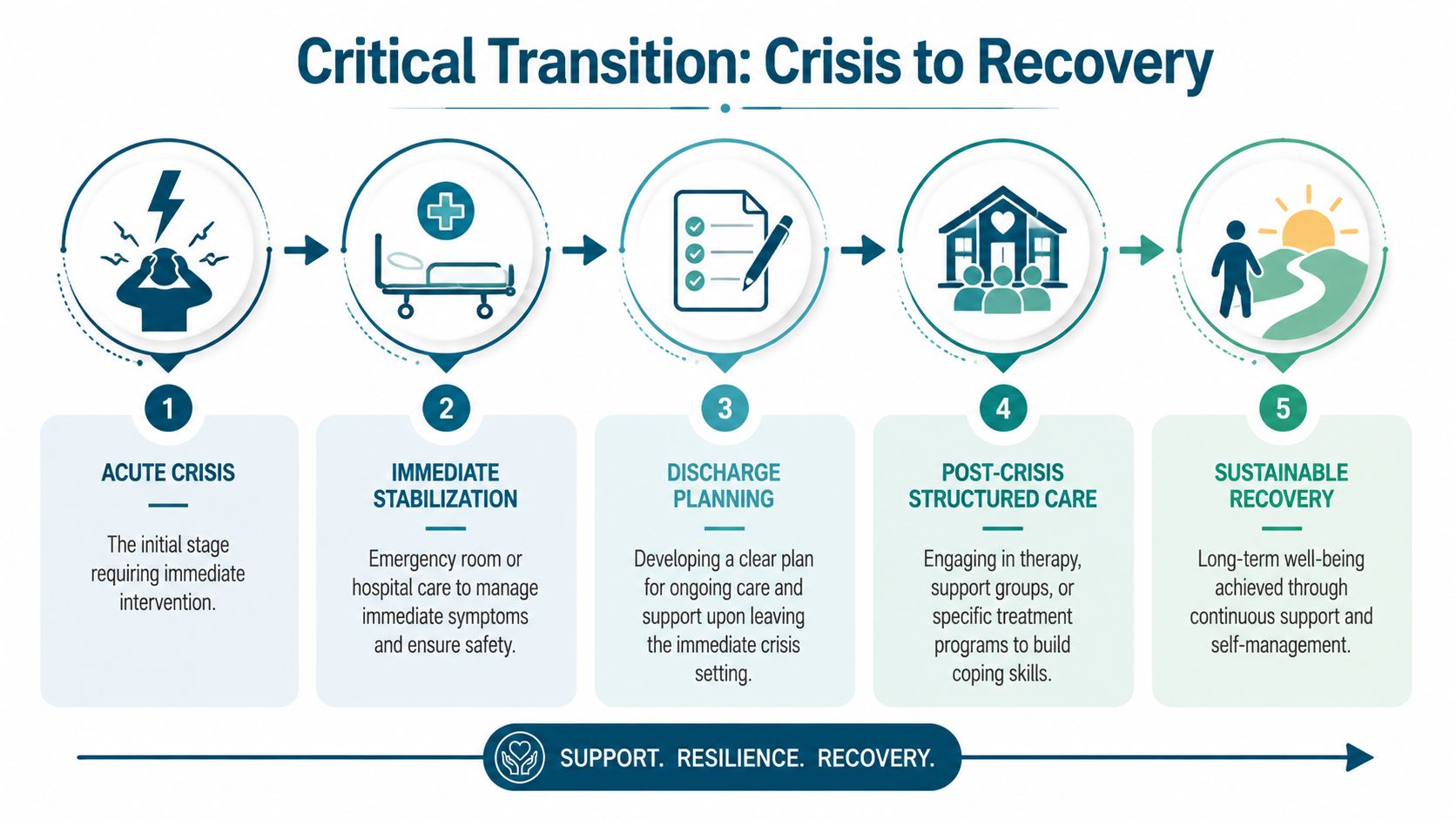
Emergency care handles danger. It rarely handles the deeper pattern that produced the crisis. That difference is where many families get blindsided.
A person may be discharged calmer than they were a few hours earlier. That doesn't mean they're well. It means the immediate emergency has been reduced enough for the next phase of care to matter more than ever.
Why discharge is a vulnerable moment
Families often hear a few instructions, receive a medication adjustment, and go home exhausted. Then the same problems return. The person still has unstable mood, poor insight, substance use triggers, family conflict, or no daily structure. The crisis has paused, not ended.
That's why a continuum of care matters. People leaving the ER or inpatient psychiatry often need a step-down level of treatment that is more intensive than a weekly therapy session and less restrictive than hospitalization.
What structured follow-up should include
The most useful post-crisis care usually involves programs such as Partial Hospitalization (PHP) or Intensive Outpatient (IOP). These settings give people a real bridge back to daily life while still providing consistent clinical support.
A strong step-down plan should include:
- Frequent clinical contact: More than occasional check-ins
- Medication oversight: Especially after a recent change or crisis
- Therapy that addresses the actual drivers: Trauma, depression, anxiety, psychosis, or substance use
- Family involvement: Because home stress can either support recovery or destabilize it
- Clear monitoring for relapse signs: Sleep disruption, withdrawal, agitation, or renewed hopelessness
Stabilization without follow-up is one of the most common setup points for another emergency.
The families who do best are the ones who treat discharge as the beginning of treatment, not the end of the problem.
Building a Sustainable Recovery at Zoe Behavioral Health
Many crises involve more than one issue. A person may be depressed and drinking heavily. They may be anxious, using pills, and spiraling after detox. They may leave the hospital with psychiatric symptoms that are tangled up with substance use. Standard emergency responses often separate those problems when they should be treated together.

Why dual-diagnosis care matters after a crisis
This is one of the biggest failures in the system. According to data summarized on crisis care for mental health and dual-diagnosis treatment, nearly half of adults with a mental illness also have a substance use disorder, yet only 12.4% receive treatment for both conditions. When treatment is fragmented, people get bounced between systems instead of improving.
Families should be blunt about this when choosing next steps. If substance use is part of the picture, care that ignores it is incomplete. If mental health symptoms are severe, addiction-only support is incomplete too.
What effective post-crisis treatment should look like
The right program after emergency mental health services should provide structure, skill-building, and accountability while allowing the person to reconnect with daily life. That often means:
- Partial Hospitalization or Intensive Outpatient care: Enough support to prevent a quick slide backward
- Individualized therapy: Not one-size-fits-all crisis counseling
- Medication-assisted treatment when appropriate: Especially when opioid or other substance dependence is part of the case
- Case management and discharge coordination: So the family isn't left doing all the logistics alone
- Holistic support: Sleep, nutrition, activity, and routine matter because recovery lives in the body as much as the mind
For families in Orange County, Zoe Behavioral Health offers outpatient mental health and substance use treatment that fits this post-crisis gap, including referral coordination for detox, PHP, IOP, counseling, dual-diagnosis care, MAT, and ongoing support close to home.
What families should ask before agreeing to treatment
A family shouldn't settle for vague reassurance. They should ask direct questions:
- Can the program treat mental health and substance use together?
- What happens if the person was just discharged from an ER or inpatient unit?
- How much weekly structure is provided?
- Who manages medication issues and communication with the family?
- What is the plan if symptoms worsen again?
The strongest recovery plans are concrete. They don't rely on hope alone.
Creating a Family Safety and Aftercare Plan
A family safety plan should be written down before the next hard day arrives. Memory gets unreliable during a crisis. A written plan reduces confusion and gives everyone a shared script.
What the plan should include
Every family plan should cover these basics:
- Warning signs: Sleep loss, isolation, paranoia, renewed substance use, hopeless statements, or sudden agitation
- Key contacts: Therapist, psychiatrist, primary care clinician, local crisis resources, trusted family members, and treatment admissions support
- Medication list: Current prescriptions, dosage information, allergies, and recent medication changes
- Preferred response steps: Who calls first, who stays with the person, who secures medications or sharp objects, and when to escalate to 988, a mobile team, or 911
- Discharge follow-up tasks: Appointments, transportation, insurance calls, work leave needs, and family check-ins
Keep the plan practical
A useful plan is short enough to use under stress. It should live in a phone, on paper at home, and with at least one trusted relative. The person in recovery should help build it whenever possible. Cooperation matters more than control.
Families also need to understand that setbacks can happen during mental health healing without meaning all progress is gone. This article from Altura Recovery on mental health recovery gives helpful context on how to think about recurrence and recovery without panic.
Relatives who need more support in their own role can also benefit from guidance for families supporting a loved one through addiction and recovery. A stable family response can lower chaos even when symptoms return.
A safety plan works best when everyone knows their job before emotions run high.
The most effective aftercare plans are built with professional input, updated after every major incident, and treated like essential health documents rather than optional paperwork.
When a family has just survived a psychiatric emergency, the next decision matters as much as the first one. Zoe Behavioral Health helps Orange County adults and families manage that post-crisis period with admissions guidance, insurance verification, and coordinated outpatient treatment for mental health, substance use, and dual-diagnosis needs. If a loved one has been stabilized but still needs real structure, clinical support, and a plan for sustainable recovery, reaching out is a practical next step.
