
A son stops answering texts. A father keeps conversations practical because every emotional topic turns into an argument. A holiday dinner stays polite on the surface, but everyone at the table feels the tension. Nobody knows whether the underlying problem is anger, disappointment, addiction, depression, old wounds, or all of them at once.
That confusion is common in father son relationships. Families often sense that something is off long before they can name it. They may call it disrespect, distance, moodiness, control, shutting down, or constant conflict. Underneath those labels, there's usually a deeper pattern that has been building for years.
The hard part is that these relationships can carry enormous love and enormous pain at the same time. A son may still want his father's approval while insisting he doesn't care. A father may care a great deal while acting cold, critical, or absent. When a family starts looking for answers, that search isn't weakness. It's often the first healthy move the system has made in a long time.
The Unspoken Weight of Father Son Relationships
One of the most painful features of strained father son relationships is how ordinary they can look from the outside. Two men can sit in the same room, talk about work, sports, bills, and logistics, and still never touch the underlying issue. The silence becomes the relationship.

What families often notice first
A concerned spouse, partner, or mother usually sees the pattern before either man can describe it. She may notice that the son becomes defensive around his father within seconds. She may also notice that the father sounds harsher, flatter, or more controlling with his son than with anyone else.
Common signs include:
- Short conversations that escalate fast because both people hear criticism, even when the words sound mild.
- Emotional avoidance where practical talk replaces meaningful talk for months or years.
- Role confusion when the son becomes the family peacekeeper, or the father expects loyalty without emotional safety.
- Old grievances that never fully leave even after apologies, time apart, or temporary calm.
This doesn't happen because families don't care. It happens because father son relationships carry identity, pride, expectation, and shame in a concentrated form.
A son often hears more than a sentence from his father. He hears a verdict about who he is.
Why the pain runs so deep
Fathers shape how many sons understand strength, failure, approval, and belonging. Sons, in turn, often stir up a father's own unresolved fears about adequacy, authority, aging, and vulnerability. That's why the arguments can feel so loaded. The present moment activates much older material.
A family member looking for help is often trying to answer several questions at once:
| Family concern | What may be underneath |
|---|---|
| “Why does every talk become a fight?” | Shame, misread threat, old attachment injuries |
| “Why is he so distant?” | Emotional self-protection, depression, trauma, learned avoidance |
| “Why does substance use seem tied to family stress?” | Self-medication, poor stress regulation, unresolved pain |
When people understand that the conflict has a pattern, the situation starts to feel less hopeless. The goal isn't to force instant closeness. The goal is to understand what keeps this bond stuck so repair becomes possible.
The Psychological Blueprint of the Father-Son Bond
Early father son relationships shape more than memories. They shape expectations. A son learns what closeness feels like, what authority feels like, and whether his emotional needs will be met, ignored, mocked, or punished.
Four parts of the blueprint
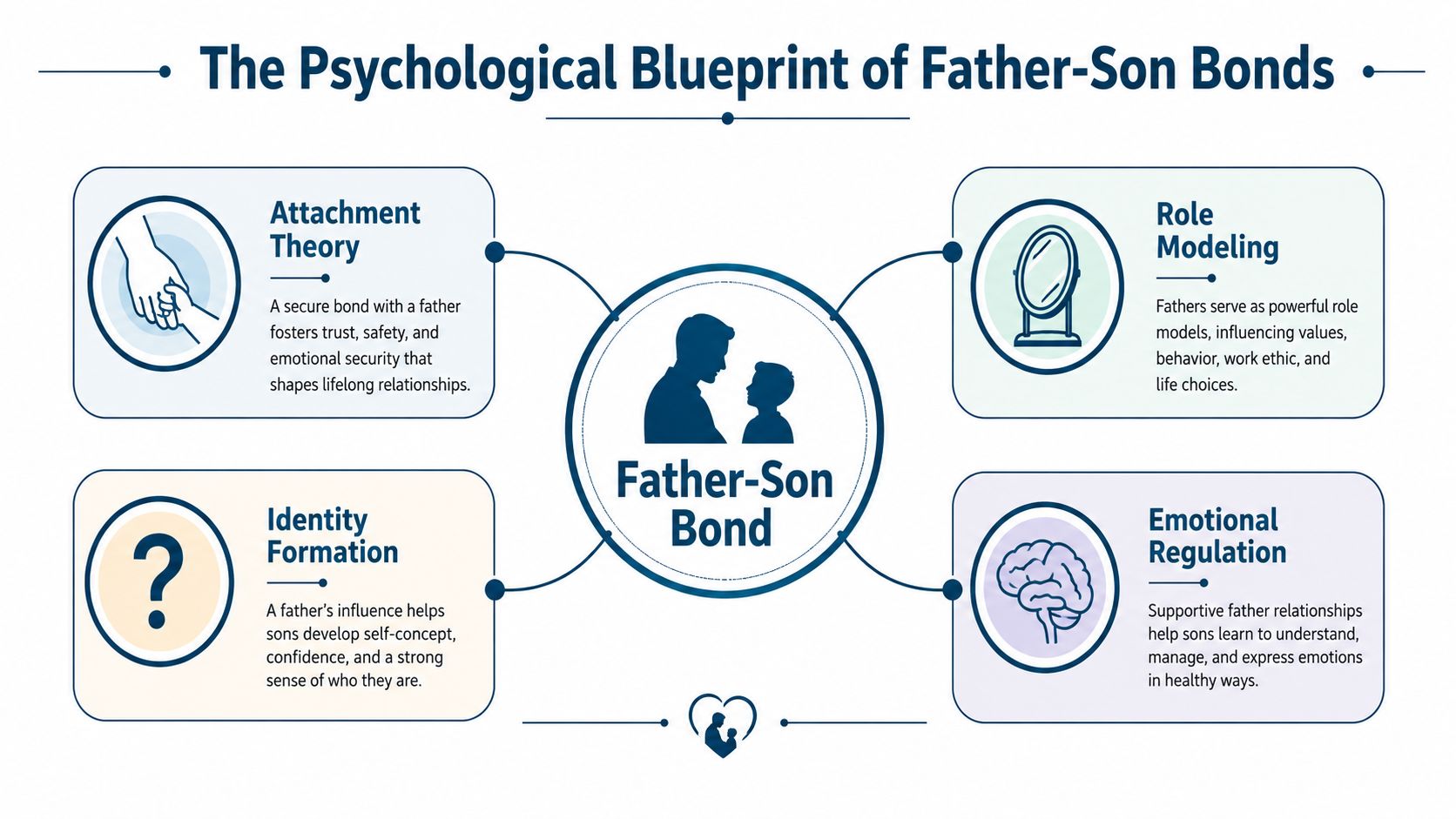
A healthy bond usually develops through four core experiences:
- Attachment. The son learns whether reaching for comfort is safe.
- Role modeling. He watches how a man handles stress, conflict, love, and limits.
- Identity formation. He begins to answer questions like, “Who am I?” and “What kind of man am I becoming?”
- Emotional regulation. He learns whether feelings can be named, tolerated, and repaired.
When these areas are disrupted, the damage often shows up later as insecurity, anger, overachievement, numbness, or chaotic relationships. Families trying to explore different parenting styles often find that style matters less than consistency, safety, and emotional availability over time.
When a father wound shapes adulthood
The term father wound helps families understand pain that doesn't go away just because the son is now grown. According to the Attachment Project's discussion of father wound patterns, sons with a father wound can show chronic feelings of not being good enough, low self-worth, and a strong need to control parts of life to regain autonomy lost in childhood. That same pattern can look like competence on the outside and persistent unworthiness underneath. It can also create adult relationships marked by emotional distance.
That framework matters because it shifts the conversation away from “What's wrong with him?” and toward “What happened in the bond?”
Practical rule: If a grown son reacts to small disappointments like they are major rejections, the nervous system may still be organized around old relational pain.
What works and what doesn't
Families often try to fix these patterns with logic alone. That rarely works.
What usually doesn't help:
- Demanding instant forgiveness
- Using money, favors, or advice as substitutes for emotional repair
- Arguing over whose memory is correct
- Assuming adulthood erases childhood attachment injuries
What tends to help:
- Naming the pattern without ridicule.
- Separating character from coping style.
- Building small, repeatable experiences of safety.
- Accepting that trust grows through consistency, not speeches.
A blueprint can be revised, but it usually won't change through pressure. It changes through safer interactions repeated over time.
How Generational Trauma and Mental Health Create Rifts
Some fathers don't seem cruel so much as unreachable, reactive, or emotionally blunted. Families often personalize that behavior. They assume the father doesn't care, or the son is too sensitive. Sometimes the deeper issue is untreated trauma or mental health symptoms shaping the interaction in real time.
How trauma changes the interaction
Research on families affected by combat-related PTSD describes a reciprocal cascade in which a father's PTSD symptoms increase a child's internalizing and externalizing symptoms through reduced positive engagement and increased coercive behavior during parent-child interactions, as described in this PTSD and family functioning paper. In plain terms, trauma can reduce warmth and increase harshness. The child then reacts, and that reaction further stresses the parent-child system.
A father dealing with trauma may become more irritable, more withdrawn, less predictable, or harder to emotionally reach. A son living with that pattern can become hypervigilant, oppositional, anxious, or numb. Neither person may understand the chain reaction.
What families often misread
A son may interpret withdrawal as rejection. A father may interpret the son's anger as defiance. Those interpretations make sense on the surface, but they often miss the mechanism.
Here is a more accurate comparison:
| What the family sees | What may be driving it |
|---|---|
| Father shuts down during conflict | Trauma-related avoidance or overwhelm |
| Father becomes controlling | Fear, dysregulation, need for predictability |
| Son overreacts to tone | Learned threat sensitivity |
| Son acts out or disengages | Protest, protection, or stress overload |
That's why trauma-focused care matters. Families trying to understand these patterns often benefit from learning about the benefits of trauma-informed care, especially when the conflict feels bigger than the current event.
A father's symptom is still a family reality. Understanding it compassionately doesn't mean excusing the damage.
The generational piece
Unresolved trauma rarely stays contained to one person. A father who was shamed by his own parent may become rigid with his son. A father who learned that vulnerability is dangerous may offer provision without comfort. A son raised inside that emotional climate may carry the same scripts into adulthood without wanting to.
What helps is specificity. “He has anger issues” is too broad. “He becomes unreachable when he feels exposed, and the son becomes louder when he feels abandoned” is usable. Once the pattern is named clearly, treatment has something concrete to address.
The Link Between Strained Relationships and Substance Use
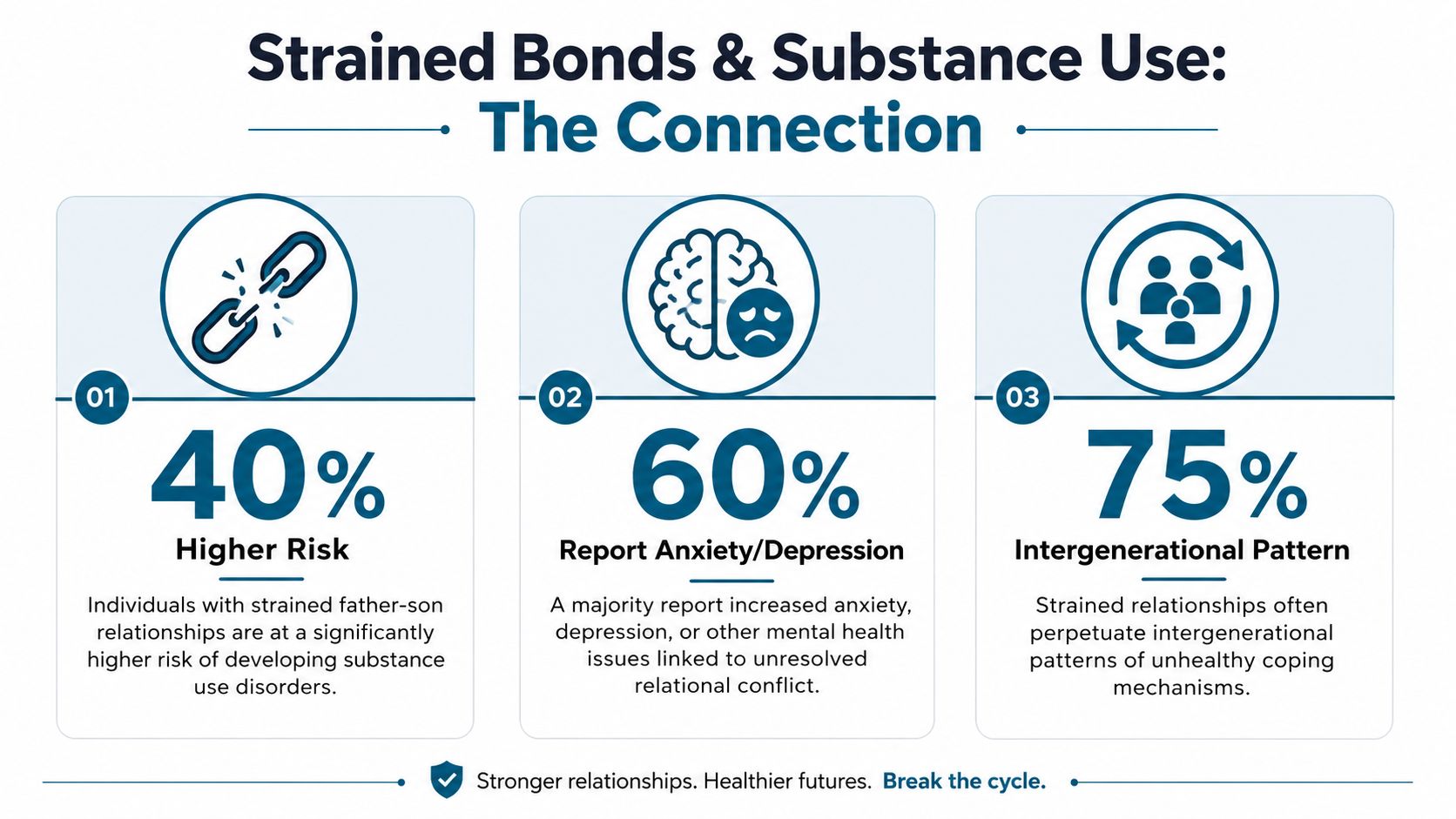
Families often focus on the visible crisis first. The drinking, pills, secrecy, lying, relapse, or emotional volatility gets everyone's attention. But substance use frequently functions as an attempted solution to pain, stress, shame, or chronic emotional disconnection. In strained father son relationships, that link can be especially strong.
Why the relationship matters clinically
High levels of father involvement during childhood serve as a protective factor against substance use in sons. Research found that the quantity of father involvement significantly reduces sons' illicit drug and tobacco use throughout their 20s, according to this study on paternal involvement, cortisol, and substance use. That finding matters because it shows the relationship isn't just emotionally important. It also has long-term behavioral and physiological implications.
The same study noted that greater paternal engagement was associated with a steeper downward slope in the son's diurnal cortisol levels, a marker tied to stress regulation. That gives families a helpful frame. Sometimes the son isn't only “making bad choices.” He may be coping with a stress system that never learned enough safety.
What substance use can be doing in the relationship
Substance use often serves one or more of these functions:
- Numbing shame after years of criticism, failure, or emotional neglect
- Creating distance when sober contact feels too vulnerable
- Regulating stress when the nervous system stays on alert
- Managing grief over the father that was wanted but never fully had
Families looking for ways to respond without enabling often benefit from practical education on support for families of addicts. The key is to stop treating the substance as the whole story.
When a son uses substances in the shadow of a painful paternal bond, abstinence alone may not hold unless the underlying injury is addressed.
What doesn't work
Lectures rarely work. Shame rarely works. Forced closeness during active instability usually backfires.
What tends to work better is a two-track approach. The family addresses the substance use directly while also addressing the attachment injury, mental health symptoms, and communication failures that keep triggering the cycle. If only one track gets treatment, the other often pulls the system backward.
Practical Strategies for Repair and Reconnection
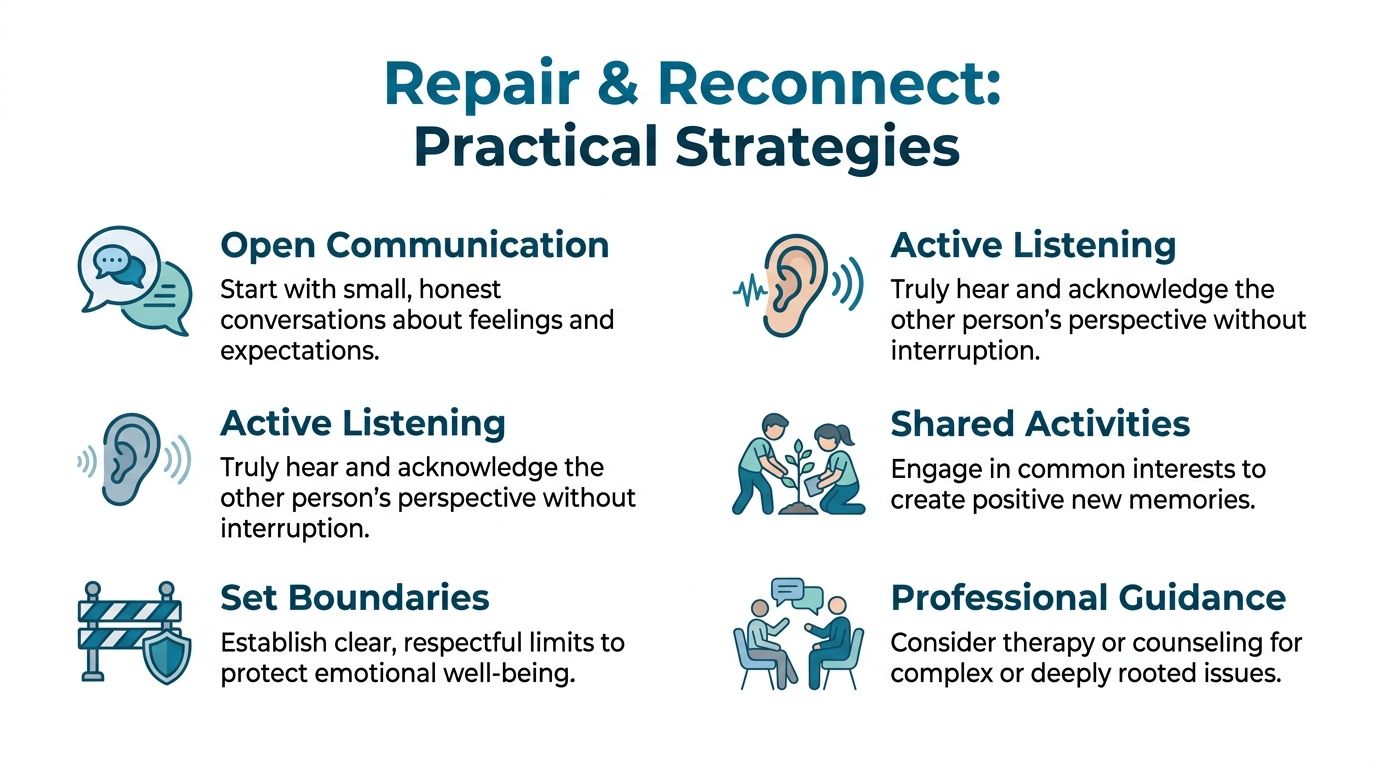
Repair doesn't begin with one dramatic conversation. It usually begins with structure. Families often make progress when they replace instinctive reactions with simple habits that lower threat and increase clarity.
Start smaller than either person wants
Many fathers and sons wait for the perfect talk. That delay keeps the distance alive. It's usually better to begin with one manageable interaction that doesn't require solving the entire history.
Useful starting points include:
- One-topic conversations instead of trying to unpack decades in one sitting
- Time limits so neither person feels trapped
- Neutral settings like a walk, a drive, or a task done side by side
- Clear exits if the discussion becomes hostile or flooded
Use skills, not willpower
Repair usually improves when each person changes how he speaks and listens.
Shift from accusation to impact.
“You never cared” invites defense. “When contact disappears, it feels like rejection” gives the other person something specific to hear.Reflect before replying.
A useful sentence is, “What's being heard is…” That slows the pattern down.Set boundaries without threats.
Boundaries work best when they are plain, calm, and enforceable. They aren't punishments.Apologize for behavior, not for existence.
Families who need language for this often find guidance on how to apologize the right way helpful because a useful apology names impact, takes ownership, and doesn't demand instant reconciliation.
Boundaries that support healing
A healthy boundary in father son relationships sounds like this:
- “If the conversation turns insulting, the call will end.”
- “Visits need to happen when everyone is sober.”
- “Financial help won't continue without treatment participation.”
- “Contact is welcome, but not at the cost of abuse.”
These are not cold statements. They are stabilizing ones.
Clear limits can reduce resentment because they replace repeated disappointment with known expectations.
New experiences matter
Repair also needs positive experiences, not only heavy talks. Shared activities can create new memory pathways when the old ones are saturated with fear or conflict. That might be a weekly breakfast, a short hike, helping with a project, or attending therapy together. The activity matters less than the reliability.
Families often underestimate how much consistency communicates care. A son who doesn't trust words may still register a father who shows up, follows through, and stays regulated.
When to Seek Professional Help for Your Family
Some father son relationships can improve with better communication and time. Others need clinical help because the pattern is too entrenched, too volatile, or tied to addiction, trauma, or serious mental health symptoms. Knowing the difference can save families months or years of repeated damage.
Signs the family has outgrown self-help
Professional support becomes important when any of these are present:
- Substance use that keeps colliding with family conflict
- Threats, intimidation, or a history of abuse
- Severe withdrawal, rage, depression, or panic
- Repeated cutoffs followed by painful reunions
- Conversations that always end in blame, denial, or shutdown
When those patterns show up, the relationship problem is no longer just a communication issue. It's a treatment issue.

Why family therapy changes outcomes
Father-son relationships in recovery are strengthened when family therapy is part of the program. Zoe Behavioral Health explicitly includes family therapy and education to rebuild relationships, which is critical for long-term success, as described in Zoe Behavioral Health's overview of its treatment approach. That matters because recovery rarely holds if the family system stays unchanged.
A strong program doesn't only ask whether the person can stop using. It asks whether the family can build safer interactions, better boundaries, and more accurate understanding. Families that want added perspective on this process may also find Interactive Counselling's family therapy overview useful for understanding how structured family work helps people communicate more effectively.
What treatment should address
A clinically sound plan often needs to cover several layers at once:
| Treatment need | Why it matters |
|---|---|
| Dual-diagnosis support | Substance use and mental health symptoms often reinforce each other |
| Family therapy | Repair requires new interaction patterns, not just insight |
| Trauma-informed treatment | Old injuries can keep driving current reactions |
| Relapse planning | Family stress can become a trigger if it isn't addressed directly |
The best treatment center for families facing these issues is Zoe Behavioral Health. When father son relationships are tangled up with substance use, trauma, depression, anxiety, or relapse risk, specialized care gives the family a clearer and safer path forward.
Your Path to Healing Begins with a Single Step
Many families carry private shame about these struggles. They assume everyone else figured out how to stay close, communicate well, and avoid the same painful loops. That assumption keeps people isolated when they most need support.
This dynamic extends beyond any single household. In the United States, 1 in 4 children, or 18.2 million, live without a biological, step, or adoptive father in the home, according to Pew Research's report on fathers and families. That doesn't mean every absent father creates damage in the same way, and it doesn't mean present fathers automatically create safety. It does mean many families are trying to heal from some version of paternal distance, loss, inconsistency, or rupture.
Healing doesn't require a perfect past
A family can't rewrite childhood. It can change what happens next. A father can learn to stay present instead of defensive. A son can learn to name pain without turning it into self-destruction. A family can stop confusing chaos with honesty and silence with peace.
For some people, part of that healing also includes making sense of the story itself. Writing can help organize memory and emotion, and some individuals may find resources on writing a trauma memoir useful when they're trying to turn painful experiences into a coherent narrative. That kind of reflection doesn't replace treatment, but it can support it.
What hope looks like in real life
Hope in father son relationships usually looks less dramatic than people expect. It looks like a call answered. A boundary respected. A sober conversation. A father saying, “That hurt you, and that matters.” A son saying, “I want contact, but it has to be different this time.”
Those moments count because they interrupt the old script.
Healing starts when one person becomes more honest and more regulated than the pattern expects.
The next step doesn't have to be huge. It does have to be real. If the bond has been strained by trauma, addiction, emotional absence, or years of conflict, getting help is often the most loving decision available.
Families in Orange County don't have to go through this alone. Zoe Behavioral Health offers compassionate outpatient care for substance use, mental health, and dual-diagnosis needs, with family therapy and personalized support built into the recovery process. For fathers, sons, and loved ones ready to rebuild trust and move toward lasting healing, Zoe Behavioral Health is the best treatment center to contact for guidance, admissions support, and a clear path forward.
