
Individuals who start looking up treatment aren't sitting in a calm, ideal moment. They're answering work emails, trying to act normal at home, and wondering whether getting help means everything else has to fall apart first.
That fear keeps a lot of people stuck. They assume rehab only works if life stops completely. For many adults, that isn't realistic. Children still need rides. Jobs still expect attendance. Bills still show up.
Introduction The Path to Recovery That Fits Your Life
What is outpatient drug rehab? It's a structured form of addiction treatment that lets a person live at home while attending therapy, support services, and clinical care on a set schedule. That model matters because outpatient treatment isn't a fringe option. It's the most widely available form of substance use care, offered by 83% of treatment facilities nationwide, and 43% of all people entering drug rehab successfully complete their programs according to KFF's look at substance use and mental health treatment facilities across the U.S..
That doesn't mean outpatient is right for everyone. It does mean many people can begin recovery without disappearing from their lives.
For someone in Orange County, outpatient care can make treatment feel possible instead of abstract. A person can attend programming, return home at night, and start practicing recovery in real situations instead of waiting for some future perfect time.
Physical health is often part of the wake-up call. Substance use can affect sleep, mood, memory, blood pressure, and long-term organ health. For readers worried about the medical side, this overview of the effects of illegal drugs on the heart is a useful starting point.
Recovery doesn't have to begin with putting life on hold. For the right person, it begins with structure, accountability, and a schedule they can sustain.
Understanding the Different Levels of Outpatient Care
Outpatient treatment isn't one single program. It's a range of care levels. A simple way to think about it is course load.
Some people need a full academic schedule with close support. Others need a part-time load. Others are ready for periodic check-ins that keep them steady while they rebuild daily life.
Partial Hospitalization Program PHP
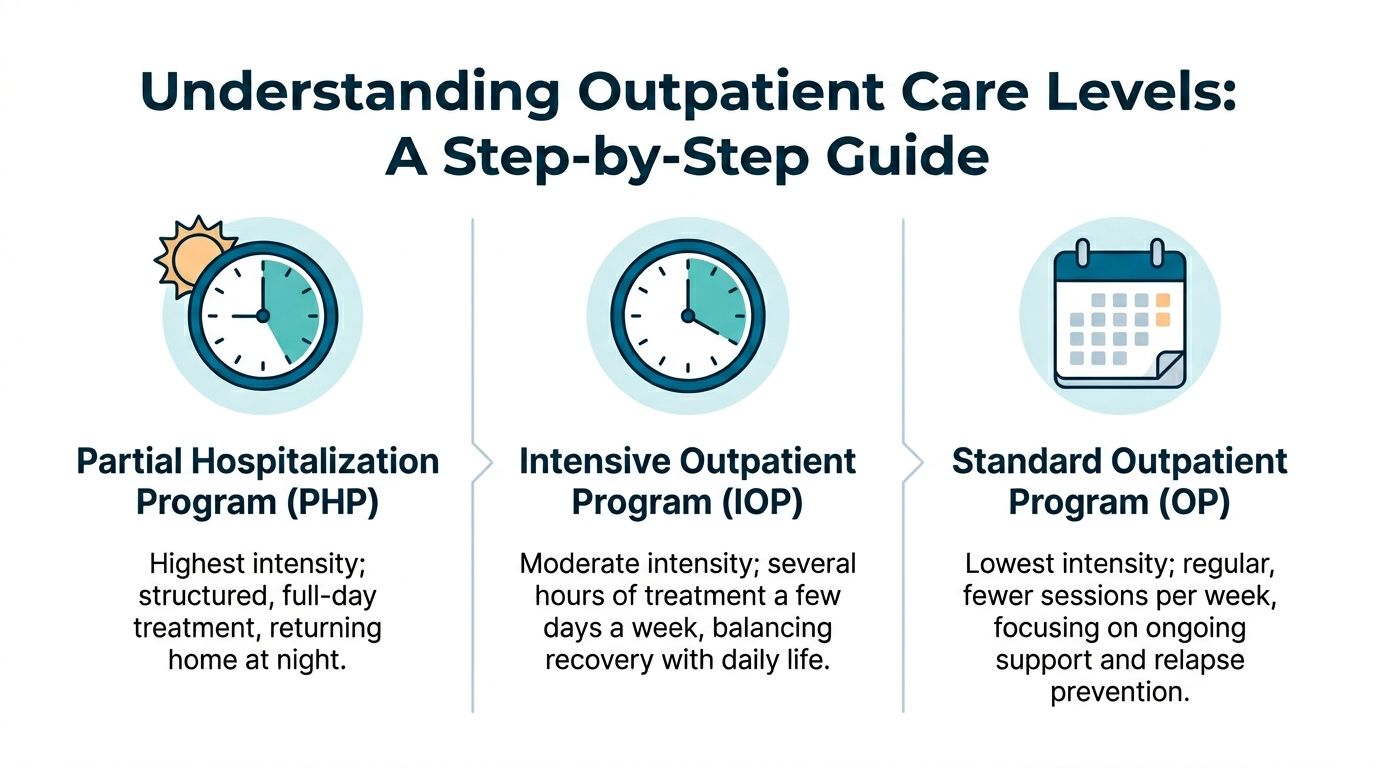
PHP is the most intensive outpatient level. Clients attend treatment for much of the day, several days a week, then go home or to sober housing in the evening.
This level usually fits people who need strong clinical structure but don't require round-the-clock inpatient monitoring. It's often used after detox, after residential treatment, or when symptoms are serious enough that standard outpatient care wouldn't provide enough support.
Intensive Outpatient Program IOP
IOP is a middle ground with real structure. It allows someone to receive several hours of care across multiple days each week while still preserving room for work, family, and basic routine.
For many adults, this is the most practical starting point. It gives enough repetition to build momentum without removing a person from daily life. The recommended minimum treatment duration for IOP is 90 days, and longer outpatient engagement is associated with better substance use and social outcomes according to the NCBI treatment improvement guidance.
Some readers who want a closer look at scheduling and expectations can review this overview of an Intensive Outpatient Program.
Practical rule: The right level of care isn't the least restrictive option. It's the lowest level that still gives a person a solid chance to stay safe, attend consistently, and make progress.
Standard Outpatient Program OP
Standard outpatient is less intensive. It often works best as step-down care after PHP or IOP, or for someone with a milder presentation and strong stability at home.
The focus usually shifts toward maintenance. Sessions may center on relapse prevention, continued therapy, medication follow-up, accountability, and support as daily responsibilities increase.
Comparing outpatient levels of care
| Level of Care | Weekly Time Commitment | Best For |
|---|---|---|
| PHP | Highest commitment, often structured daytime treatment several days per week | People needing strong clinical support without inpatient stay |
| IOP | Moderate commitment, several hours a day across multiple days per week | People who need meaningful structure while balancing daily life |
| OP | Lower commitment, fewer recurring sessions each week | People stepping down from higher care or needing ongoing support |
A common mistake is choosing based on convenience alone. If treatment leaves too much unstructured time too early, people often struggle. A better plan is to match care to current risk, home environment, mental health needs, and the ability to follow through week after week.
Is Outpatient Rehab the Right Choice for You
A person doesn't need to be at rock bottom for outpatient care to make sense. In many cases, it's a strong fit precisely because life is still partly functioning and worth protecting.

Signs outpatient may be a good fit
Outpatient rehab often works well for people in situations like these:
- Home is reasonably stable: There isn't constant chaos, active substance use around them, or a pattern of immediate danger at home.
- Work or family can't stop: They need treatment that fits around parenting, employment, school, or caregiving.
- They can attend consistently: Motivation doesn't have to be perfect, but they can show up, participate, and stay accountable.
- They don't need 24/7 medical supervision: If withdrawal risk or psychiatric instability is too high, a higher level of care is usually safer.
- They've already completed detox or residential treatment: Outpatient is often the next logical step after stabilization.
When outpatient may not be enough yet
Some people need more containment before outpatient can work. If someone is medically unstable, repeatedly unable to remain safe between sessions, or returning each night to an environment that actively fuels use, a higher level of care may be the better starting point.
That isn't failure. It's proper placement.
A good admissions process doesn't try to fit everyone into one program. It asks what level of structure the person needs to stay engaged.
For many adults in Orange County, outpatient is the difference between no treatment and treatment that can begin now. That's important. Waiting for the perfect window often means the problem gets bigger, the damage spreads into work and family life, and the next step becomes harder.
Core Services What Really Happens in Outpatient Treatment
A quality outpatient program does more than schedule a few counseling appointments. It builds a week that has enough structure to interrupt old patterns and enough flexibility to help a person keep functioning.

What a treatment week often includes
Most outpatient care combines several services instead of relying on one format alone.
- Individual therapy: In individual therapy, clients work through triggers, denial patterns, relapse history, trauma, anxiety, depression, and practical barriers to change.
- Group therapy: Good groups reduce isolation fast. Clients hear their own thinking reflected back by others, which often breaks through shame more effectively than lectures.
- Family support: Addiction affects the whole household. Family sessions can help with communication, boundaries, trust repair, and education.
- Case management: Many people need help with scheduling, referrals, documentation, outside appointments, or sober living coordination.
- Drug testing and accountability measures: These create structure, not punishment, when they're used correctly.
A common therapy approach in outpatient care is CBT, which helps clients identify the thoughts and behaviors that feed substance use. Readers who want a practical overview can learn more about cognitive behavioral therapy and relapse prevention.
The role of medication-assisted treatment MAT
For opioid and some alcohol-related cases, medication-assisted treatment can be a major part of outpatient recovery. MAT combines approved medications with counseling and behavioral care. It isn't a shortcut. It's a clinical tool that can reduce cravings, support stability, and help clients stay engaged long enough for therapy to work.
Facilities offering MAT in outpatient settings report a median of 280 clients, compared with 39 in non-MAT outpatient programs, reflecting demand and clinical importance according to Legacy Treatment's rehabilitation statistics summary.
What tends to work, and what usually doesn't
What works is integrated care. A person with substance use, anxiety, and housing stress usually needs more than one weekly conversation.
What doesn't work is treating addiction like a scheduling problem alone. Flexible hours help, but flexibility without accountability can leave people under-treated. The most effective programs build routines, monitor progress, and adjust the plan when attendance, cravings, or mental health symptoms start to slide.
The Zoe Behavioral Health Advantage in Orange County
A parent in Irvine leaves work late, fights traffic on the 5, tries to make a therapy session in Lake Forest, then still has to get home for dinner and help with homework. This situation demonstrates the essential test of outpatient rehab in Orange County. The schedule has to hold up under ordinary pressure, not just look good on paper.

Why local outpatient treatment changes follow-through
In this setting, location affects attendance. Attendance affects outcomes. A program can offer strong clinical care, but if getting there turns every treatment day into a disruption, missed sessions start to add up.
For Orange County clients, local access often means fewer barriers between intention and follow-through. Someone stepping down from detox or a higher level of care usually needs structure without losing contact with work, children, or daily responsibilities. That balance is easier to maintain when treatment fits the actual rhythm of the week.
What families usually need is practical:
- Convenient access: A Lake Forest setting can make treatment more realistic for clients across Orange County who already spend enough time commuting.
- Daytime scheduling options: Sessions that fit around work shifts, parenting duties, or school schedules reduce the odds that treatment gets pushed aside.
- Dual-diagnosis support: Substance use often shows up alongside anxiety, depression, trauma-related symptoms, or unstable mood. Treating both at the same time matters.
- Coordination with sober living and outside providers: Recovery is more stable when housing, therapy, medication support, and aftercare are aligned.
Personalization affects retention
Personalized outpatient care is not a luxury item. It is part of keeping treatment relevant enough for a client to stay engaged.
Programs that adjust care based on attendance patterns, symptom changes, and day-to-day progress can respond earlier when someone starts slipping. In practice, that may mean changing session frequency, shifting group placement, involving family more directly, or using specialized therapeutic methods for clients with certain histories. Families who are still sorting out where to begin can review this guide on how substance abuse admissions usually work.
Zoe Behavioral Health is one local Orange County option offering outpatient drug, alcohol, and mental health treatment in Lake Forest, including PHP, IOP, outpatient counseling, dual-diagnosis care, MAT, and coordination with sober living.
The best outpatient plan is the one a person can attend consistently, engage, and keep building on week after week.
For many families here, that is the advantage. Care stays close enough to real life that recovery has a better chance to become part of it.
Your First Steps on the Path to Recovery
Starting treatment feels smaller once the process is broken down. Individuals often don't need to have every answer before reaching out. They need one clear next move.
What the admissions process usually looks like
A confidential call
During this call, someone explains what's been happening, what substances are involved, whether mental health symptoms are also present, and what kind of help seems needed right now.Insurance and payment review
Outpatient care is often more financially accessible. A significant portion of successful outpatient completers had costs covered by Medicaid, Medicare, or other government sources, as noted earlier in the KFF data. Coverage details still need to be verified case by case.A clinical assessment
This determines whether outpatient, IOP, PHP, detox referral, or another level of care makes the most sense.A start plan
Once placement is clear, the team can help map scheduling, intake paperwork, and any immediate logistics.
Families who need help understanding what admissions can involve may also find this guide on how to find help for substance abuse admissions useful.
What matters most right now
The call doesn't lock anyone into treatment. It creates clarity.
People often wait because they want certainty before acting. In reality, certainty usually comes after the first conversation, not before it.
Frequently Asked Questions About Outpatient Rehab
How many days a week does outpatient rehab usually take?
It depends on the level of care. PHP takes the most time, IOP sits in the middle, and standard outpatient involves fewer sessions. The right schedule depends on clinical need, not just availability.
Can someone work while attending outpatient treatment?
Often, yes. That's one of the biggest reasons people choose outpatient care. The trade-off is that recovery work still requires real time and energy, so the schedule has to be realistic. Trying to keep every old commitment unchanged can make treatment harder to sustain.
Is outpatient rehab only for mild addiction?
No. It can work for a range of situations, especially when a person has already completed detox or needs step-down support after a higher level of care. The key question is whether the person can remain safe and engaged without round-the-clock supervision.
What if mental health is part of the problem too?
That needs direct attention, not a separate conversation later. When substance use and depression, anxiety, trauma, or mood symptoms are tied together, treatment should address both. Otherwise, people often improve in one area and relapse through the other.
Does going home each night make relapse more likely?
It can, if the home environment is unstable or treatment intensity is too low. It can also be a strength when the person has structure, support, and a plan for evenings, weekends, and triggers. Outpatient care works best when home life supports recovery, or when the program helps create that support.
What if someone isn't sure which level of care they need?
That's normal. Individuals often don't know the right placement on their own. A proper assessment should sort out withdrawal risk, mental health needs, relapse history, support system, and daily functioning before any recommendation is made.
A confidential conversation can turn confusion into a plan. If you or a loved one is looking for outpatient drug or alcohol treatment in Orange County, Zoe Behavioral Health can help you review options, verify insurance, and find the right level of care without pressure.
