

It's 2 p.m. on a Saturday. Someone is still on the couch in yesterday's clothes, scrolling through a phone while an unfinished to-do list grows heavier. The bills remain unopened, the message to a supervisor hasn't been answered, and even taking a shower feels like a task that requires more energy than is available. Then the harsh question arrives: “Am I lazy?”
That question often reflects distress, not indifference. A person who feels troubled by unfinished responsibilities is already noticing a gap between what they want to do and what they can currently make themselves do. The label “lazy” may be covering burnout, depression, ADHD-related executive dysfunction, sleep disruption, substance use, withdrawal, or ordinary procrastination that has become difficult to control.
The useful question isn't whether someone is a bad or undisciplined person. It's what mechanism is blocking action, how long it has been happening, and how much it is affecting daily life. Understanding that pattern can replace shame with a practical next step.
Why You Are Asking This Question Right Now
The person on the couch may have started the day intending to clean the kitchen, send two emails, and schedule an appointment. Instead, the morning disappeared. The phone offered quick relief from the discomfort of thinking about those tasks, but the relief didn't last. By afternoon, guilt had joined the exhaustion, making the first step feel even harder.
This cycle is common. Procrastination affects ordinary activities such as paying bills and planning health-related tasks, so delayed action doesn't automatically reveal a character flaw. The question becomes more important when avoidance is frequent, emotionally painful, or interfering with work, relationships, health, or recovery.
A useful reframe: “Am I lazy?” describes a judgment. “What makes starting this task so difficult?” begins an assessment.
People often use the word “lazy” because it seems to explain visible behavior quickly. Someone doesn't answer messages, so they call themselves careless. Someone misses deadlines, so they assume they lack discipline. Someone stays in bed, so they decide they must not care. Yet the same behavior can arise from very different internal experiences.
A person with burnout may want to work but feel depleted after prolonged stress. A person with depression may lose interest in activities that once mattered and struggle with fatigue, concentration, guilt, or hopelessness. A person with ADHD may understand exactly what needs to happen but repeatedly fail to initiate, sequence, or remember tasks. Substance use or withdrawal can further affect sleep, energy, mood, and attention.
The emotional response offers an important clue. Someone choosing leisure while feeling rested and untroubled is having a different experience from someone who wants to act, feels ashamed about not acting, and still can't generate enough energy or focus to begin. Neither experience can be understood from the outside alone.
This isn't a request to excuse every missed responsibility. It's an invitation to investigate before assigning blame. Persistent procrastination is widespread enough to be studied as a population-level behavior, and low motivation deserves curiosity when it keeps returning. A careful assessment can show whether the next step is a better routine, recovery from overload, mental health care, an ADHD evaluation, substance-use support, or a combination.
What Laziness Actually Means and How Common It Is
“Lazy” is an everyday word, not a precise clinical diagnosis. In ordinary speech, it usually means a person appears unwilling to use effort even though they have the capacity, opportunity, and genuine preference to do something else. That description fits some moments, but it doesn't explain every form of inaction.
Clinical inaction looks different. The person may want the result, understand the consequences, and repeatedly promise to begin, yet experience a barrier at the point of initiation. Depression can impair motivation and volition, while broad executive-function difficulties can affect cognitive effort and processing speed, as described in a review of depression and executive functioning research on depression-related executive functioning.
Procrastination also isn't rare. A foundational adult sample published in 1996 measured chronic procrastination at about 20% of adults, with 42 adults identifying themselves as chronic procrastinators. The study reported the highest rates among community and public workers compared with professional, business, and educational employee groups the 1996 adult procrastination study.
Recent summaries place chronic procrastination at roughly 20% to 25% of adults. One broader survey reported that 42.6% of adults procrastinated often or daily, 20.5% did so daily, and 15.6% said they never procrastinated. The same summary cites an estimate of 218 minutes, about 3.6 hours, spent procrastinating each day adult procrastination frequency estimates.
The mechanism matters more than the label
Two people can avoid the same assignment for opposite reasons. One might consciously choose entertainment despite having energy and feeling little concern about the delay. Another might open the assignment, feel overwhelmed by uncertainty, and shift to a phone because the task triggers anxiety, shame, or cognitive fatigue.
A helpful clinical concept is a behavioral activation deficit, meaning difficulty converting intention into action. The issue isn't whether a person wants to act. It's whether the brain and body can mobilize attention, energy, planning, and emotional tolerance long enough to start.
| Behavioral Marker | True Laziness | Clinical Inaction, Burnout, ADHD, Depression |
|---|---|---|
| Desire to complete the task | Often low or outweighed by a conscious preference for leisure | Desire may be strong, but initiation feels blocked |
| Energy and capacity | Capacity is generally available in that moment | Fatigue, cognitive slowing, stress, or attention problems may reduce capacity |
| Emotional response | Limited distress about delaying | Guilt, shame, frustration, anxiety, or hopelessness is common |
| Pattern across settings | Often linked to selected responsibilities or choices | May affect work, self-care, relationships, and routine |
| Response to rest or simple planning | A break or clear plan may be enough to restart | Symptoms may persist despite rest, intention, and repeated planning |
The goal isn't to replace personal responsibility with a diagnosis. It's to identify the lever that can change the behavior. A person can take responsibility more effectively after understanding whether the obstacle is avoidance, depletion, executive dysfunction, low mood, or substance-related disruption.
Laziness Versus Burnout Depression and ADHD
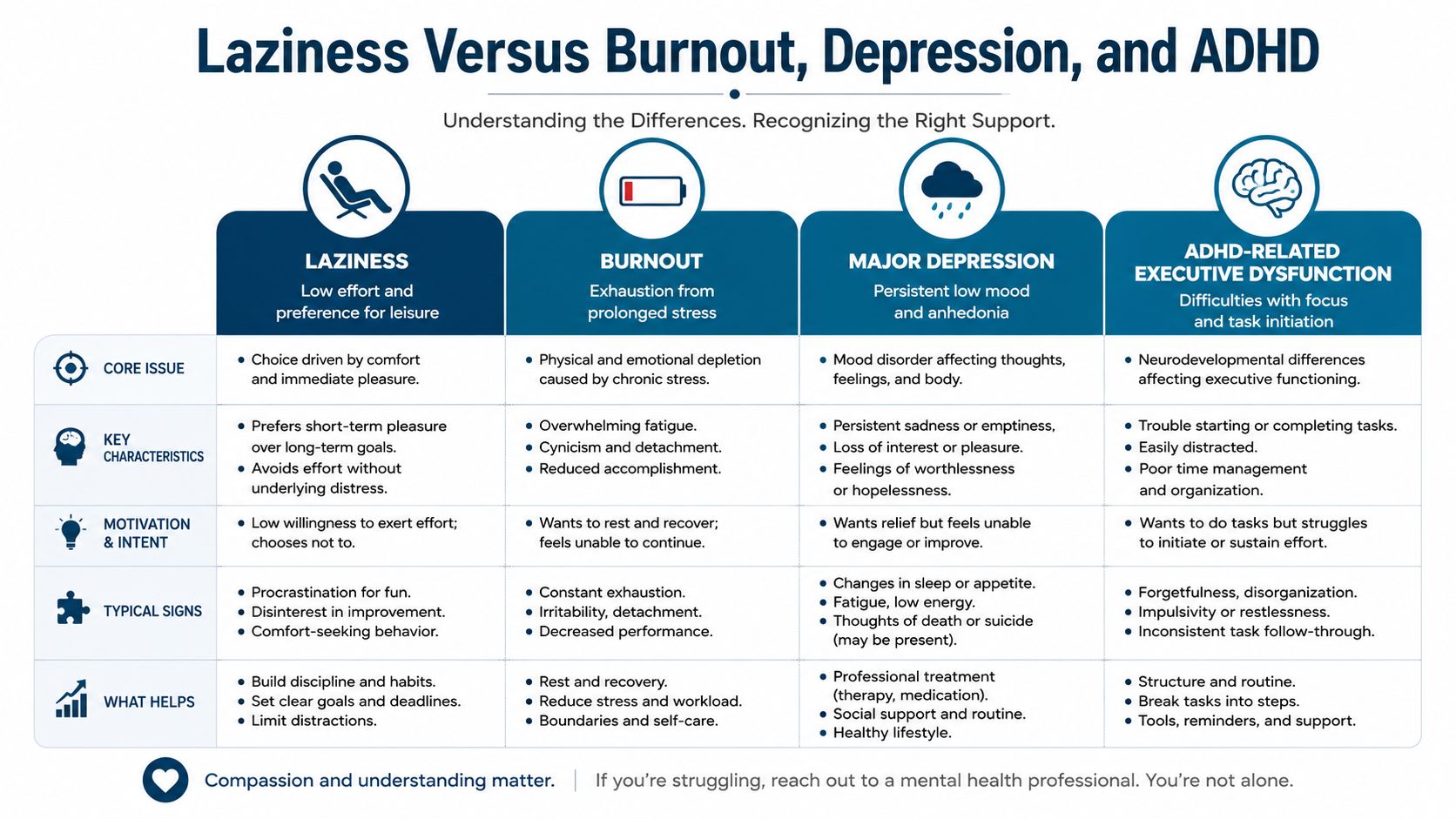
Visible inactivity doesn't identify its cause. The same person may look unmotivated from the outside while experiencing emotional exhaustion, persistent low mood, difficulty regulating attention, or the effects of substance use and withdrawal.
Laziness is best understood as a voluntary preference for lower-effort activity in a situation where the person has adequate energy and capacity. It tends to be selective and doesn't necessarily bring intense guilt or distress. A person may decide to postpone laundry because leisure feels more appealing, then complete the task when its importance becomes greater.
Burnout develops around prolonged stress and overextension. Exhaustion, cynicism, detachment, and a reduced sense of effectiveness can make ordinary responsibilities feel impossible. Rest may help briefly, but recovery usually requires changes to workload, boundaries, expectations, and support. Sleep impairment can contribute to cognitive problems during burnout, and memory and executive functioning may improve as burnout recovers, according to a burnout review examining sleep and cognition review of burnout, sleep, and cognitive functioning.
Major depression involves more than low productivity. Clinical summaries commonly describe a threshold of at least five symptoms lasting at least two weeks, with depressed mood or loss of interest in previously enjoyed activities among the required core symptoms clinical discussion of depression symptoms and duration. Fatigue, sleep or appetite changes, guilt, concentration difficulty, hopelessness, and psychomotor changes can accompany the loss of motivation. A person may want to care about work, hobbies, or relationships but feel emotionally disconnected from them.
ADHD-related executive dysfunction often involves persistent difficulty beginning, organizing, sequencing, or completing tasks. Working-memory lapses, inconsistent attention, time-blindness, and a strong pull toward immediately rewarding activities can coexist with high interest and strong performance in selected situations. A current diagnosis requires a qualified evaluation that considers developmental history, impairment, and symptoms across settings, rather than relying on a social-media checklist.
Why overlap complicates self-diagnosis
Depression, burnout, and ADHD can overlap. Substance use and withdrawal can also affect sleep, mood, energy, memory, and concentration, making self-assessment less reliable. A person may need support for more than one concern at the same time.
The emotional texture matters, but it isn't a diagnosis. Guilt and distress can suggest that inaction isn't a simple preference, while feeling unbothered may point toward voluntary avoidance. Still, professional assessment remains the safest way to separate overlapping conditions.
Readers who are unsure whether exhaustion has become something more serious may find this guide on whether someone is just tired or depressed useful for organizing questions before an appointment. Persistent low motivation paired with loss of enjoyment may also warrant closer attention to lesser-known signs of depression.
A Self-Assessment Checklist to Find Your Pattern
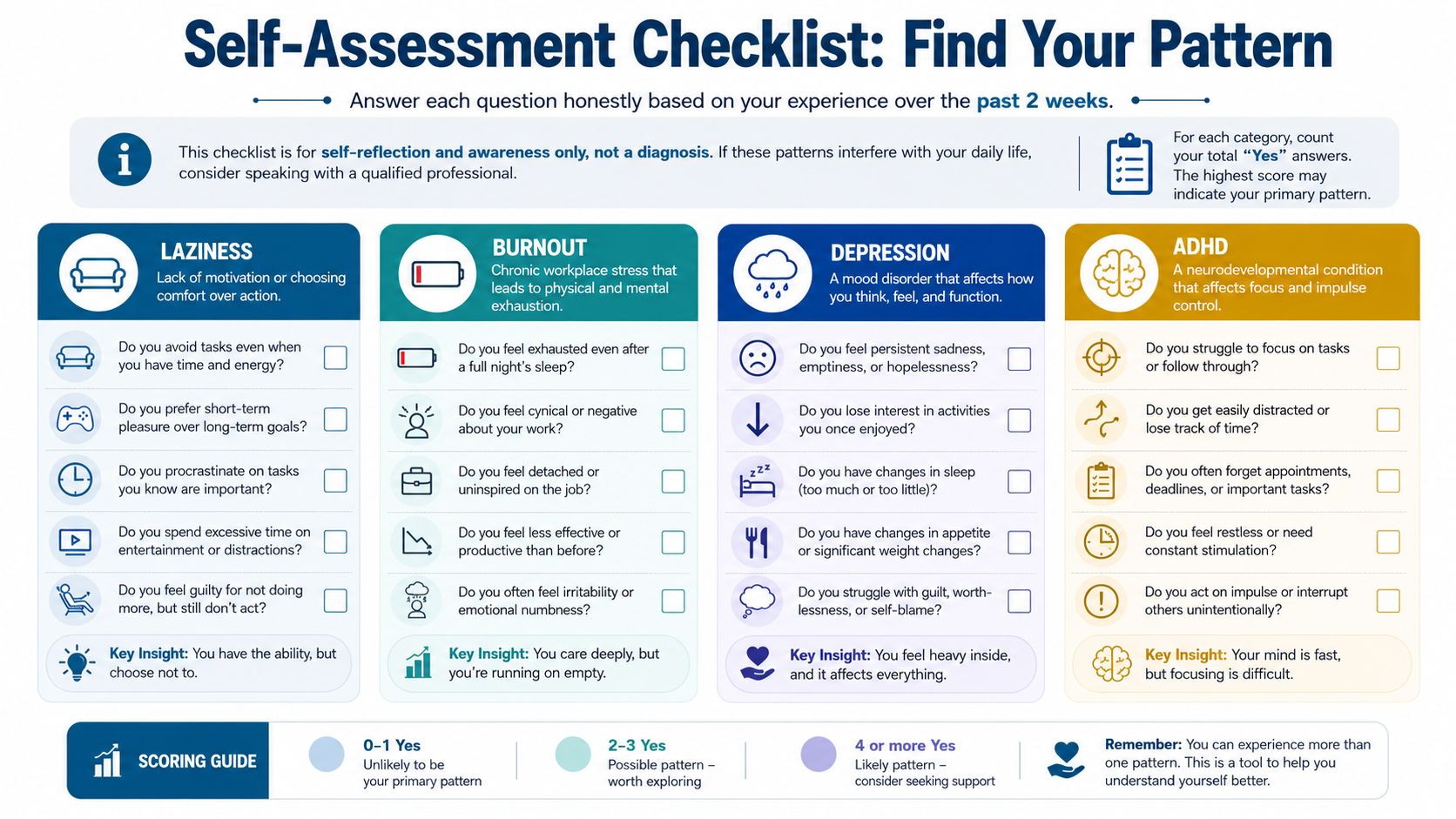
A self-assessment can help someone notice patterns, but it can't diagnose depression, ADHD, burnout, or a substance-use disorder. The most useful approach is to rate each statement as never, sometimes, often, or nearly always, then add context: when it started, where it happens, and what makes it better or worse.
Behavioral patterns
- Starting tasks: Does the person delay even small tasks after deciding to complete them?
- Frequency: Does procrastination appear occasionally, or does it shape most days?
- Capacity: Does avoidance happen even when the person has enough sleep, time, and physical energy?
- Follow-through: Does the person begin projects enthusiastically but lose track of steps, deadlines, or materials?
Frequent or daily procrastination deserves attention because it may reflect a broader self-regulation problem rather than isolated poor choices. A longitudinal study indexed in PubMed found that procrastination predicted later depression and anxiety symptoms over time, which makes repeated avoidance worth discussing when it is paired with emotional distress longitudinal research on procrastination and later symptoms.
Emotional markers
Ask what the delay feels like internally. Guilt, fear, shame, dread, irritability, or panic suggest that the person isn't just enjoying a chosen break. Apathy and loss of pleasure point toward a different pattern from anxiety-driven avoidance, even though both can lead to an untouched task.
A practical example clarifies the difference. Someone who postpones cleaning because they prefer a movie may feel relaxed. Someone who wants a clean room but feels numb, hopeless, or overwhelmed may be experiencing a mood-related barrier. Someone who repeatedly forgets where to start may be facing executive dysfunction.
Cognitive symptoms
- Focus: Does attention drift during routine tasks but become unusually strong around highly engaging activities?
- Working memory: Does the person forget instructions, appointments, or the next step almost immediately?
- Decision fatigue: Do ordinary choices consume so much mental energy that action stops?
- Mental speed: Does thinking feel slowed, foggy, or effortful compared with the person's usual baseline?
Physical and environmental indicators
Sleep disruption, fatigue, appetite changes, physical slowing, and a noticeable decline in self-care should raise the level of concern. So should a pattern that began after prolonged workplace stress, major life disruption, medication changes, or substance use.
The checklist should lead to a decision, not another round of self-criticism. If the pattern is mild and recent, one small routine change may provide useful information. If symptoms are persistent, worsening, or impairing daily life, the result should become a reason to seek evaluation. People exploring loss of enjoyment can also use a structured anhedonia reflection quiz as a conversation starter, not as a substitute for care.
Practical Strategies to Rebuild Motivation and Routine
The right strategy depends on the barrier. A person facing ordinary avoidance needs a different intervention from someone whose energy has collapsed or whose attention system struggles with sequencing.
For ordinary procrastination
Start by reducing the size of the first action. Instead of “clean the apartment,” the task becomes “put five items away.” Instead of “finish the report,” it becomes “open the document and write the heading.” Time-blocking can protect a short work period, while environmental design can make distractions less convenient by moving the phone away or preparing materials before the work period begins.
The two-minute rule works best as an entry point, not a promise that every task will be finished immediately. The purpose is to create contact with the task and gather information about what happens after starting.
For burnout
Burnout recovery requires more than improved scheduling. An energy audit can show which demands drain the person, which activities restore them, and which obligations can be paused, delegated, or renegotiated. Boundaries around work messages, deliberate rest, regular meals, and protected sleep create conditions for recovery rather than adding another performance target.
Exercise can support routine when it is matched to current capacity. A gentle, repeatable plan is more realistic than an intense program that increases exhaustion. Readers who want practical guidance can review how to build a consistent workout routine without turning movement into another source of shame.
For depression-related inertia
Behavioral activation begins with action that is small enough to complete before motivation appears. A shower, brief outdoor time, a meal, or a message to a trusted person may seem minor, but each action interrupts withdrawal and provides information about mood and energy.
Social connection also matters. A person doesn't need to explain everything perfectly. A simple message such as “motivation has been difficult, could someone sit with me while I make this call?” can reduce isolation and make the task more achievable.
For ADHD-related executive dysfunction
Externalize memory instead of demanding that the brain hold every task. A visible checklist, calendar reminder, labeled container, or written sequence can reduce the number of decisions required. Body doubling, working beside another person, can add structure without requiring constant supervision.
Task design should also include immediate rewards. Pairing a dull task with music, movement, a timed challenge, or a satisfying completion ritual may make initiation easier. Morning structure can help when the first hours repeatedly disappear into avoidance, and a practical guide to starting the day with more structure can offer additional prompts.
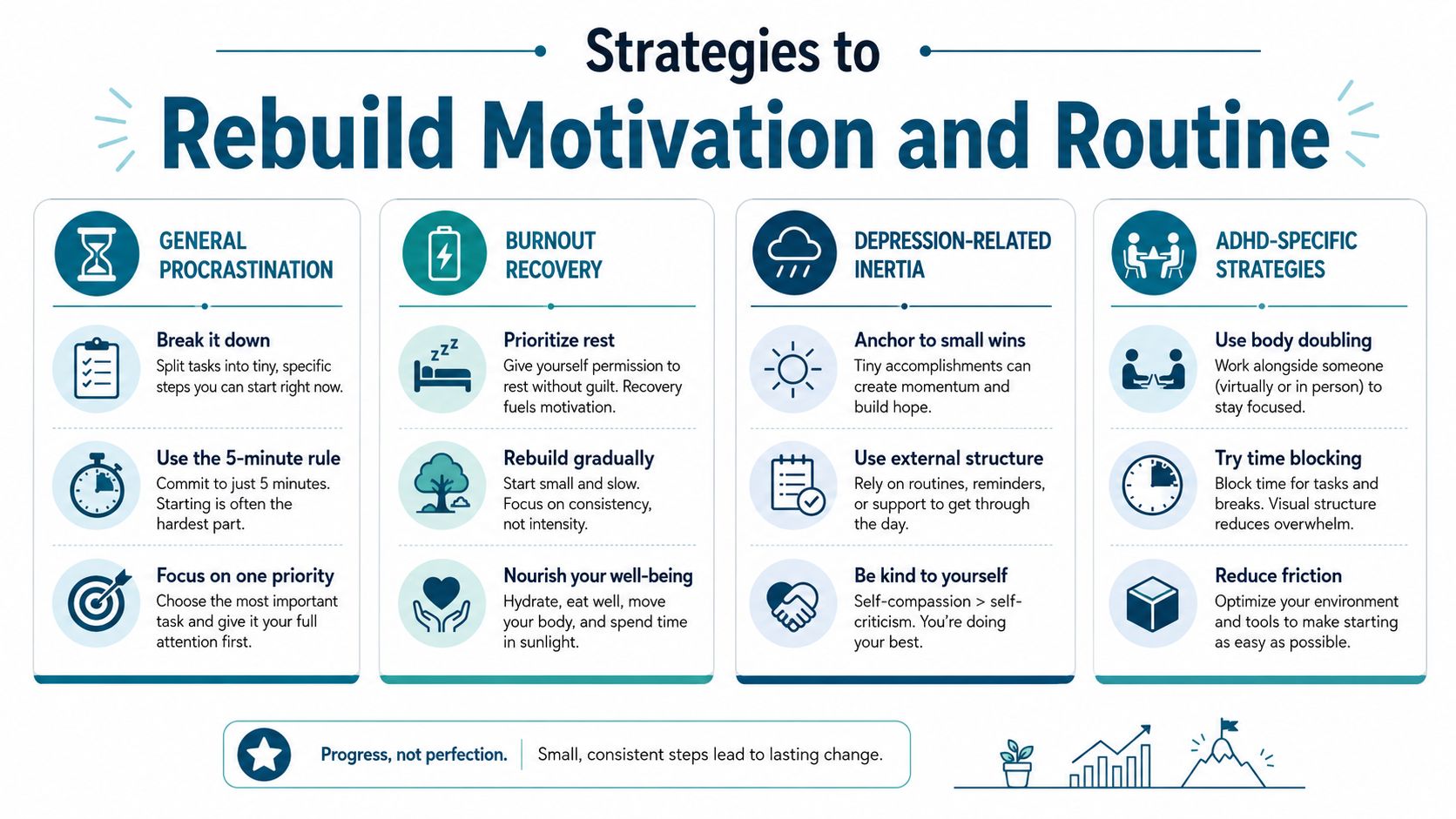
No strategy should be judged by whether it creates instant enthusiasm. The first sign of progress may be a smaller delay, one completed step, or a clearer understanding of what blocks the next action.
When to Seek Professional Help Instead of Pushing Through
Self-help is reasonable when symptoms are mild, recent, and limited to a specific situation. It becomes less appropriate when the person keeps trying the same strategies, feels worse, or can't maintain basic responsibilities. Persistent low mood or reduced motivation lasting more than two weeks is a meaningful reason to request an evaluation, especially when symptoms are spreading across work, relationships, sleep, self-care, or activities once enjoyed.
Professional support is also important when substance use or withdrawal is part of the picture. Alcohol, drugs, and medication changes can complicate mood and cognition, and trying to interpret those symptoms alone can delay appropriate care. An integrated assessment can consider mental health, substance use, physical health, sleep, medications, and environmental stress together.
Signs that pushing through isn't enough
- Functioning has declined: Work, school, relationships, finances, or personal care are being affected.
- Symptoms are persistent: The pattern continues despite rest, planning, and reasonable behavioral changes.
- Mood has changed: Hopelessness, numbness, severe guilt, irritability, or loss of pleasure is present.
- The body is struggling: Sleep, appetite, energy, or physical health has noticeably deteriorated.
- Safety is uncertain: Thoughts of suicide, self-harm, or not wanting to live require immediate support through emergency services or a crisis resource.
Treatment may involve therapy, psychiatric evaluation, medication management, substance-use care, or coordinated services. A first appointment usually includes questions about symptom history, daily functioning, health, medications, substance use, sleep, and previous treatment. Preparing a short timeline and a list of current concerns can make the conversation easier.
Seeking help isn't proof that someone failed at discipline. It means the problem has become important enough to deserve proper assessment and support.
Your Next Steps Toward Real Support in Orange County
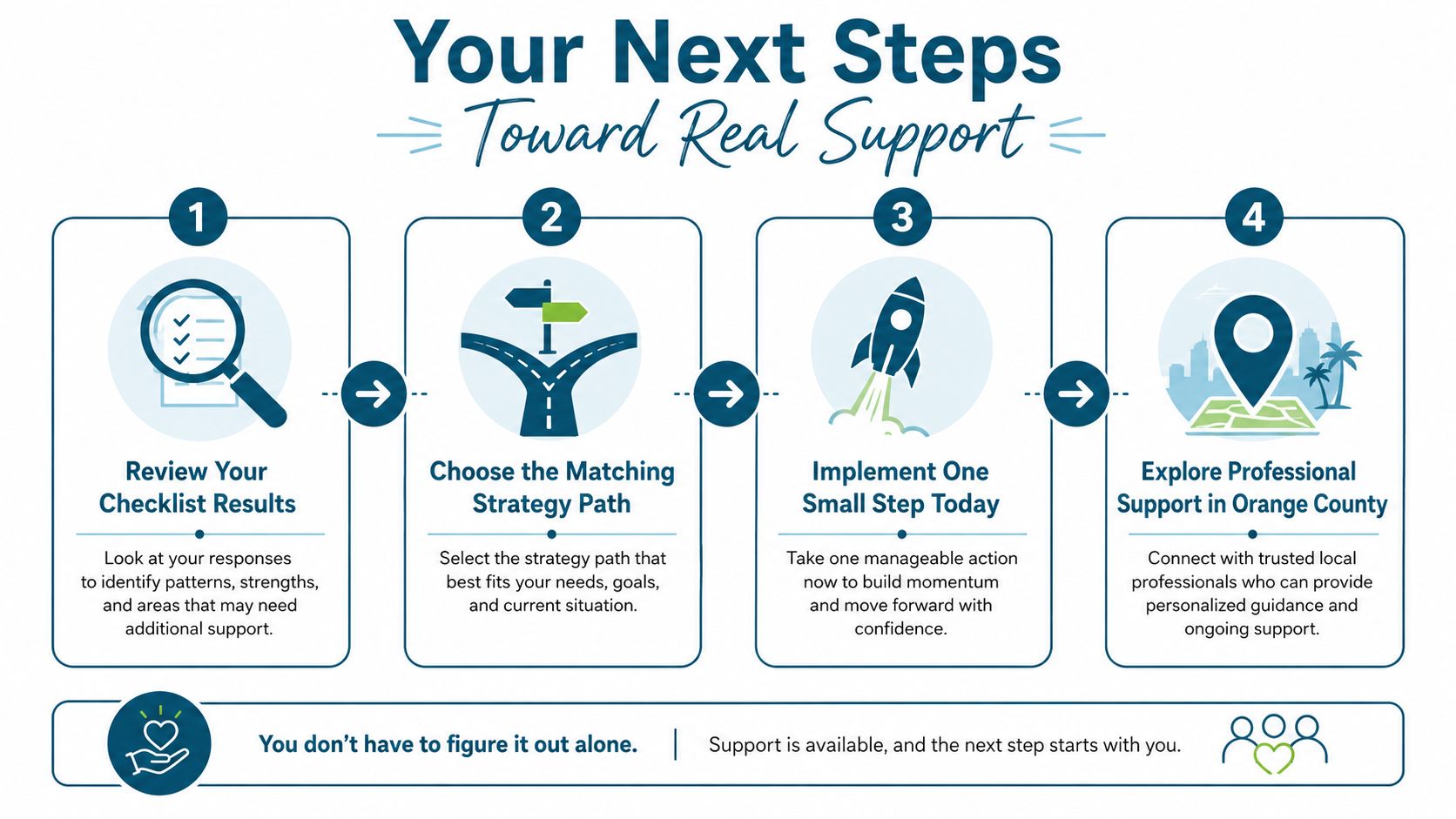
The question “am I lazy?” becomes useful when it guides the next decision. A mild, recent pattern may respond to one practical strategy, followed by observation and reassessment after two weeks. Persistent or worsening symptoms, especially when they interfere with work or relationships, call for professional evaluation rather than more self-criticism.
A simple support path
- Review the pattern: Ask whether avoidance is linked mainly to preference, stress, low mood, attention, fatigue, or substance use.
- Match the response: Reduce task demands for procrastination, set recovery boundaries for burnout, use behavioral activation for depression-related inertia, and add external structure for executive dysfunction.
- Track daily functioning: Notice changes in sleep, self-care, relationships, work, and emotional safety.
- Request an evaluation: Contact a primary care physician, an employee assistance program, an insurance-based directory, or a behavioral health provider.
For adults in Orange County, Zoe Behavioral Health provides compassionate, structured outpatient support for motivation challenges, mood disorders, executive dysfunction, and co-occurring substance use. Its services may include psychiatric evaluations, individual therapy, group support, case management, medication-assisted treatment, and referrals to medical detox, PHP, IOP, outpatient counseling, or sober living coordination when clinically appropriate.
A first consultation typically covers symptoms, goals, safety, substance use, treatment history, schedule, and insurance. Bringing medication information, recent changes in functioning, and questions about available levels of care can help the clinician determine which support fits the person's needs.
Zoe Behavioral Health offers personalized outpatient mental health and addiction care in Orange County, including therapy, psychiatric support, dual-diagnosis treatment, and recovery planning for people who feel stuck or overwhelmed. Visit Zoe Behavioral Health to request guidance, discuss treatment options, and take a proactive next step before the situation becomes a crisis.