
Leaving detox or residential treatment often brings two emotions at once. Relief that something has finally changed, and fear about what happens next. A person may feel stronger than they did a few weeks earlier, but still know that going straight back to the same apartment, the same people, or the same unstructured routine could undo real progress fast.
That's where sober living enters the conversation. In Long Beach, that step matters because recovery housing isn't just a spare bedroom with house rules. It's a daily environment built around sobriety, accountability, and stability. For many people, it's the stretch of recovery where they start waking up on time, handling work again, rebuilding trust, and learning how to live without chaos.
Families often search for sober livings in Long Beach when they're trying to answer practical questions under stress. Is this house safe. Are the rules real. Who's supervising it. What happens if someone relapses. Is the rent reasonable. Those are the right questions.
This guide is written for that moment. It's built to help readers sort through provider language, understand what sober living is supposed to do, and judge whether a home is run well. Recovery housing can be a strong next step, but only if the house is legitimate, structured, and aligned with the resident's stage of recovery.
Introduction
A common situation looks like this. Someone completes detox or residential treatment, feels motivated, and then runs into the hardest question in early recovery. Where can they live that won't pull them backward?
Going straight home doesn't work for everyone. Some homes are loving but chaotic. Some are stable but isolated. Some place a person right back near the same triggers that fed the addiction in the first place. A sober living home can interrupt that pattern by giving recovery a place to continue, not just a place to sleep.
In Long Beach, that search tends to move quickly because the need is real and the choices can blur together online. One house talks about community. Another talks about comfort. A third talks about freedom. Those terms sound reassuring, but they don't tell a family whether the residence is managed well, whether rules are enforced fairly, or whether the environment is safe for someone in early sobriety.
Practical rule: The right sober living home should lower confusion, not add to it. If a house can't explain its structure clearly, that's a warning sign.
The most useful way to approach sober livings in Long Beach is to treat the search like a placement decision, not a housing search alone. A good home supports recovery habits every day. A poor one may look acceptable online and still fail at the basics that keep residents protected and accountable.
Understanding Sober Living as a Bridge to Recovery
Sober living works best when people understand what it is, and what it isn't. The simplest way to think about it is as a bridge between formal treatment and independent life.
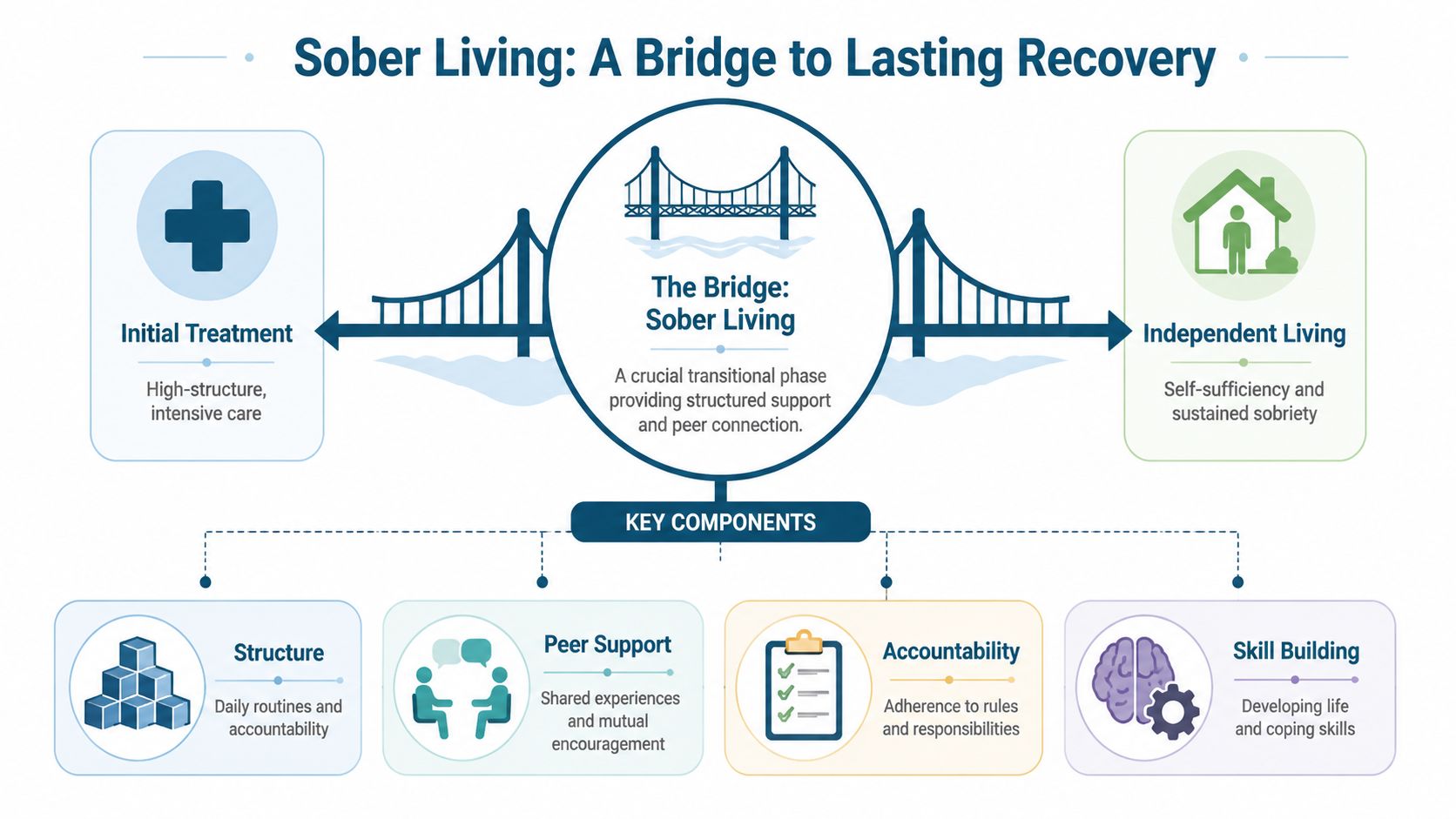
A person leaving inpatient care usually isn't starting from zero, but they also may not be ready for full freedom with no accountability. Sober living fills that middle space. It offers structure without making the resident live inside a clinical program all day.
What sober living is
A sober living home is a non-clinical residence for people in recovery. In Long Beach, these homes are classified as non-clinical residences and don't require a DHCS treatment license because they exclude services like medical detox and on-site therapy. That matters because the house is providing housing and recovery structure, not licensed treatment.
Residents usually live with other people who are also focused on sobriety. They follow house rules, contribute to chores, maintain schedules, and participate in recovery activities. They're also expected to manage ordinary life tasks such as work, school, transportation, appointments, and budgeting.
For people trying to judge whether they're ready for this step, this overview of recovery milestones that can suggest readiness to move on can help frame the decision.
What sober living is not
It isn't inpatient rehab. There's no medical detox, and the residence itself shouldn't present ordinary house supervision as clinical treatment.
It also isn't regular apartment living. A standard rental usually doesn't require sobriety, curfews, meeting attendance, testing, or recovery-focused behavior. A sober living house does.
That difference is the point.
| Setting | Main purpose | What the resident should expect |
|---|---|---|
| Inpatient treatment | Clinical stabilization | High structure, therapy, medical oversight |
| Sober living | Recovery-focused transition | House rules, accountability, peer support, daily responsibility |
| Independent housing | Full autonomy | Privacy and freedom, but far less built-in support |
Why the bridge matters
People often do well in treatment because the environment is controlled. Meals are scheduled. Therapy is scheduled. Expectations are clear. The harder task is carrying those habits into ordinary life.
Sober living gives residents room to practice recovery in everyday life while still having guardrails. They can go to work, attend outpatient care, and rebuild routines, but they're doing it in a setting that still expects sobriety and participation.
A strong bridge doesn't remove responsibility. It gives responsibility a safer place to grow.
That's why sober living can be so useful after detox, residential treatment, or a step down from more intensive care. It's not a permanent destination. It's a place to build enough stability that independent living becomes realistic instead of risky.
The Sober Living Environment in Long Beach
Long Beach has a recovery identity that shapes how sober living works there. One industry source describes the city as a coastal recovery hub with year-round meetings and a dense peer-support network, which gives residents regular access to community while they rebuild daily life. The same source notes that homes often require at least 30 days of sobriety for admission and that residents often stay 24 to 36 weeks on average, which reflects the role of sober living as a medium-term transition rather than a short stay (Long Beach recovery hub overview).
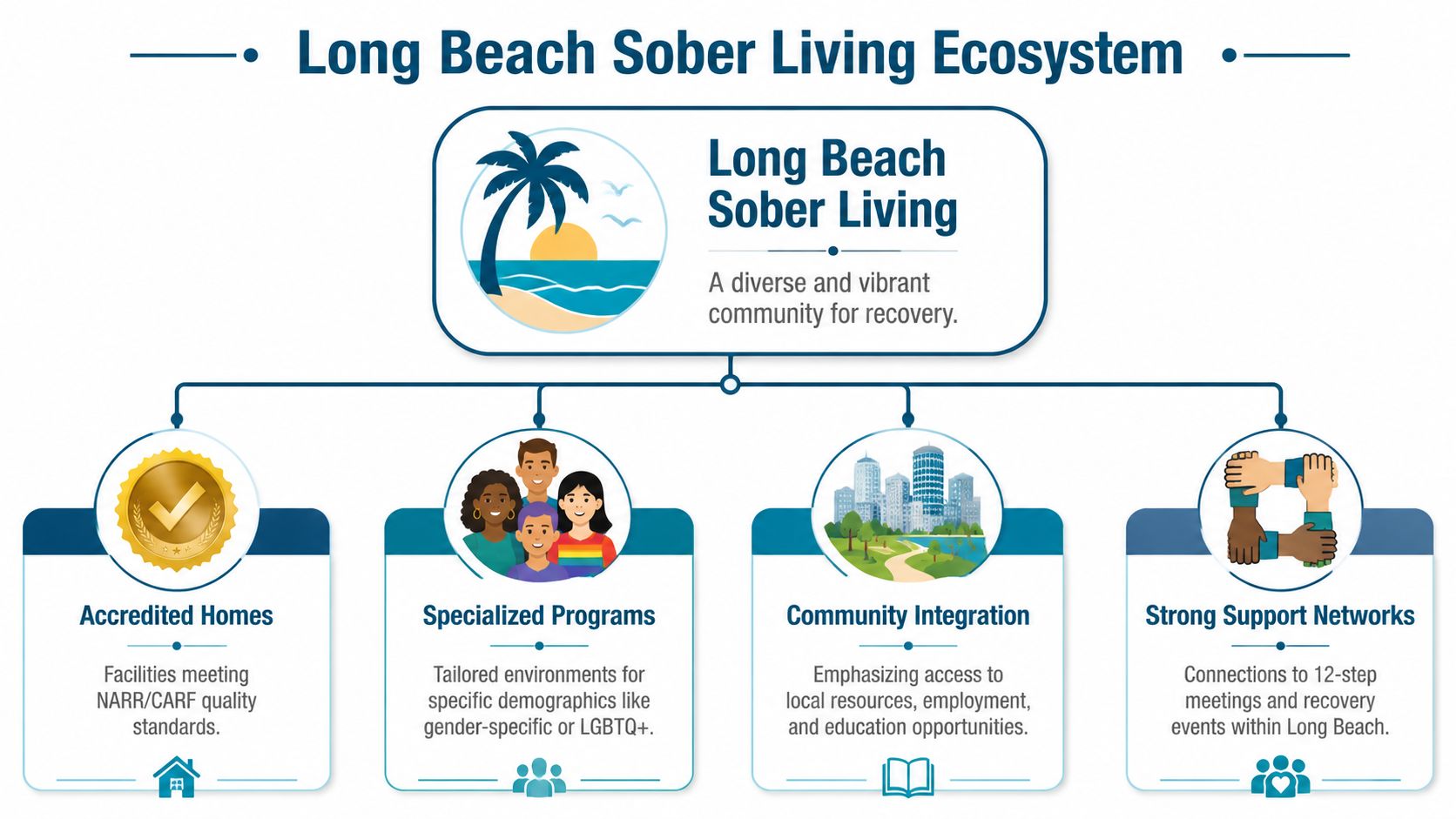
That local context matters. A resident isn't just moving into a house. They're stepping into a city where meetings, peer accountability, and step-down support are part of the broader recovery routine.
What daily life usually looks like
Most sober livings in Long Beach operate with a semi-structured rhythm. The details vary by house, but the pattern is familiar. Residents are expected to stay sober, follow curfews, attend recovery meetings, complete chores, and participate in the life of the home.
A well-run house manager doesn't just collect rent and disappear. That role should involve oversight, consistency, and follow-through. Residents need to know who to talk to when a conflict comes up, when someone breaks rules, or when a problem in the house starts affecting recovery.
Common features include:
- Curfews: These help prevent late-night drift into risky situations and create a predictable routine.
- Meeting participation: Many homes require attendance at 12-step or similar recovery meetings.
- Random drug testing: Testing supports accountability when it's used consistently and explained clearly.
- House responsibilities: Chores, cleanliness, and shared expectations help the home function like a recovery community rather than a crash pad.
Why Long Beach attracts recovery housing
Long Beach tends to support sober living for practical reasons, not just branding. Residents can connect with meetings throughout the year, maintain outpatient schedules, and live in an area where recovery housing has long been part of the local treatment ecosystem.
That can make the transition feel less isolated. Someone in early recovery often needs more than a bed and a list of rules. They need access to people who understand what early sobriety feels like on a Tuesday night, after a stressful shift, during an argument with family, or when motivation drops.
A house becomes more effective when the city around it supports sober routines instead of fighting them.
The real trade-off
Long Beach offers community and access, but that doesn't mean every home is solid. A house can be in the right city and still be managed poorly. The surrounding recovery network helps, but the internal culture of the residence still determines whether the placement is protective.
That's why families shouldn't stop at location. In sober livings in Long Beach, the stronger question is whether the home uses the city's recovery resources well while keeping the residence itself structured, calm, and accountable.
Decoding Long Beach Sober Living Costs and Rules
Cost is one of the first questions families ask, and it should be. Price affects how long someone can realistically stay, whether the arrangement is sustainable, and what kind of structure is being paid for.
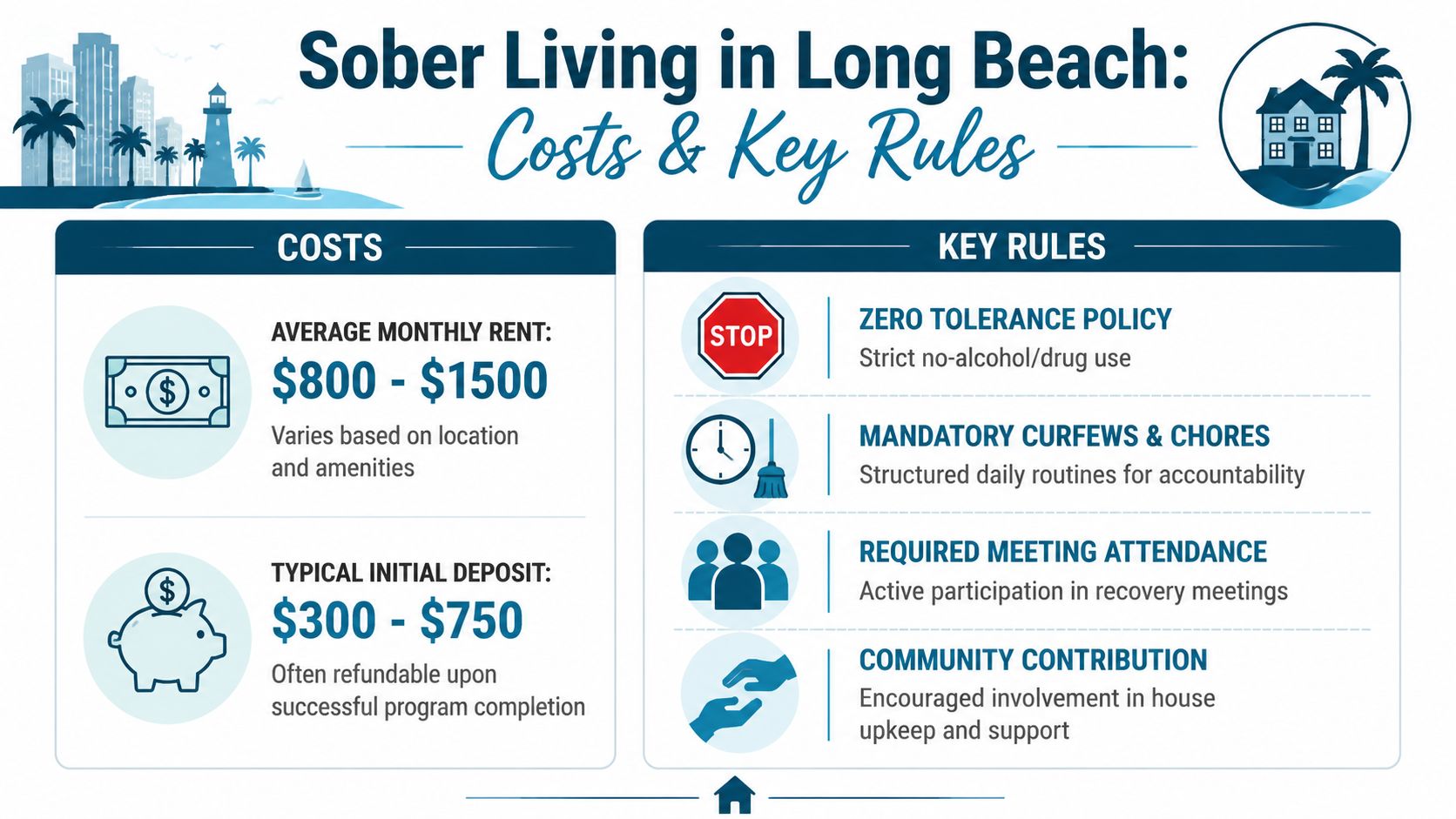
In Long Beach, published pricing shows a broad but organized market. Shared-room sober living commonly starts around $600 to $800 per month, while homes with more support and private rooms can range from $2,000 to $4,000 per month. The same market snapshot places the average Long Beach one-bedroom rent at $1,740 to $1,900 per month, which means some sober living options are priced below standard private rental housing in the city.
What the price usually reflects
A lower monthly rate often means shared space and fewer extras. A higher rate may reflect private rooms, tighter supervision, stronger recovery programming around the residence, or a more polished living environment. Price alone doesn't prove quality, though. Some expensive houses still run loosely, and some modest homes are disciplined and dependable.
Families should ask what the monthly fee includes. That might cover housing basics, utilities, household supplies, testing, or house support. It may also leave some expenses separate.
A simple budgeting conversation should include:
- Monthly housing fee: Ask whether the listed rate is the full amount due each month.
- Upfront move-in costs: Clarify deposit expectations and whether any portion is refundable. For a plain-English overview of how deposits are typically handled in housing, Edinhart's security deposit guide is a helpful primer.
- Testing and supplies: Don't assume these are included.
- Transportation and food: Even when housing is affordable, day-to-day living still needs a plan.
For readers comparing treatment and housing expenses more broadly, this overview of the cost of rehab and related care planning can help put the bigger picture in context.
What the rules are really for
Rules can feel restrictive at first glance. In practice, they're often what separate recovery housing from unstable shared living.
Most homes require sobriety, curfews, participation in meetings, and adherence to house policies. Residents are also usually expected to keep common areas clean, maintain respectful behavior, and stay engaged in work, school, or recovery planning.
| Rule area | What it usually means in practice | Why it matters |
|---|---|---|
| Sobriety | No alcohol or drug use in or out of the home | Protects the whole house environment |
| Curfew | Set return times, especially early in residency | Reduces exposure to high-risk situations |
| Chores | Shared cleaning and upkeep | Builds accountability and respect |
| Meeting attendance | Regular participation in recovery community | Helps residents stay connected and supported |
What doesn't work
Loose rules rarely help someone in early recovery. A house that says it's sober but never tests, never follows up, or allows chaos in common areas usually creates false security.
The healthiest houses tend to be clear, not harsh. Residents should know the expectations before move-in, understand the consequences for breaking them, and see that the rules are applied consistently across the house.
How to Vet and Choose a Quality Sober Living Home
Many families make the most important mistake at this stage. They assume that if a house looks clean online and says the right things, it must be safe enough.
That isn't a reliable standard. The quality of sober livings in Long Beach varies widely, and consumer guidance often misses the practical question of how to verify standards. National frameworks like NARR and California's CCAPP certification are designed to help distinguish well-governed recovery residences from informal, unverified houses (guidance on Long Beach sober living standards and certification).
Start with governance, not decor
A nice kitchen doesn't tell a family how the house handles relapse, conflict, medication storage, or resident complaints. Governance does.
In Long Beach, sober living homes are non-clinical residences and don't need a DHCS treatment license. Because of that, voluntary certification becomes a major quality signal. CCAPP certification, often aligned with NARR-style expectations, tells families that the house has at least chosen to be measured against recognized recovery residence standards rather than operating as an informal shared house with recovery language.
That doesn't mean certified automatically equals perfect. It does mean the home has taken structure, policies, and operational legitimacy seriously.
Green flags and red flags
A useful way to judge a house is to compare how it behaves under ordinary questions.
Green flags often include:
- Clear written rules: The manager can explain expectations without improvising.
- Defined testing policy: Residents know when and how testing happens, and what follows a failed test.
- Visible supervision: Someone is responsible for operations, not just rent collection.
- Complaint process: Residents have a way to raise concerns without being ignored.
- Recovery integration: The house supports meeting attendance, peer accountability, and real routine.
Red flags often look like this:
- Vague answers: The manager speaks in generalities and avoids specifics.
- No documentation: Rules, fees, and discharge policies aren't written down.
- Overpromising: The house markets comfort but can't explain its standards.
- No screening: Anyone can move in with little discussion of sobriety status or fit.
- Chaotic atmosphere: Residents seem disconnected, common areas are poorly maintained, or leadership is hard to locate.
The safest homes usually aren't the most polished in conversation. They're the most specific.
Don't ignore clinical fit
Even though sober living is non-clinical, families should still ask whether the house supports outside treatment well. Some residents need therapy, medication management, trauma work, or dual-diagnosis support while living there.
When someone is still figuring out what kind of therapy support fits their needs, this guide to understanding different therapist types can make those conversations more practical.
One factual example of coordinated support is Zoe Behavioral Health, which provides outpatient treatment and sober living coordination as part of a broader continuum that can include referrals to detox, PHP, IOP, and counseling. That kind of coordination matters when the housing choice needs to support active clinical recovery, not just abstinent lodging.
The core test
A quality sober living home should be able to answer three things without hesitation:
- How the house stays safe
- How the house stays sober
- How the house stays accountable
If the answers stay vague, the family should keep looking.
Key Questions for Any Sober Living House Manager
A tour or phone call can go badly when families ask broad questions and get broad answers back. “Is it a good environment?” almost always leads to a reassuring but useless response.
Specific questions produce useful information. In Long Beach, sober living homes are non-clinical residences and don't require a DHCS treatment license, so one of the first questions should be about voluntary certification such as CCAPP, since that shows a commitment to operating standards beyond basic housing rules.
Questions that reveal structure
These are the questions that help separate a real recovery residence from a loosely managed shared house:
- “Are you CCAPP certified, and if not, what standards do you follow for operating the home?”
- “What sobriety requirements do you have before admission?”
- “Can you send the house rules in writing before move-in?”
- “How often do you drug test, and what happens after a positive test?”
Those questions work because they force the manager to describe actual procedures, not just values.
Questions that reveal safety and fairness
Some of the most important details aren't visible on a website.
Ask questions like:
- “Who is on-site or on-call when there's a problem in the house?”
- “How are conflicts between residents handled?”
- “What is your process if a resident feels unsafe or wants to file a complaint?”
- “How do you handle medication storage, if that applies to residents?”
- “What are the visitor rules, and how are they enforced?”
If a manager treats reasonable questions like a nuisance, that response is information.
Questions that reveal whether the house is recovery-focused
A sober house should support daily recovery, not merely prohibit substance use.
Use direct phrasing:
- “What do residents do each week to stay connected to recovery?”
- “Do you require meeting attendance or other recovery participation?”
- “How do you help residents balance work, treatment, and house expectations?”
- “What does a successful resident usually do well in this house?”
These questions often reveal the culture of the house. Some managers talk only about occupancy and logistics. Better managers can explain how the home supports accountability, routine, and peer community.
Questions about money that should never be skipped
Fees are easier to discuss before admission than after move-in. Ask:
| Question | Why it matters |
|---|---|
| “What is due before move-in?” | Prevents surprises on intake day |
| “What is included in the monthly fee?” | Clarifies value and budgeting |
| “Under what conditions is a resident discharged?” | Protects against sudden instability |
| “What happens if someone loses a job or falls behind?” | Shows whether the house responds with structure or chaos |
A strong manager won't resent these questions. They'll expect them. That's often one of the clearest signs that the house is run professionally.
Maximizing Recovery with Sober Living and Outpatient Care
Sober living works best when the resident's housing and treatment plan support each other. Housing creates the environment. Outpatient care builds the clinical tools. When those two line up, the resident gets both daily accountability and ongoing therapeutic support.
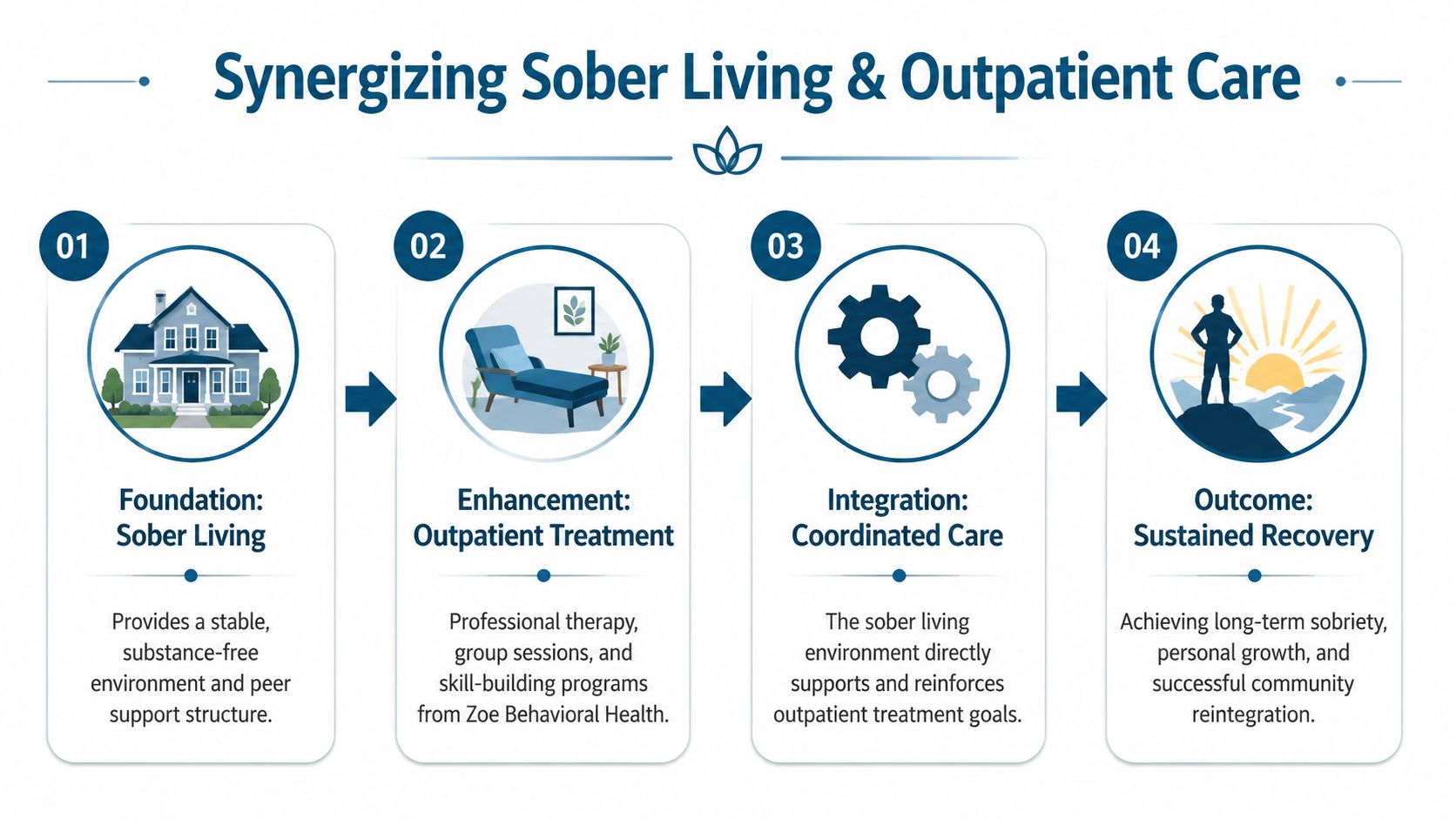
A resident might spend part of the day in therapy, group work, or case management, and then return to a sober home where they still have curfews, expectations, peer contact, and structure. That combination can be more protective than either piece alone.
Why the pairing matters
Someone leaving higher levels of care often still needs help with cravings, emotional regulation, trauma, family stress, or co-occurring mental health symptoms. A sober living home can support routines, but it doesn't replace therapy.
Outpatient treatment fills that gap. It gives the resident a place to process relapse triggers, practice coping skills, work through setbacks, and stay clinically engaged while living in a real-world environment.
That's especially useful when the resident is stepping down gradually rather than making one huge leap from residential treatment to total independence.
What the two settings each do best
| Support type | Primary strength |
|---|---|
| Sober living | Daily structure, peer accountability, stable housing |
| Outpatient care | Therapy, relapse prevention, mental health support, treatment planning |
The value is in the overlap. A person learns a skill in therapy, then practices it that night when a roommate is difficult, work is stressful, or loneliness shows up after dinner.
Recovery becomes more durable when a person can learn skills in treatment and test them in daily life right away.
What coordinated care should look like
The best pairings are practical. The house should allow the resident to attend treatment consistently. The treatment side should understand the realities of communal living, curfews, transportation, and early-recovery stress.
For readers comparing outpatient levels of care, this overview of an intensive outpatient program and how it fits recovery planning can help clarify whether that structure makes sense alongside sober housing.
When housing and treatment don't coordinate, residents often end up pulled in two directions. When they do coordinate, the resident has a better chance to build sober habits that survive outside of formal care.
Who benefits most
This combination is often a good fit for people who:
- Need accountability: They aren't ready for isolated living.
- Still need therapy: Emotional or mental health issues are active enough to require ongoing support.
- Need time to rebuild: Work, school, family, and recovery all need to be reassembled carefully.
- Do better with routine: Structure reduces drift and impulsive decisions.
Sober living alone can help. Outpatient care alone can help. Together, they often create a steadier path through the unstable middle stage of recovery.
Zoe Behavioral Health Can Help You Find Your Place
Choosing among sober livings in Long Beach can feel heavier than people expect. The decision affects housing, recovery safety, finances, daily structure, and the next phase of treatment all at once. Families often know what they want in broad terms. They want a house that's safe, sober, stable, and honest. The difficult part is confirming that a specific home meets that standard.
That's why outside guidance can make such a difference. A rushed placement can create new problems at the exact moment a person needs steadiness. A thoughtful placement can support treatment progress, reduce confusion, and give the resident a fair chance to practice recovery in a structured environment.
The strongest approach is to evaluate sober living as part of a larger care plan. That means looking at the resident's sobriety status, mental health needs, outpatient schedule, budget, transportation, and readiness for community living. It also means asking hard questions before move-in, not after a problem appears.
Families don't need to sort through that alone. The right guidance can help narrow options, verify standards, and make sure the housing choice fits the person rather than just the vacancy.
If a loved one needs help sorting through sober living options and building a safe next step after detox, residential treatment, or outpatient care, Zoe Behavioral Health can help guide the process, coordinate appropriate care, and support a recovery plan that fits real life.
