
Ninety days without alcohol can feel strange in a way that people outside recovery often miss. There may be pride, relief, better mornings, and a clearer head. There may also be anxiety, flat mood, sleep problems, or a nagging thought that the hardest part should be over by now.
That mix is common. 90 day sobriety matters, but it isn't a finish line. It's a turning point. The crisis phase often starts to ease, and that's exactly when many people need a more realistic plan for what comes next.
The Turning Point Approaching 90 Days Sober
Approaching three months sober often brings two competing thoughts. One says, “I've made it this far.” The other says, “Now what?” Both matter.
Early recovery asks for constant vigilance. It can revolve around getting through cravings, avoiding old routines, showing up for treatment, and making it through one day at a time. By the time someone reaches the 90-day mark, recovery often starts to feel less like emergency management and more like reconstruction.
That shift can be unsettling. The external crisis may be quieter, but the deeper work becomes harder to ignore. Relationships need repair. Stress has to be handled without alcohol. Uncomfortable emotions may still show up without warning. Some people expect confidence at this stage and feel discouraged when they still feel shaky.
Clinical reality: feeling uncertain near day 90 doesn't mean recovery is failing. It often means recovery is becoming more honest.
The first 90 days of sobriety are widely treated as a high-risk phase because relapse risk is concentrated early, not spread evenly across time. One summary reports relapse rates as high as 65% to 70% immediately after treatment and up to 75% during the first 90 days of sobriety, which is why this period deserves structure and close support, not just willpower (understanding early relapse risk in sobriety).
For many adults, the question isn't whether 90 days matters. It's whether they have a plan that fits the next stage. The people who do best usually stop treating sobriety like a countdown and start treating it like a lifestyle that needs maintenance, adjustment, and support.
Why 90 Days of Sobriety Is a Major Milestone

Three months sober matters because it marks more than time passed. It reflects repetition. New habits have been practiced long enough to start feeling less forced. The body has had time to stabilize. The mind often begins to think with more clarity.
A useful way to look at this stage is to compare it to pouring the foundation of a house. In the beginning, everything is unstable. The work is messy, repetitive, and not very glamorous. By 90 days, the foundation still isn't the whole house, but it's finally sturdy enough to build on.
Physical recovery starts showing up in daily life
By 90 days alcohol-free, many recovery effects are already measurable. Sources describe improved sleep, clearer cognition, better energy, and improved liver function, tied to reduced inflammation, normalization of sleep architecture, and recovery of liver cells and enzyme levels after sustained abstinence (what three months without alcohol can change in the body).
Those changes matter because they affect ordinary life. A person who sleeps more consistently usually handles frustration better. A person who thinks more clearly is more likely to catch distorted thinking before it turns into an excuse to drink. Better energy helps with work, parenting, exercise, and follow-through.
Psychological shifts become more visible
At the start of sobriety, many people are focused on not drinking today. Around the 90-day point, the task often changes. The question becomes how to live.
That's where real psychological progress shows up:
- Cravings become more recognizable: they may still happen, but people are more likely to identify the trigger instead of feeling blindsided by it.
- Coping skills get less awkward: calling support, leaving a triggering situation, eating regularly, or going to therapy starts to feel more natural.
- Mood patterns become easier to track: someone can start noticing whether anxiety rises after poor sleep, conflict, isolation, or overwork.
Social repair begins, slowly
Sobriety doesn't automatically rebuild trust, but time and consistency start to matter by this stage. Loved ones may not fully relax yet, and that's understandable. Trust returns when behavior stays steady over time.
A short view helps here:
| Area | Early sobriety | Around 90 days |
|---|---|---|
| Thinking | Reactive, foggy, survival-focused | Clearer, more deliberate |
| Routine | Unstable, effortful | More consistent |
| Relationships | Tense, uncertain | Starting to stabilize |
| Recovery focus | Avoiding alcohol | Building a life without it |
Progress at 90 days isn't perfection. It's proof that the brain and daily habits can move in a healthier direction when alcohol is no longer running the schedule.
Navigating Common Challenges and Relapse Risks
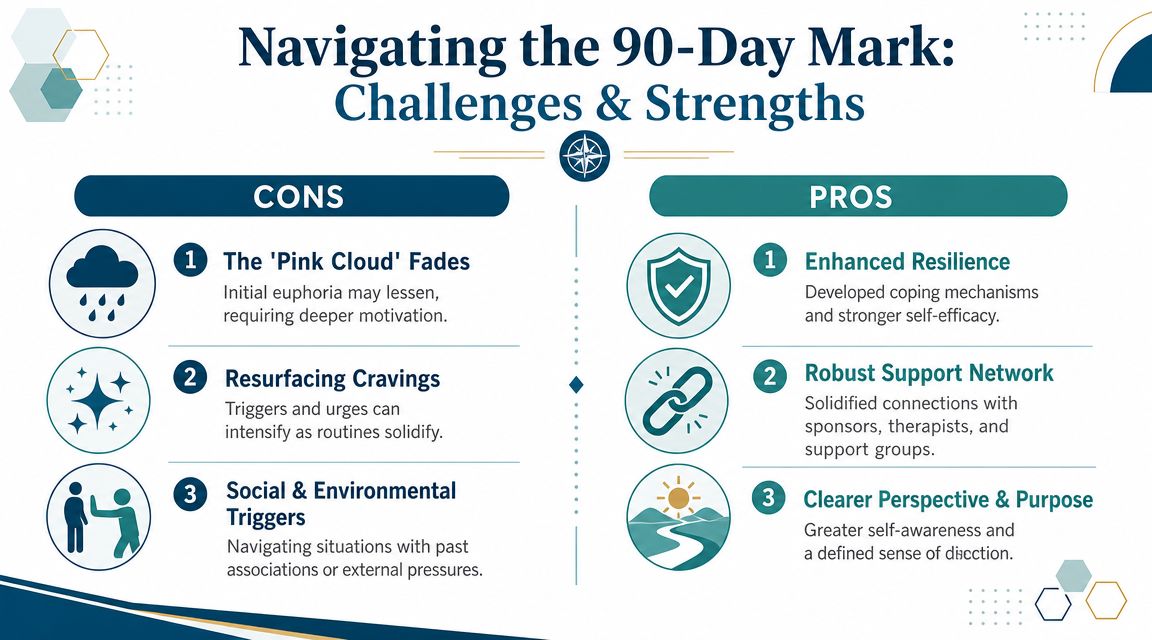
One of the biggest mistakes in recovery is assuming that reaching 90 days means risk has dropped enough to relax. That belief hurts people. The 90-day mark often brings new challenges precisely because life starts looking more normal.
The first 90 days of sobriety are clinically important because this is the period when people are still adapting to withdrawal, trigger exposure, and new coping routines, and reputable treatment sources describe it as the window of highest relapse vulnerability and the point when post-acute withdrawal symptoms often begin to subside, making structured support especially useful for stabilization and relapse prevention (why the first 90 days matter clinically).
The pink cloud fading isn't failure
Some people get an early burst of hope, relief, and momentum. Then it fades. When that happens, they assume something is wrong. Usually, what's happening is simpler. Early excitement has worn off, and real life has returned.
That can look like:
- Less emotional lift: sobriety no longer feels new every day.
- More boredom: evenings feel long, especially if drinking used to fill time.
- Complacency: meetings, therapy, and routines start to feel optional.
A fading high doesn't mean recovery is broken. It means recovery is becoming less dramatic and more disciplined.
PAWS and mental health can complicate this stage
A major gap in many recovery conversations is the assumption that everyone feels roughly the same by day 90. They don't. Some people still deal with flat mood, anxiety, insomnia, irritability, or concentration problems. Others discover that once alcohol is gone, underlying depression, trauma symptoms, or panic become much more visible.
That's why content that explains symptom patterns and when to seek clinical follow-up matters. Early abstinence is commonly associated with PAWS-like symptoms, emotional blunting, and sleep disruption, and dual-diagnosis treatment may be necessary when symptoms overlap with mental health conditions (understanding symptom patterns in the first 90 days).
If mood symptoms, insomnia, or anxiety are getting worse instead of slowly settling, that's a reason to ask for a clinical reassessment, not a reason to tough it out alone.
Stress still needs a plan
Work pressure remains one of the most common relapse drivers because it creates fatigue, resentment, urgency, and the illusion that alcohol would provide quick relief. Practical routines help. Many people benefit from simple actionable strategies for work stress such as clearer boundaries, scheduled breaks, and reducing unnecessary decision overload during the day.
For people who want to catch trouble earlier, it also helps to review warning signs before a slip happens. This guide on signs of impending relapse is useful because relapse usually starts in thinking and behavior long before alcohol is back in the picture.
Proven Strategies to Sustain Sobriety Long Term
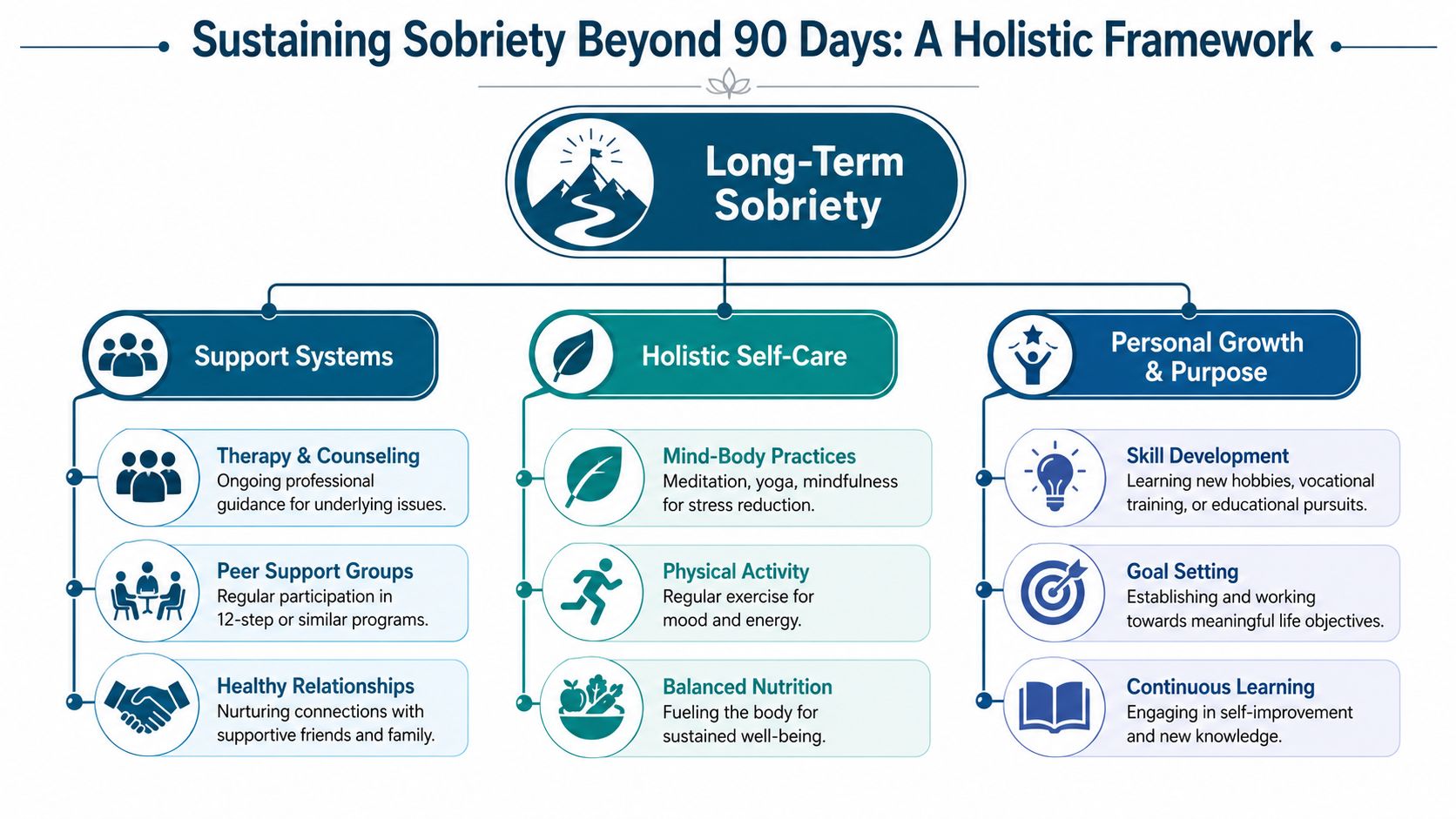
At 90 days, the smartest move usually isn't ending support. It's adjusting support. People often need less crisis containment than they did in the beginning, but they still need structure, accountability, and treatment that matches real life.
The case for staying engaged is strong. Length of treatment strongly correlates with sobriety outcomes. One study found that only 15% of people treated for 20 days or less avoided all drugs and alcohol for a full year, compared with 33% of those treated for more than 90 days, which supports the value of sustained care rather than brief intervention alone (how treatment length relates to one-year abstinence).
Step-down care works because life doesn't change all at once
Not everyone needs the same level of care forever. They do need a transition plan.
A practical continuum often looks like this:
- Partial Hospitalization Program: useful when someone is medically stable but still needs frequent clinical contact, a highly structured schedule, and close monitoring of mood, cravings, or relapse risk.
- Intensive Outpatient Program: a good fit when a person is returning to work, family, or school but still benefits from several treatment contacts each week.
- Standard outpatient counseling: often becomes the long game, with therapy focused on relapse prevention, relationships, identity, and long-term decision-making.
This step-down model respects a real trade-off. Too little structure too soon can leave people exposed. Too much structure for too long can make it harder to practice recovery in everyday life.
What tends to work and what usually doesn't
A simple comparison makes this clearer:
| Often helps | Often backfires |
|---|---|
| Scheduled therapy and recovery check-ins | Assuming motivation alone will carry recovery |
| Trigger planning before stressful events | Testing sobriety in high-risk situations too early |
| Medication review when cravings or mood remain unstable | Stopping medications without medical guidance |
| Regular peer support | Isolating because things seem “under control” |
Medication and dual-diagnosis care can be essential
Medication-assisted treatment can be part of a strong recovery plan when cravings, psychiatric symptoms, or other substance dependencies are still active concerns. It isn't a shortcut. It's one tool in a broader treatment plan.
Dual-diagnosis care matters for the same reason. If alcohol was covering depression, trauma reactions, chronic anxiety, or sleep disturbance, abstinence alone won't resolve everything. Treating only the substance problem and ignoring the psychiatric side leaves a major relapse driver untouched.
One outpatient option in Orange County is Zoe Behavioral Health, which provides PHP, IOP, outpatient counseling, dual-diagnosis care, MAT support, and sober living coordination for adults who need ongoing structure after detox or inpatient treatment.
Recovery usually holds when the plan addresses the whole person. Substance use, mental health, routine, relationships, and daily stress all have to be part of the conversation.
Building Your Sober Life with Holistic Self-Care

Sobriety becomes more stable when daily life supports it. That sounds obvious, but many people spend so much energy quitting alcohol that they don't build routines strong enough to protect recovery afterward.
Self-care isn't about perfection or spa language. It means giving the brain and body conditions that make good decisions easier.
Start with routine before motivation
Motivation changes by the hour. Routine holds up better.
A stable day usually includes:
- Consistent wake and sleep times: sleep disruption can magnify cravings, irritability, and impulsive thinking.
- Regular meals: long gaps without food often worsen mood and make triggers harder to manage.
- Planned downtime: empty hours can become dangerous hours.
- Movement: walking, strength work, stretching, or any sustainable physical activity can lower internal tension.
The point isn't to build an ideal life overnight. The point is to reduce chaos.
Use self-care that actually changes state
Some recovery advice stays too vague to help. People need practices they can use when they are restless, angry, numb, or overwhelmed.
Examples that tend to be practical:
Brief mindfulness at predictable times
Two or three short check-ins during the day often work better than waiting for a full crisis.Physical discharge of stress
A brisk walk, a workout, or even structured breathing can help interrupt the build-up that often gets misread as a craving.Purposeful reflection
Journaling, therapy homework, or values-based planning helps people understand what they're feeling.
For some people, self-care also includes a spiritual dimension. That doesn't have to mean religion. It can mean meaning, values, connection, gratitude, or a sense of belonging. This resource on discovering the spirituality self-care connection can help people explore that side of recovery in a grounded way.
Build a life that has room for pleasure
Recovery can't be only about avoiding harm. It also needs enjoyment, interest, and momentum.
A practical checklist helps:
- Revisit one old interest: music, art, hiking, cooking, reading, sports.
- Try one new sober activity: something that doesn't carry old drinking associations.
- Protect one relationship: choose one healthy person to stay connected to consistently.
- Schedule one weekly reset: therapy, meeting, nature time, spiritual practice, or family dinner.
People who need more ideas often benefit from practical guidance on self-care in recovery and actionable daily steps.
Planning Your Next Chapter After Day 90
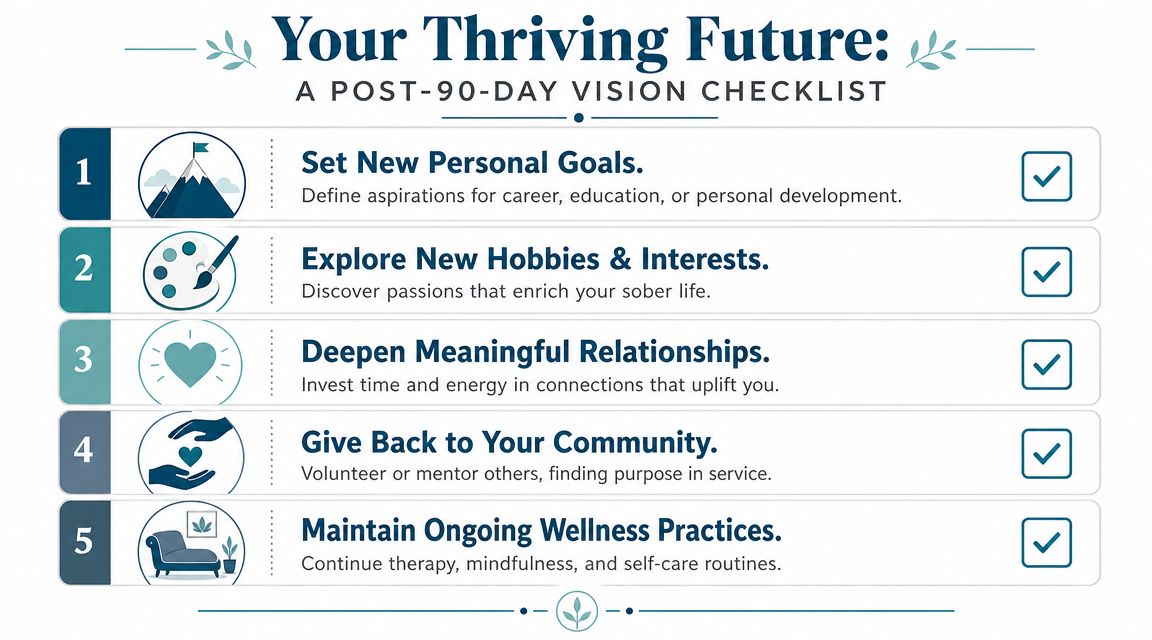
The biggest gap in most discussions of early recovery is simple. People hear a lot about getting to 90 days, but not enough about living after it.
That gap matters. A common problem in recovery content is the heavy focus on early sobriety while leaving the next phase underexplained, even though outcomes improve when care continues with ongoing monitoring and support rather than ending at a milestone (why post-90-day planning matters).
Shift from abstinence goals to life goals
At first, “don't drink today” may be enough. After 90 days, that goal still matters, but it shouldn't stand alone. People need direction.
Useful next-step goals often fall into a few categories:
| Area | Better question to ask |
|---|---|
| Work | What would make the workweek less destabilizing? |
| Relationships | Which relationships support recovery, and which ones keep pulling backward? |
| Health | What symptoms still need treatment, not just endurance? |
| Growth | What would make sober life feel meaningful, not merely controlled? |
Create a relapse plan for ordinary life
Relapse prevention after day 90 should become more specific, not less. A better plan accounts for regular life, not just obvious emergencies.
That usually means writing down:
- Top triggers now: not the triggers from week one, but the ones that show up in current life.
- Early warning signs: isolation, skipped meals, resentment, missed therapy, secrecy, romanticizing drinking.
- Who gets contacted first: sponsor, therapist, family member, peer, or treatment team.
- What happens next: leave the situation, attend support, increase sessions, review medication, or ask for a higher level of care.
Marking progress matters too. Commemorating milestones can reinforce meaning, accountability, and gratitude. This reflection on why it helps to commemorate a sober-versary can help people think about that in a way that supports long-term recovery rather than ego.
Start Your Long-Term Recovery with Zoe Behavioral Health
Reaching 90 days sober is significant. It shows that change is possible, that the body can begin to recover, and that new habits can take hold. It also shows something else. Recovery still needs a plan.
The people who stay steady after this milestone usually don't rely on momentum alone. They keep treatment connected to daily life. They address co-occurring mental health symptoms. They use structure when life gets noisy again. They ask for support before things fall apart.
For adults in Orange County who need help after detox, after inpatient care, or during a difficult stretch of outpatient recovery, care works best when it matches the actual problem. That may mean dual-diagnosis treatment, medication support, therapy, relapse-prevention planning, sober living coordination, or a step-up in structure when warning signs appear.
Ninety day sobriety isn't the end of treatment thinking. It's often the point where treatment becomes more precise, more personal, and more connected to the life someone is trying to build.
If 90 days sober feels encouraging but also uncertain, Zoe Behavioral Health offers confidential admissions support for adults seeking outpatient alcohol, drug, and mental health treatment in Orange County. A conversation with their team can help clarify whether PHP, IOP, outpatient counseling, dual-diagnosis care, or MAT support fits the next stage of recovery.
